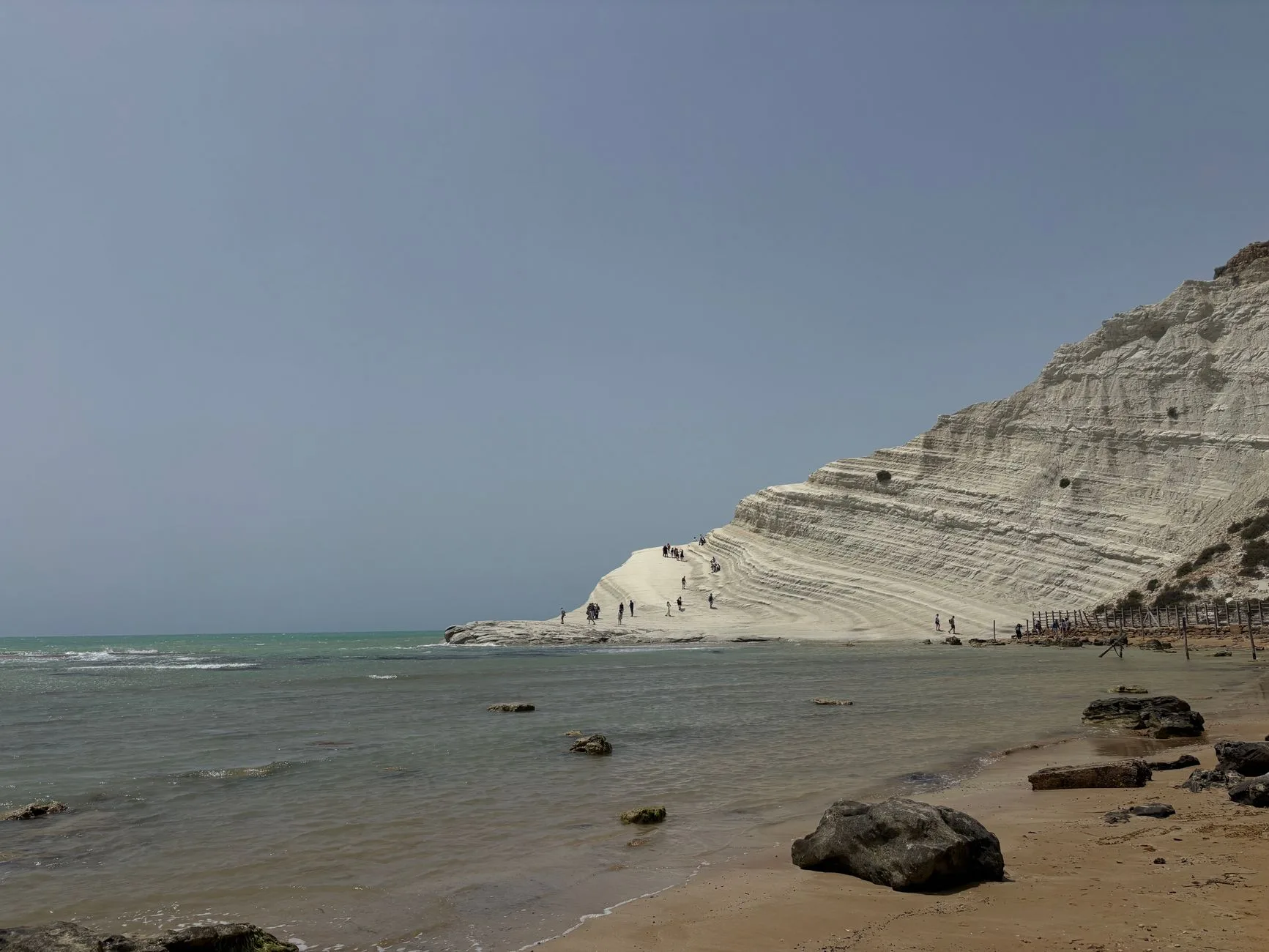
Photo by Veneta Mihova on Pexels
The 7:14am train from Palermo to Caltanissetta runs on a single track through wheat fields the colour of old brass, and it stops at stations with no town visible from the platform — just a sign, a dog asleep in the shade, and the smell of diesel and dry grass. Nobody else gets off at Vallelunga Pratameno. This is the Sicily that exists quietly behind the one most visitors see: the Sicily of inland towns built on volcanic rock, of markets that open before dawn and close before the tour buses arrive, of a slower rhythm that has nothing to prove to anyone.
Most trips to Sicily move along a fixed line — Palermo, Taormina, Agrigento’s Valley of the Temples, Syracuse, maybe Mount Etna from a cable car. All of it is worth seeing. None of it is wrong. But Sicily rewards travellers who stay longer in fewer places, who take the bus that only runs twice a day, who eat where the menu is handwritten and only in Italian. This is a guide to that Sicily — not instead of the coast and the temples, but around and beyond them.
Base Yourself Inland, Not Just on the Coast
Most itineraries treat Sicily’s interior as something to drive through en route to the sea. That’s a mistake. The hill towns of the Madonie and Nebrodi mountains — places like Petralia Soprana, Gangi, and Castelbuono — sit at 800 to 1,100 metres, which means July afternoons here are bearable when the coast is a furnace.
Gangi, a stone town stacked on a conical hill in the Madonie Regional Park, was named one of Italy’s borghi più belli (most beautiful villages), and it earns the label without irony — alleys narrow enough to touch both walls, balconies crowded with geraniums, and a view from the Torre dei Ventimiglia that stretches to the Tyrrhenian coast on a clear day. Stay two or three nights, not one. The town only reveals its rhythm once the day-trippers from Cefalù have gone home: old men playing cards outside the Bar Centrale, the smell of woodsmoke from bakeries firing up for the next morning’s bread.
Getting there requires patience — the SAIS or AST bus from Palermo’s Via Paolo Balsamo takes roughly two hours and runs only a few times daily, more often on weekdays than weekends. Renting a car gives far more freedom to explore the Madonie’s smaller villages, like Geraci Siculo or Petralia Sottana, where almost nothing is signposted in English.
Eat Where the Menu Isn’t Translated
Sicilian food beyond the coastal seafood restaurants tells a different story — one shaped by Arab, Norman, and peasant traditions. In Castelbuono, the Fiasconaro family’s panettone has made the town famous, but the real find is the manna harvested from ash trees in the surrounding hills, still used in local desserts the way it has been for centuries.
In the Belice Valley, towns like Salemi and Gibellina (the latter rebuilt after a devastating 1968 earthquake, its abandoned original site turned into a surreal land-art memorial called Cretto di Burri) serve cuscusu — a Sicilian couscous dish with fish, a direct echo of the island’s centuries under Arab rule. Order it at a trattoria without a laminated menu; if the server has to ask the kitchen what’s available, that’s usually a good sign, not a bad one.
Market mornings matter here. Skip Palermo’s Ballarò and Vucciria once in a while — both wonderful, both overrun by 10am — and instead visit the smaller Thursday market in Mussomeli, in the Caltanissetta province, where farmers sell what they picked that morning, not what was trucked in. For a broader sense of how Europe’s food markets vary in character and pace, Steeped World’s guide to the continent’s best local food markets covers a few useful comparisons.
Walk the Interior, Not Just the Coastal Paths
Sicily’s coastal trails get the attention — rightly, the Zingaro Nature Reserve near San Vito Lo Capo is spectacular, a seven-kilometre coastal path with turquoise coves and almost no shade, best walked at dawn between May and October. But the island’s interior walking is underrated and far less crowded.
The Sentiero Italia CAI, a long-distance trail network maintained by Italy’s Club Alpino Italiano, runs sections through the Madonie and Nebrodi that pass beech forests, abandoned shepherds’ huts, and the Rocche dei Crasti — a limestone ridge where griffon vultures have been reintroduced after decades of local extinction. Trails are marked but not always maintained to the standard of the Alps; a good paper map (the Madonie park office in Petralia Sottana sells one) is worth more than a phone signal, which disappears often.
Readers who enjoy pairing coastline and footpath might also want to look at Steeped World’s roundup of Europe’s best coastal walks worth the effort, several of which share Sicily’s mix of heat, altitude change, and reward-for-effort logic.
Take the Ferry to the Aeolian Islands’ Quieter Corners
Lipari and Vulcano get the cruise-ship crowds. Salina — greener, quieter, and the setting for the film Il Postino — is reachable by the same Liberty Lines hydrofoils from Milazzo, just forty minutes further, and feels like a different archipelago entirely. Base in the fishing village of Santa Marina Salina or the hilltop town of Malfa, where the Capofaro vineyard produces Malvasia delle Lipari, a sweet amber wine made from grapes grown on volcanic terraces facing the sea.
Further out, Alicudi and Filicudi have no cars at all — transport is by foot, mule, or small electric carts — and ferries run only once or twice daily, weather permitting. Bring cash; card machines are unreliable here, and some guesthouses don’t take them at all.
| Island/Area | How to Get There | Best For | Crowd Level |
|---|---|---|---|
| Lipari | Hydrofoil from Milazzo (~45 min) | First-timers, amenities | High |
| Salina | Hydrofoil from Milazzo (~1 hr 20 min) | Wine, hiking, quiet towns | Moderate |
| Filicudi | Hydrofoil (limited daily service) | Solitude, diving, no cars | Low |
| Alicudi | Ferry only, weather-dependent | True disconnection | Very low |
| Vulcano | Hydrofoil from Milazzo (~30 min) | Thermal mud, day-trippers | High |
Visit Syracuse’s Ortigia Island at the Hours Nobody Else Does
Ortigia, the old island core of Syracuse, is firmly on the tourist trail by midday — tour groups funnel through the Piazza Duomo, where the Duomo di Siracusa is built directly into the columns of an ancient Greek temple to Athena. But arrive at 7am, when the Mercato di Ortigia is just setting up stalls of swordfish, sea urchins, and bitter orange, and the piazza belongs to residents walking dogs and sweeping doorsteps.
Stay in Ortigia itself rather than mainland Syracuse — walking the narrow streets at night, past the Fonte Aretusa (a freshwater spring, improbably, steps from the sea, where papyrus still grows), gives a sense of the island’s layered history that a day trip never will.
Go to Modica and Scicli, Not Just Noto
The Val di Noto’s Baroque towns, rebuilt after the catastrophic 1693 earthquake, are usually reduced to a single stop at Noto itself, with its honey-coloured Corso Vittorio Emanuele. Modica and Scicli, 30–40 minutes away by car or local bus, carry the same UNESCO-listed Baroque architecture with a fraction of the visitors.
Modica is layered into a ravine, its churches stacked almost on top of one another, and it’s the birthplace of Sicily’s distinctive cold-processed chocolate — grainy, unrefined, made to a method with Aztec origins brought via Spanish rule. Antica Dolceria Bonajuto, the island’s oldest chocolate producer, is worth the detour alone.
Scicli, meanwhile, has a slower, more residential feel — its Baroque churches are tucked into ordinary neighbourhood streets rather than arranged for photographs, which somehow makes them more striking.
When to Go, and How to Move Around
Sicily’s shoulder seasons — April to early June, and mid-September to late October — offer the best balance of weather, lower prices, and manageable heat for walking inland trails. July and August bring temperatures that regularly exceed 35°C inland, and many smaller towns effectively close for the afternoon riposo.
Public transport inland is workable but requires planning: Trenitalia covers the coast reasonably well, but interior routes rely on regional bus companies like AST and SAIS, whose timetables are not always reflected accurately on Google Maps. For slow, unhurried exploration, a rental car remains the most practical option once you leave Palermo, Catania, or Syracuse — Sicily’s interior simply wasn’t built with public transit as a priority.
The Bottom Line
Slow travel in Sicily means accepting a different pace than the coastal highlight reel — fewer stops, longer stays, and a willingness to let a bus schedule or a closed trattoria rearrange your day. Base in the Madonie or Nebrodi hills for cooler air and real village life, not just the coast. Eat where the menu isn’t translated, and treat the smaller markets as seriously as the famous ones. Take the extra forty minutes to Salina instead of stopping at Lipari, and visit Modica and Scicli alongside Noto rather than skipping them. None of this requires avoiding the island’s famous sights — it just means not stopping there.
Keep reading: Find more ideas for unhurried itineraries in our guide to the best cities in Europe for slow travel