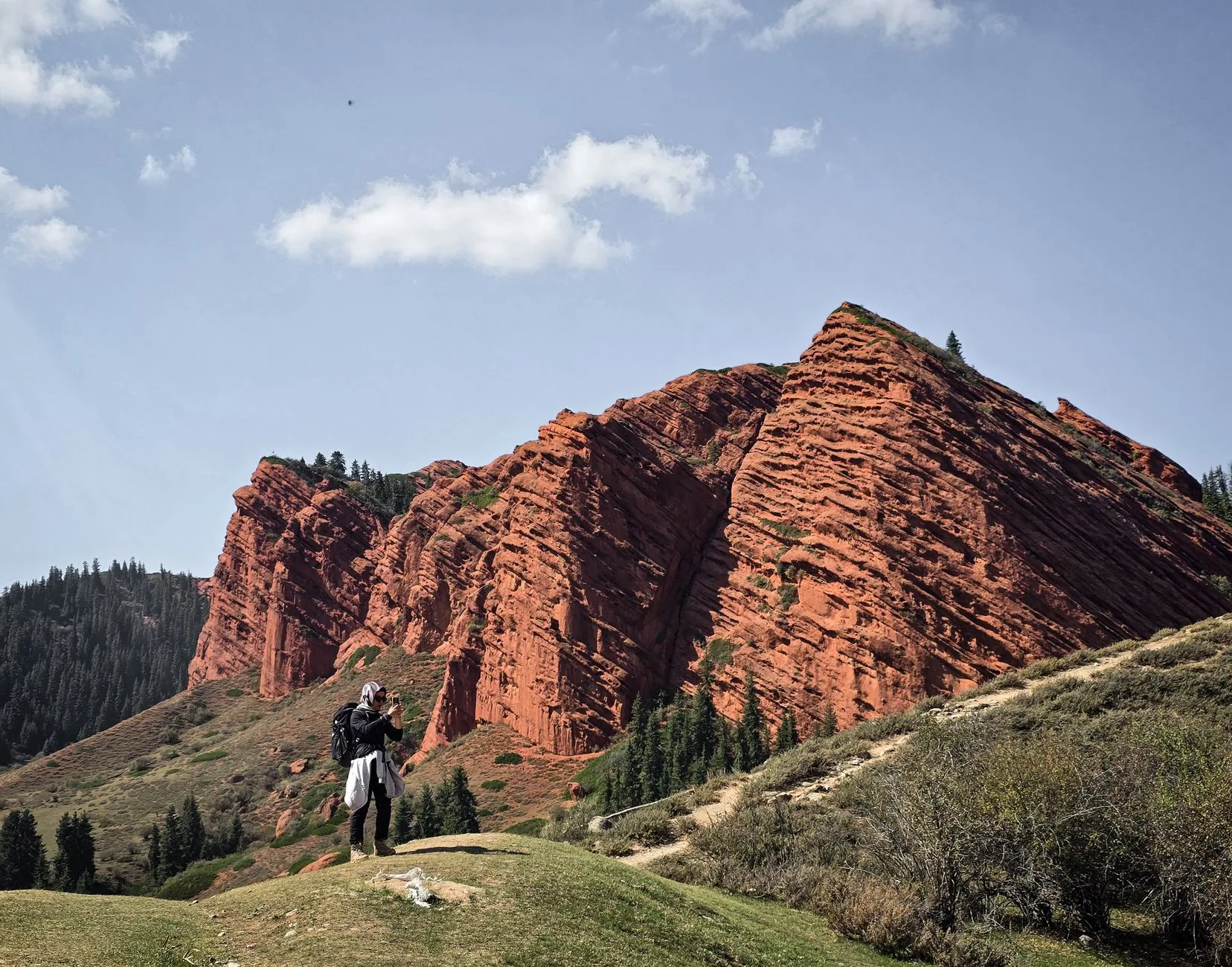
Photo by serap sağbaş on Pexels
At six in the morning, the livestock section of Karakol’s Sunday market is already thick with dust kicked up by cattle being walked in from trucks parked along the perimeter road. Men in flat caps grip horses by rope halters and run their hands down the animal’s foreleg the way a mechanic checks a engine, murmuring prices that drop and rise in Kyrgyz and Russian. Somewhere past the sheep pens, a woman sells plastic bags of dried apricots and walnut halves from a blanket on the ground, and the smell of diesel, wet wool and frying bread all arrive at once.
This is not a trailhead. Kyrgyzstan’s reputation abroad rests almost entirely on its mountains — the Tien Shan and Pamir-Alay ranges, the trek to Ala-Kul, the multi-day routes out of Jyrgalan — and that reputation is earned. But treating the country as a hiking destination with a capital city attached means missing most of what makes it interesting to travel through slowly and independently: Soviet-era bazaars still running on barter logic, a nomadic horse culture that never fully settled, Silk Road caravanserais a few hours off the main roads, and borders into China, Tajikistan and Kazakhstan that most travellers never consider crossing overland.
Bishkek is a transit city, but give it two days anyway
Most independent itineraries treat Bishkek as a layover between the airport and the mountains. That’s a mistake worth correcting, at least for 48 hours. The city is a grid of Soviet boulevards and chestnut-lined avenues, laid out with a logic that makes it easy to walk — rare for a post-Soviet capital.
Start at Osh Bazaar in the west of the city, not to be confused with the city of Osh in the south. It’s Bishkek’s working market, selling everything from horsemeat sausage (chuchuk) to pirated DVDs to bags of dried kurut (salted yoghurt balls, an acquired taste that rewards persistence). It’s louder and rougher around the edges than the tidied-up central market near Ala-Too Square, which is more geared toward tourists and souvenir felt goods.
Walk east from there into the Soviet mosaic belt along Chui Avenue and Kyivska Street — murals on the sides of apartment blocks and former cinemas, some crumbling, some restored, almost none signposted. The Osh Bazaar to Panfilov Park corridor also takes you past the State Historical Museum, a squat Brutalist building with a lobby mural of Lenin that’s survived three decades of independence without being painted over, which tells its own story about how Kyrgyzstan relates to its Soviet past — ambivalent rather than hostile.
Budget two nights, not one. Bishkek’s guesthouses in the Vostok 5 and Dzerzhinka districts run $10–20 for a private room, and the city’s banya culture (public bathhouses, often segregated by gender, with birch-branch platza treatments) is worth an afternoon on its own.
Son-Kul and Suusamyr: yurt life without a trek attached
Son-Kul, a high alpine lake at roughly 3,000 metres, gets folded into trekking itineraries as a stopover point. But you don’t need to hike in — a 4×4 or shared jeep from Kochkor reaches the lake directly, and from June to September the surrounding pastures fill with yurt camps run by families practising jailoo — seasonal transhumance, moving herds up to summer pasture.
Staying in one of these camps through the Community Based Tourism (CBT) network is less a trek and more a homestay with horses attached. A night costs around $15–25 including dinner — usually besh barmak (boiled lamb or horse over wide noodles, eaten communally with the hands, as the name suggests) and fermented mare’s milk, kymyz, which is sour, faintly alcoholic, and an entirely different substance from anything sold as “milk” elsewhere. If the idea of community-run homestays and locally guided experiences appeals, it’s worth reading more broadly about how community based tourism works on the ground, since Kyrgyzstan’s CBT cooperative — built in the early 2000s with Swiss development funding — is one of the more functional and widely replicated models of its kind.
Suusamyr Valley, on the main road between Bishkek and Osh, offers something similar with far less effort: roadside yurts where drivers stop for kymyz and fried bread, horses grazing within arm’s reach of the highway, and almost no other foreign travellers, since it’s a drive-through valley rather than a destination.
Osh: the south’s real centre, and a market older than the Silk Road branding suggests
Osh is Kyrgyzstan’s second city and feels like a different country from Bishkek — more Uzbek in its food and architecture, denser, hotter, and built around Sulaiman-Too, a sacred mountain rising directly out of the city centre that has drawn pilgrims for over a thousand years and carries UNESCO World Heritage status as one of the few sacred mountains with a near-continuous history of religious use. Climb it in the early morning before the heat sets in; the path passes caves used as pilgrimage shrines and a small museum built into the rock.
At the base of the mountain, the Osh Bazaar (distinct again from Bishkek’s market of the same name) is one of the oldest continuously operating markets in Central Asia, selling spices, dried fruit, and bread stamped with carved wooden seals — a Silk Road trading tradition that predates any modern tourism marketing around the term. Plov here is cooked outdoors in enormous cast-iron cauldrons from mid-morning, and it’s worth timing a visit for lunch rather than evening, since the best cauldrons sell out.
From Osh, the town of Uzgen, 50km east, has a restored 11th-century minaret and mausoleum complex that gets a fraction of the visitors Burana Tower near Bishkek receives, despite being arguably more intact.
Tash Rabat and the Silk Road sites nobody treks to
Most visitors who make it to Tash Rabat, a stone caravanserai at 3,200 metres near the Torugart Pass, arrive as a side trip from a trek — but it doesn’t require one. A shared taxi or hired driver from Naryn covers the roughly 2.5-hour drive up a valley that narrows dramatically in its final stretch, and the caravanserai itself — a 15th-century domed stone building that once sheltered merchants and their animals on the route toward Kashgar — can be visited in an afternoon, with yurt camps nearby for those who want to stay the night rather than return to Naryn.
Further north, Burana Tower, about an hour east of Bishkek, is a crumbling 11th-century minaret surrounded by a field of balbals — carved stone figures moved here from burial sites across the region. It’s touristed by regional standards (meaning a few tour buses, not crowds), but still quiet enough to wander alone among the stones.
The petroglyph field at Cholpon-Ata, on the north shore of Issyk-Kul, is less visited still: thousands of Bronze and Iron Age rock carvings of ibex, hunters and sun symbols scattered across a boulder field just outside town, unfenced and unsupervised except for a small ticket booth.
Crossing a border instead of just visiting a country
Kyrgyzstan’s land borders are part of its appeal for independent travellers who want to keep moving rather than fly in and out. The Torugart Pass into China’s Xinjiang region requires a pre-arranged Chinese-side permit and guide and is bureaucratically fiddly — budget a full day and expect delays. The Irkeshtam Pass, further south near Osh, is more straightforward for onward travel toward Kashgar, with shared transport available from Osh to the border and Chinese transport picking up on the other side.
Crossings into Tajikistan via the Pamir Highway (through Sary-Tash) connect into one of the more demanding overland routes in the region, while the Kazakhstan border near Bishkek is a routine, low-friction crossing by shared taxi, useful for travellers combining Kyrgyzstan with Almaty. None of these borders are difficult in the way mountain passes are difficult — the challenge is bureaucratic patience and flexible timing, not physical endurance.
What to eat, and where it actually tastes right
Kyrgyz food has a reputation for being plain, which is only half fair. Besh barmak and lagman (hand-pulled noodle soup, Dungan in origin) are everywhere, but the more interesting eating happens where Dungan, Uyghur and Kyrgyz food traditions overlap — most visibly in Karakol, where the Dungan community, descendants of Hui Chinese Muslims who fled China in the 1880s, run some of the best food in the country. Look for ashlan-fu, a cold, spicy starch-noodle dish sold from carts near Karakol’s central bazaar — sour, chilli-heavy, and nothing like the mutton-and-bread diet travellers expect from the region.
| Destination | Best season | How to get there | Typical cost (per day) | What it’s for |
|---|---|---|---|---|
| Bishkek | May–Sept (year-round liveable) | International flights, land border from Kazakhstan | $20–35 | Bazaars, Soviet architecture, banya culture |
| Son-Kul | June–Sept only (snowed in otherwise) | 4×4/shared jeep from Kochkor | $20–30 (incl. yurt stay) | Yurt camps, horseback riding, jailoo life |
| Karakol | May–Sept | Marshrutka from Bishkek (6–7 hrs) or shared taxi | $15–25 | Dungan food, Sunday livestock market, banya |
| Osh | Year-round | Flight from Bishkek (40 min) or 10–12 hr road | $15–25 | Sulaiman-Too, oldest bazaar, plov culture |
| Tash Rabat | June–Sept | Shared taxi/driver from Naryn (2.5 hrs) | $25–35 (incl. yurt) | Silk Road caravanserai, Torugart Pass access |
Visa requirements are genuinely easy to satisfy: citizens of the EU, UK, US, Canada, Australia and many other countries get 60 days visa-free, which is generous enough to combine mountain time with the rest of this list without rushing either. Before finalising dates, it’s worth checking your government’s current travel advisory — the US State Department’s Kyrgyzstan page is a reasonable baseline, particularly for border-region updates that change more often than guidebooks are reprinted.
Getting around without a private driver means marshrutkas — shared minivans that leave when full rather than on a schedule, cheap but cramped, running between every major town. For border regions and caravanserai detours, a hired driver or shared taxi is usually worth the extra cost in time saved. The currency, the som, is used almost everywhere; carrying cash is essential outside Bishkek and Osh, where card acceptance remains patchy.
For travellers weighing Kyrgyzstan against other budget-friendly, independent-travel-friendly destinations with a similar mix of landscape and under-the-radar culture, it sits in interesting company with places like the Caucasus — budget travel in Georgia shares a similar rhythm of mountain access, home-hosted meals, and a currency and bureaucracy that reward patience over polish.
The Bottom Line
- The mountains are real and worth the hype, but they’re not the whole country — build at least a third of your itinerary around markets, borders and towns rather than trailheads.
- CBT homestays and yurt stays don’t require a multi-day trek to access; Son-Kul and Suusamyr can both be reached directly by vehicle.
- Osh deserves at least as much time as Bishkek, and its bazaar culture, food and Sulaiman-Too are reason enough on their own.
- If overland borders interest you, Irkeshtam and the Kazakhstan crossing near Bishkek are the two most straightforward; Torugart requires more planning on the China side.
- Cash, patience with marshrutka schedules, and a loose itinerary matter more here than in most Central Asian destinations — the rewards come from the detours, not the fixed plan.
Keep reading: See how community based tourism works on the ground