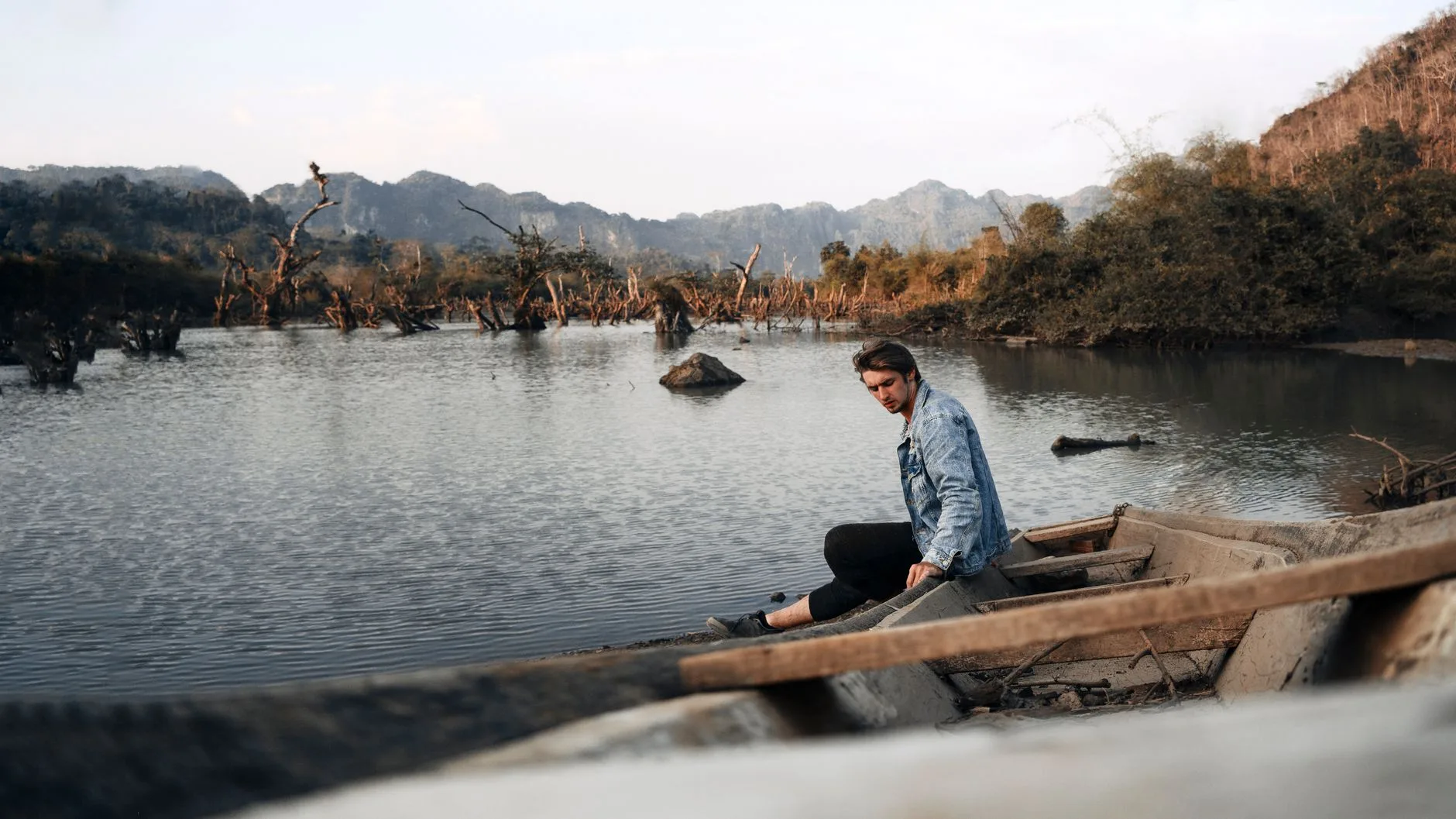
Photo by Artem Korsakov on Pexels
The engine of the slow boat sounds like a tractor that’s swallowed a fishing net — a low, rattling drone that becomes, after an hour or two, the background hum of the Mekong itself. You’re sitting on a wooden bench seat salvaged from an old minibus, knees against the rucksack in front of you, watching limestone hills slide past the window in shades of green that shift with the light. Someone’s selling warm Beerlao and instant noodles from a cooler near the stern. The river is the colour of milky tea, high and fast if you’re travelling in the wet season, lower and more sedate from November through March, exposing sandbanks where buffalo stand knee-deep and children wave at the boat without much enthusiasm, because boats like this pass every day.
This is the spine of independent travel in Laos: the two-day slow boat from Huay Xai, on the Thai border, down to Luang Prabang. It’s slower than flying, slower than the minivan, and that’s rather the point. Laos rewards a traveller willing to move at the pace of the country rather than through it, and the river is where that pace is set for you, whether you like it or not.
The Slow Boat: Huay Xai to Luang Prabang
The journey splits into two legs. Day one runs from Huay Xai to the riverside town of Pak Beng, roughly six to seven hours depending on water levels. Day two continues from Pak Beng to Luang Prabang, another seven hours or so. Tickets run around 220,000–250,000 kip per leg (roughly $11–13 USD at current rates, though it’s worth checking before you go), bought either at the Huay Xai pier the morning of departure or through a guesthouse the night before — the latter is marginally more expensive but saves you queuing at 7am with sixty other backpackers.
The alternative is the speedboat, which does the same journey in six or seven hours total rather than two days. It’s louder, genuinely dangerous if the driver is reckless (life jackets and crash helmets are handed out for a reason), and strips out everything that makes the slow boat worth doing. Most people who’ve done both will tell you the same thing: take the slow boat once, and you’ll understand why it has a cult following among people who’d never otherwise choose a wooden bench for fourteen hours.
| Route option | Duration | Approx. cost | Best for |
|---|---|---|---|
| Slow boat (2 days) | ~13–14 hrs total | $22–26 USD | Scenery, pace, meeting other travellers |
| Speedboat | 6–7 hrs | $30–35 USD | Time-pressed, high risk tolerance |
| Minivan via Route 13 | 9–10 hrs | $20–25 USD | Those prone to seasickness on water, faster overland |
| Flight (Bangkok–Luang Prabang) | 2 hrs + transfers | $80–150 USD | Skipping the north entirely |
Pack snacks, a cushion if you have one, and patience. There’s no dining car. The boat stops briefly at small riverside villages to load and unload cargo and passengers, and those few minutes — sacks of rice, crates of Pepsi, a motorbike somehow wedged into the hold — tell you more about how this stretch of river actually functions than any amount of scenery.
Pak Beng: The Unglamorous Middle
Pak Beng exists for one reason: it’s the halfway point. It is not a destination anyone plans a holiday around, and that’s worth saying plainly, because some guides oversell it. It’s a single strip of guesthouses, noodle shops, and massage parlours clinging to a steep hillside above the river, and most travellers are there for one night only.
That said, it’s not without its pleasures. The sunset from the upper terrace of nearly any guesthouse along the main street is genuinely good — the river turns copper, longtail boats cut dark lines across it, and the hills opposite go purple before the light drops fast, the way it does near the equator. Eat at one of the simple riverside restaurants for khao soi or larb, wash it down with a cold Beerlao, and be in bed early. The boat for day two tends to leave between 8 and 9am, and punctuality in Laos is a loose concept until suddenly it isn’t.
Luang Prabang: Alms, Markets, and the Morning After the Boat
Luang Prabang, at the confluence of the Mekong and the Nam Khan, is a UNESCO World Heritage town, and it earns the designation — low-slung French colonial shophouses sit beside gilded temple roofs stacked in tiers, and the whole peninsula is small enough to cross on foot in twenty minutes. The morning alms-giving ceremony, where saffron-robed monks process silently through the streets at dawn to receive rice from kneeling locals, has become heavily touristed — tour buses now arrive before 5:30am, and the experience has been reshaped by it. If you want to witness it, do so quietly, keep a respectful distance, don’t use flash photography, and consider that your presence there is part of what’s changed it.
More rewarding, and less commodified, is the Luang Prabang morning market along Thanon Phousi, where vendors sell river weed (kai paen), jungle herbs, live fish still gasping in shallow basins, and sticky rice steamed in conical baskets before sunrise properly breaks. In the evening, the night market along the main street is worth an hour for handwoven textiles from the surrounding Hmong and Khmu villages — bargain gently, prices are already low by most visitors’ standards.
For food, head to Dara Market for a bowl of khao soi (a turmeric-tinged noodle soup distinct from its Thai namesake) or find one of the simple sticky rice and grilled fish stalls along the Mekong promenade. If you want a half-day outside the centre, Kuang Si Falls — about 30km south, reachable by tuk-tuk or shared minivan for around 150,000 kip return — delivers tiered, turquoise pools genuinely worth the detour, though arrive early; by mid-morning the car park fills and the lower pools crowd fast.
Beyond the River: Nong Khiaw and Muang Ngoi
This is where independent travel in Laos earns its name properly. Most visitors stop at Luang Prabang and fly or bus onward to Vang Vieng, which is a shame, because three hours northeast by minivan sits Nong Khiaw, a small town on the Nam Ou river hemmed in by dramatic limestone karsts that rise almost vertically from the water. There’s a viewpoint hike up to a hilltop pavilion (about 45 minutes of steep, often slippery steps) that delivers one of the best panoramas in northern Laos for the price of a 20,000 kip entry fee and a sweaty shirt.
From Nong Khiaw, a slow boat — smaller, more weathered than the Huay Xai version — runs upriver to Muang Ngoi Neua, a village with no road access at all, reachable only by boat. Electricity arrived relatively recently and is still inconsistent; there’s no ATM. It’s the kind of place where a day plan amounts to a walk to a nearby cave, a swim in the river, and watching the light change on the karsts, and for travellers tired of moving, it’s worth staying two or three nights rather than one.
Vang Vieng: Reputation and Reality
Vang Vieng has a reputation problem it’s still working through. A decade ago it was synonymous with reckless river tubing and bar crawls that produced a genuinely alarming number of injuries and deaths; the government cracked down hard, closed most of the riverside bars, and the town has spent the years since trying to rebuild an identity around what’s actually there: a landscape of limestone peaks, caves, and blue lagoons that would be a major draw anywhere else in the world.
Tham Chang cave, a short walk from the town centre, and the Blue Lagoon (Lagoon 1), about 4km out, are the obvious stops — go early to beat the tour groups. More interesting, if you have a scooter or a mountain bike, are the quieter lagoons (Lagoon 2 and 3) and the limestone backroads that loop through rice paddies and villages rarely visited by the daytrip crowd. Renting a bike costs around 60,000–100,000 kip a day; check the brakes before you leave the shop, since the roads out here are unpaved and the hire bikes have seen heavy use.
Vientiane: The Low-Key Capital
Vientiane rarely gets top billing, and that’s broadly fair — it’s a quiet, unhurried capital rather than a showstopper. But it rewards a day or two: Pha That Luang, the gold stupa that’s become a national symbol, Wat Sisaket with its thousands of small Buddha niches, and the riverside night market along the Mekong promenade, where the food stalls sell grilled river fish and fresh spring rolls for a fraction of what you’d pay elsewhere. It’s also where most overland routes into Laos from Thailand (via the Friendship Bridge at Nong Khai) or onward to Vietnam converge, making it a natural bookend to a Laos itinerary rather than its centrepiece.
Logistics: Visas, Money, and Timing
Most nationalities can get a visa on arrival at major border crossings and Luang Prabang/Vientiane airports, costing $30–42 USD depending on nationality, payable in cash (USD preferred). Bring passport photos — not always required, but it speeds things up. ATMs are reliable in larger towns but scarce or non-functional in places like Muang Ngoi, so carry more kip in cash than feels comfortable.
The dry season, November to February, is the easiest time to travel: cooler nights, clearer river water, less chance of flooding delaying boat departures. March to May brings intense heat and smoky haze from agricultural burning, which can obscure the mountain views that are much of the draw. The wet season, June to October, turns the Mekong into something faster and browner, occasionally cancelling boat departures altogether, though the countryside is at its greenest.
Connectivity between towns runs on a patchwork of minivans, songthaews (shared pickup trucks), and the boats themselves — nothing runs on a fixed timetable the way European trains do, and delays of an hour or two are standard rather than exceptional. If you’re coming from Vietnam or Thailand and want a wider sense of how this kind of unhurried, overland travel works across the region, it’s worth reading about budget travel in Vietnam’s north-to-south route or budget travel in Thailand beyond Bangkok, both of which connect naturally to a Laos itinerary via Chiang Khong or the Lao Bao crossing.
Street food is one of the country’s underrated pleasures, and it’s worth knowing how to approach night markets and roadside stalls with some basic sense — the UK’s FCDO travel advice is a sensible first check before departure for any current health or safety notices, and it’s worth reading alongside general advice on eating at local markets in Southeast Asia if street food is new territory for you.
The Bottom Line
- The slow boat is worth doing once, not because it’s comfortable — it isn’t, particularly — but because the version of northern Laos it shows you doesn’t exist from a bus window or a plane seat.
- Don’t stop at Luang Prabang. Nong Khiaw and Muang Ngoi, a few hours further north, are where the karst landscape and river life feel least filtered through a tourist itinerary.
- Vang Vieng has genuinely changed since its reckless-tubing years; judge it on the caves and lagoons, not its old reputation.
- Cash is king outside the main towns — carry more kip than you think you need, since ATMs thin out fast once you leave Luang Prabang and Vientiane.
- Build in slack. Boats run late, minivans fill up unpredictably, and the single best use of extra time in Laos is almost always to stay one more night somewhere rather than rush to the next stop.
Keep reading: Avoiding overtourism in Southeast Asia: where to go