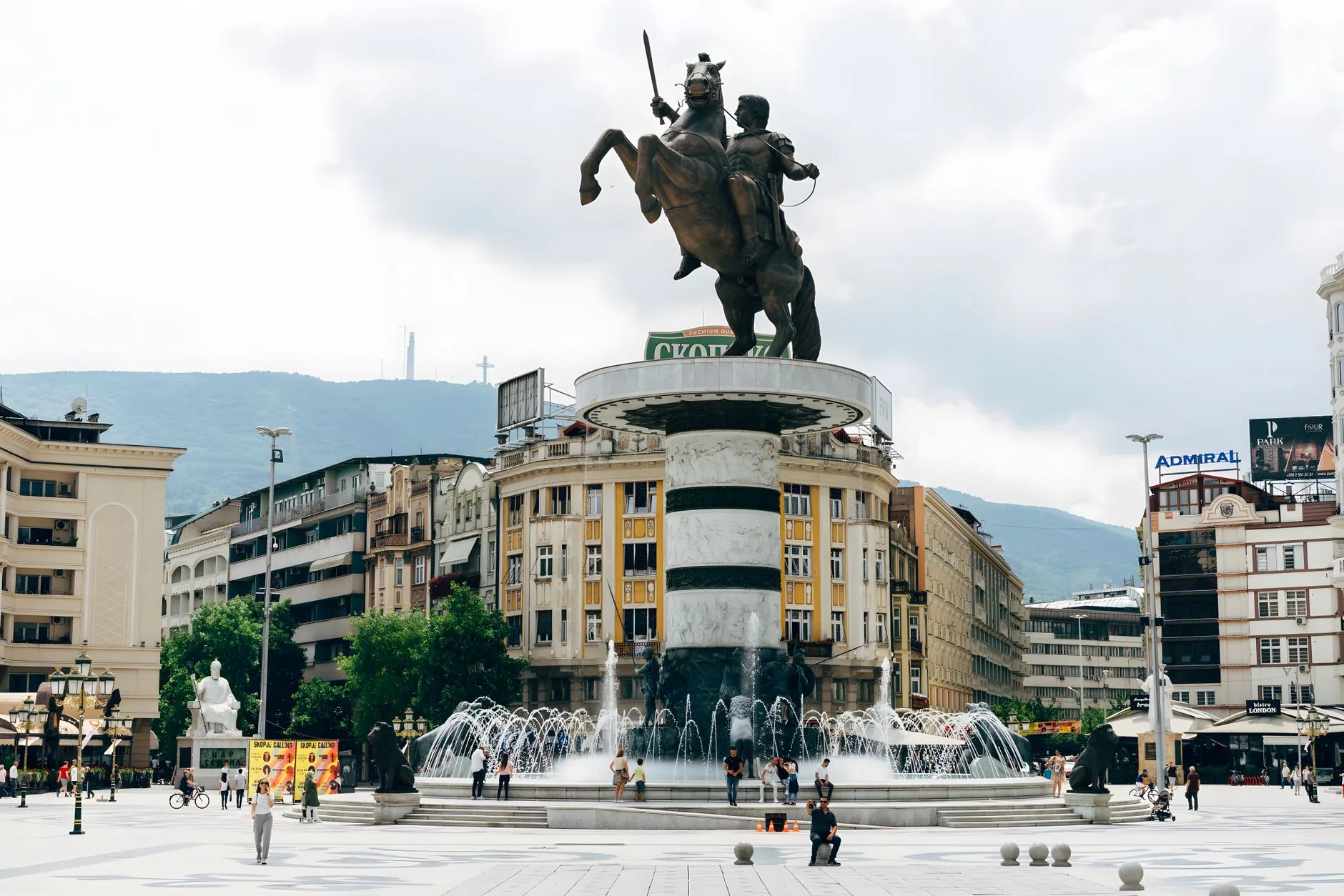
Photo by Markus Winkler on Pexels
Dawn on Lake Ohrid arrives quietly. Fishermen push wooden boats off the shingle below the Church of St. John at Kaneo, the water so still it holds the church’s reflection like a photograph. By eight, the old town’s cobbled lanes start to wake — a baker slides trays of banica out of a wood oven near Samoilova Street, and the smell of warm cheese pastry follows you up toward the fortress walls of Tsar Samuil. None of this costs anything. That’s the first thing worth knowing about North Macedonia: some of its best mornings are free, and most of what isn’t is still cheap by almost any European standard.
This is a country that gets skipped over more than it deserves — squeezed on maps between Greece, Albania, Kosovo, Serbia, and Bulgaria, and often treated as a one- or two-night stopover on a longer Balkan loop. That’s a mistake for budget travellers in particular. North Macedonia offers Ottoman-era bazaars, alpine national parks, Byzantine frescoes, and a wine region most of Europe hasn’t caught onto yet, all at prices closer to Southeast Asia than Western Europe. Here’s how to actually do it.
Getting In: Borders, Flights, and the Bus Network
Skopje International Airport (also called Alexander the Great Airport) has budget connections from several European hubs, primarily on Wizz Air, which is usually the cheapest way in if you’re flying from the UK, Germany, or Italy. Ohrid also has a smaller airport with seasonal budget flights, useful if Lake Ohrid is your main destination and you’d rather skip Skopje entirely.
Overland is often more interesting and just as cheap. Buses run regularly from Sofia to Skopje (around 5 hours), from Belgrade (roughly 6–7 hours), and from Pristina (about 2 hours, and one of the easier border crossings in the region). Coming from Albania, the crossing at Qafë Thanë near Lin puts you almost directly on the shores of Lake Ohrid — a route worth pairing with time spent on the Albanian side of the same lake, covered in more detail in our guide to budget travel in Albania. From Greece, buses connect Thessaloniki to Skopje in about 3–4 hours, a natural link if you’re already exploring the mainland rather than the islands, as we cover in budget travel in Greece beyond the islands.
Inside the country, buses are the backbone of getting around. The rail network exists but is slow and limited — fine for the Skopje–Bitola route if you’re not in a hurry, but buses will get you everywhere faster and more frequently. Minibuses (kombi) fill in gaps to smaller towns and villages, and while schedules can be loose, drivers are generally happy to wait an extra five minutes for a visibly running passenger.
Where to Base Yourself
Skopje is the obvious starting point, though it’s a strange city to first encounter — the centre is dotted with oversized neoclassical statues and buildings from a controversial 2014 urban redevelopment project, which sits jarringly next to the genuinely atmospheric Ottoman-era Old Bazaar, Stara Čaršija. Wander through the bazaar’s stone lanes past coppersmiths, gold shops, and the Mustafa Pasha Mosque, then cross the Stone Bridge over the Vardar River to see the statue-heavy modern centre for contrast. A dorm bed runs €10–15, a private room in a guesthouse €25–35.
Ohrid is where most travellers fall for the country. The old town climbs a hill above the lake, past Plaošnik — where the ruins of an early Christian basilica sit beside a rebuilt church with mosaic floors — up to Samoil’s Fortress, where the views stretch across the water into Albania. Lake Ohrid itself is one of Europe’s oldest lakes and, along with the town, is recognised as a UNESCO World Heritage Site for both its natural and cultural value — you can read more on UNESCO’s official listing. Rooms here are slightly pricier in July and August (€30–40) but drop by a third outside peak season.
Bitola, an hour and a half south of Ohrid, gets a fraction of the visitors and deserves more. Širok Sokak, its pedestrian main street, is lined with Ottoman and Habsburg-era buildings and cafés where a coffee costs €1–1.50 and nobody rushes you to leave. Just outside town, the archaeological site of Heraclea Lyncestis has Roman mosaics you’ll often have entirely to yourself.
What to Eat, and What It Costs
Food is where the budget maths in North Macedonia becomes genuinely generous. A full meal at a neighbourhood restaurant, not a tourist-facing one, typically runs €4–8.
Start with tavče gravče, a baked bean stew that’s practically the national dish, best eaten in winter but served year-round. Skopska salata — tomato, cucumber, onion, and grated white cheese — comes before almost everything and is usually a euro or two. Kebapi, small grilled meat rolls served with raw onion and ajvar (the red pepper relish that appears on every table), are the reliable street-food staple; Destan in Skopje’s Old Bazaar has served them for decades and is worth the short queue. In Bitola, look for pastrmajlija, a boat-shaped flatbread topped with cured meat, similar in spirit to pizza but distinctly its own thing.
The wine is a genuine surprise. The Tikveš region south of Skopje produces most of the country’s wine, and Vranec, the dominant red grape, is full-bodied and often sold in restaurants for €8–12 a bottle — a fraction of what comparable wine costs across the border in Greece or Italy. Several wineries around Kavadarci offer tastings for a few euros if you have a car or can arrange a day trip from Skopje.
Beyond the Lake: Mountains, Canyons, and Slower Routes
Matka Canyon, just 20 minutes by bus or car from central Skopje, is the easiest adventurous detour in the country. A path along the artificial Matka Lake leads past Orthodox monasteries carved into the cliffside; renting a kayak for an hour costs around €5–7, and the canyon walls close in enough that the city noise disappears almost immediately.
Mavrovo National Park, a couple of hours west of Skopje, is where the country turns properly alpine. In summer, trails around Mavrovo Lake and up toward Bistra mountain offer hiking without crowds or entrance fees; in winter, it becomes a modest, inexpensive ski destination — lift passes are a fraction of Alpine prices. Pelister National Park, near Bitola, has old-growth Molika pine forest and a genuinely quiet, unmanicured feel; the trail to the Big Lake (Golemo Ezero) is a full-day hike best attempted between June and September when the path is clear of snow.
Tetovo, an hour from Skopje, is worth a half-day trip for the Painted Mosque (Šarena Džamija), its exterior covered in intricate floral frescoes, and for the base of the Šar Mountains, a serious hiking range that sees far fewer international visitors than its scenery deserves.
Costs at a Glance
| Category | Budget option | Mid-range option |
|---|---|---|
| Dorm bed / private room | €10–15 / €25–35 | €40–60 |
| Meal at local restaurant | €4–8 | €10–15 |
| Intercity bus (2–3 hrs) | €4–8 | — |
| Coffee or beer | €1–2 | €2.50–3.50 |
| Museum / site entry | €1–3 | €3–6 |
| Full day, one person | €20–30 | €50–70 |
A comfortable travelling budget of €30–35 a day covers private rooms, restaurant meals, local buses, and entry fees without much sacrifice. Backpackers sticking to hostels and self-catering can realistically get by on €15–20 a day, comparable to what you’d budget in Georgia, another country where low costs coexist with real depth of experience.
The Honest Bits
North Macedonia is not a country with polished tourist infrastructure, and that’s mostly part of its appeal — but it comes with friction. English is spoken reliably in Skopje and Ohrid’s hospitality scene, less so in smaller towns and on regional buses, where a translation app earns its keep. Card payments are increasingly common in cities but rural guesthouses, minibuses, and market stalls are often cash-only; withdraw denar in larger towns before heading out to places like Pelister or Mavrovo.
Bus schedules, especially to smaller villages, are more suggestion than timetable — build in slack rather than trying to connect tightly between towns. And the country’s name and political history (the long dispute with Greece over the “Macedonia” name, only resolved in 2019) is a genuinely sensitive topic locally; it’s fine to be curious, but don’t expect it to be a light conversation starter.
The Bottom Line
- Base yourself in Ohrid and Skopje for the essentials, but give Bitola and Mavrovo at least a day each — they’re where the crowds thin out and the prices drop further.
- Budget €20–35 a day depending on comfort level; this is one of the cheapest countries in Europe to travel well, not just cheaply.
- Cross overland from Albania, Greece, or Kosovo if your route allows it — the border landscapes, especially around Lake Ohrid, are part of the experience.
- Carry cash outside the cities, learn a handful of Macedonian phrases, and don’t schedule your days too tightly around bus times that are more approximate than fixed.
- Come for Lake Ohrid, but stay for Tikveš wine, Pelister’s pine forests, and a bazaar in Skopje that still feels lived-in rather than staged for visitors.
Keep reading: Budget travel in Albania: Europe’s last hidden gem