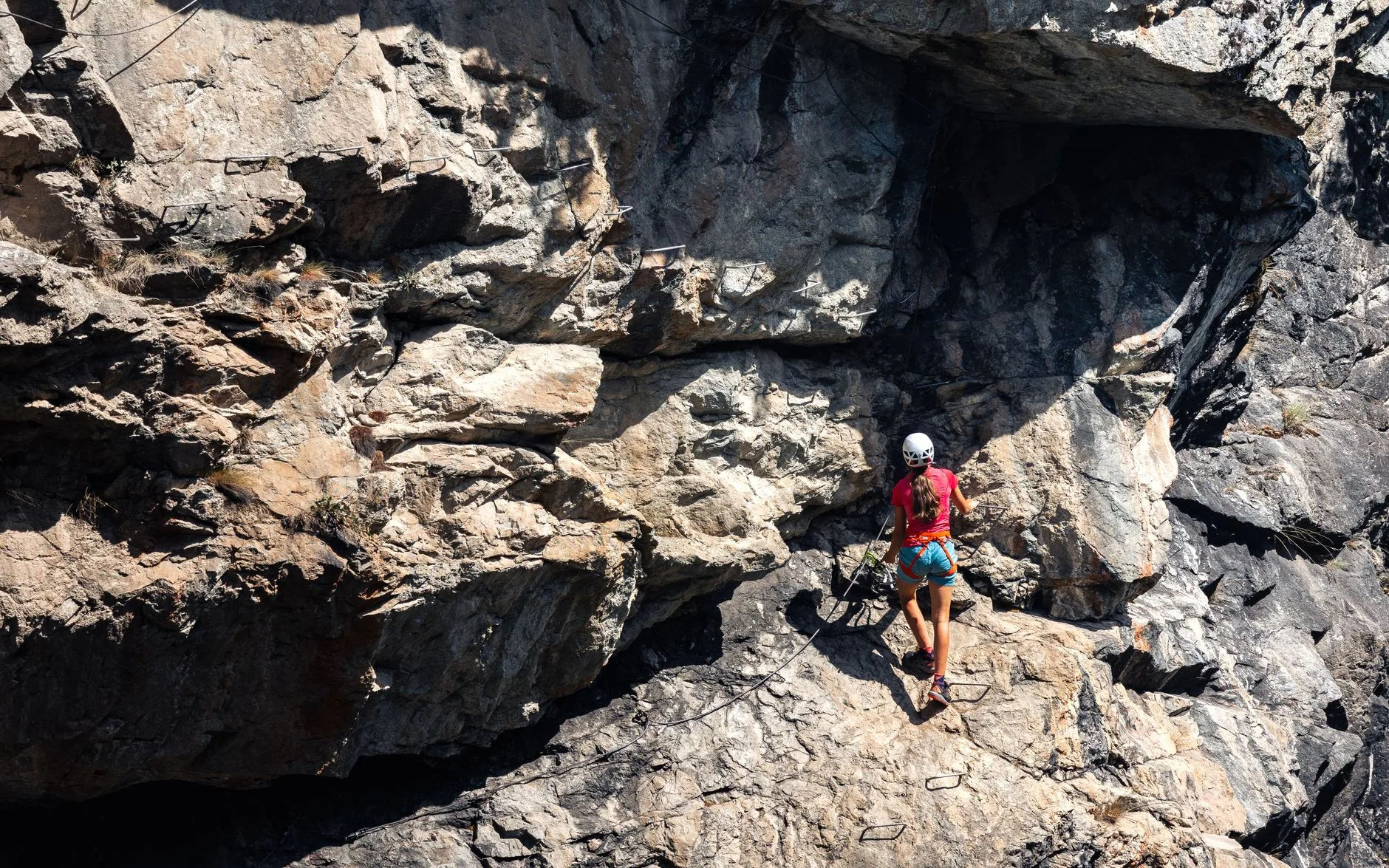
Photo by Marek Piwnicki on Pexels
The cable runs along the rock face at chest height, bolted every few metres into limestone the colour of old bone. Below, the Boite valley drops away in a long green sweep toward Cortina d’Ampezzo, and somewhere behind you a group of Italian teenagers is arguing cheerfully about whose turn it is to lead. You clip one carabiner past the anchor, unclip the other, re-clip, and keep moving — a rhythm that within an hour stops feeling like a safety procedure and starts feeling like walking.
This is via ferrata: fixed cables, iron rungs, and the occasional suspension bridge bolted onto mountainsides across the Alps, built originally so soldiers could move supplies and men across terrain no army should have been fighting on. Most of what remains dates from the First World War, when Italy and Austria-Hungary fought at altitudes above 2,500 metres, and the routes climbers use today in the Dolomites were often literal front lines. What’s left is a strange gift: a way to climb genuinely exposed rock without ropes, ice axes, or years of technical training, using equipment you can rent for the day.
This guide is for people who’ve hiked plenty but have never clipped into a cable, and want to know exactly where in Europe to try it first, what it costs, and how much fear to budget for.
What via ferrata actually is (and isn’t)
Via ferrata — “iron path” in Italian, also called Klettersteig in German-speaking regions — is not rock climbing and not quite hiking. You’re moving over vertical or near-vertical terrain using a continuous steel cable bolted to the rock, along with metal rungs, ladders, and sometimes suspension bridges. You wear a harness connected to the cable via a via ferrata lanyard: a Y-shaped tether with two carabiners and a built-in shock absorber designed to limit fall force if you slip.
The difference from climbing is that the cable is always there — you’re never trusting your own gear placement. The difference from hiking is that a fall, while arrested by the cable system, still means a genuine drop of several metres before the shock absorber engages, and exposure is constant. Vertigo, not fitness, is usually what stops beginners partway through their first route.
Routes are graded, most commonly on the Hüsler scale used across the Alps, from A (easy, mostly walking with occasional cable) to F (near-vertical, sustained, often overhanging). For a first outing, stick to A or B. Some guidebooks use the French/Italian scale (PD, AD, D, TD, ED) instead, which measures overall route difficulty rather than technical sections — worth checking which system a given resource uses before you commit to something that sounds tame and isn’t.
Gear: what you need and what to rent
Buying a full via ferrata kit before you know if you enjoy it is a waste of money. Every alpine town with meaningful via ferrata access — Cortina, Arco, Bovec, Chamonix — has outdoor shops that rent the full set for around €15–25 per day: harness, via ferrata lanyard with shock absorber, and helmet. Gloves are worth buying outright (€10–15) since rental pairs are often stretched out and grim, and the cable will shred bare hands within an hour.
Do not attempt a route with a homemade lanyard or a static sling clipped directly to the cable — this is a real and recurring cause of injury, because a fall onto a non-shock-absorbing tether transmits far more force than the human body is built to handle. Certified via ferrata kits (look for a CE or UIAA rating, easily checked via the International Climbing and Mountaineering Federation) are non-negotiable, not a suggestion.
A daypack with 2 litres of water, a light waterproof shell, and proper hiking boots with ankle support and stiff soles rounds out the kit. Approach shoes work but boots grip better on wet iron rungs, which are more common than the postcard photos suggest.
Where to start: the best beginner routes in Europe
The Dolomites in northeastern Italy have the highest concentration of via ferrata anywhere in the world, largely because of that wartime infrastructure, and they’re the obvious starting point. But Lake Garda and Slovenia’s Julian Alps offer gentler introductions with easier logistics if the full Dolomites trip feels like too much at once.
Via Ferrata delle Trincee, Monte Piana (Dolomites) — This is the route to do first. Monte Piana was fought over so intensely in WWI that the summit plateau is still scattered with trench lines, and the via ferrata follows old military positions with minimal technical difficulty (Grade A/B). A toll road and shuttle from Misurina get you to the trailhead, cutting the approach to under an hour. Allow 3–4 hours round trip, including time in the small open-air war museum at the top.
Via Ferrata Ivano Dibona (Dolomites) — A step up in commitment (Grade B/C) and considerably more scenic, tracing a ridge beneath Monte Cristallo with views toward Cortina and the Sorapiss group. It’s long — plan on 5–6 hours — with a chairlift from Rio Gere shortening the initial climb. This is a good second route once Monte Piana feels comfortable.
Rio Sallagoni, near Arco (Lake Garda) — Arco, at the northern tip of Lake Garda, has become one of Europe’s climbing hubs, and its via ferrata routes are shorter, lower-altitude, and warmer than anything in the high Dolomites, making them viable from April through October rather than the shorter Dolomites season. Rio Sallagoni is graded easy to moderate and takes 2–3 hours, with the added appeal of a swim in the lake afterward.
Mala Mojstrovka, Julian Alps (Slovenia) — Accessed from the Vršič Pass road above Kranjska Gora, this route sits inside Triglav National Park and offers a genuinely different flavour: quieter trails, fewer crowds than the Dolomites in August, and a summit view across a serrated ridge of limestone peaks. Grade B, roughly 3 hours up and down from the pass car park.
Aiguillette des Posettes area, Chamonix Valley (France) — France has far fewer via ferrata routes than Italy or Austria, but the ones near Chamonix sit against the backdrop of Mont Blanc, which counts for something. Routes here tend to run steeper and shorter than the Dolomites classics — good for an afternoon rather than a full day trip. If you’re already building a longer hiking itinerary in France, this region pairs naturally with some of the country’s best hiking trails further south in the Alps and Pyrenees.
| Route | Location | Grade | Approach | Time needed |
|---|---|---|---|---|
| Via Ferrata delle Trincee | Monte Piana, Dolomites (IT) | A/B | Shuttle bus from Misurina | 3–4 hrs |
| Via Ferrata Ivano Dibona | Cortina area, Dolomites (IT) | B/C | Chairlift from Rio Gere | 5–6 hrs |
| Rio Sallagoni | Arco, Lake Garda (IT) | A/B | 20 min drive from Arco | 2–3 hrs |
| Mala Mojstrovka | Vršič Pass, Slovenia | B | Car park at pass summit | 3 hrs |
| Aiguillette des Posettes area | Chamonix Valley, France | B/C | Short drive + trail approach | 2–4 hrs |
Getting there
Venice Marco Polo Airport is the easiest gateway into the Dolomites, with a roughly two-hour drive or a combination of bus and coach service to Cortina d’Ampezzo — car hire is worth the cost here, since public transport to individual trailheads is patchy and infrequent outside peak summer weeks. Innsbruck Airport works well for Austrian and western Dolomites routes and has better rail connections onward.
For Lake Garda, Verona Airport is closest to Arco, about an hour by car or a combination of train to Rovereto and local bus. For Slovenia’s Julian Alps, Ljubljana Airport is the obvious hub, with a rental car essentially required to reach Vršič Pass and Kranjska Gora — this is genuinely remote, winding mountain road territory, not a place to arrive without your own wheels.
When to go
Late June through mid-September is the reliable window for most Alpine via ferrata routes, once winter snow has cleared from the higher cables and before autumn ice returns. Arco and the Lake Garda routes extend that season by a month or two on each end, being lower altitude and considerably warmer. July and August bring crowds on the famous Dolomites routes — expect to queue behind slower groups on narrow sections of Ivano Dibona in peak season — while June and September offer thinner crowds at the cost of a slightly higher chance of afternoon thunderstorms, which is the single most common reason routes get closed or turned back on.
Guides, insurance, and going it alone
Many beginners’ first instinct is to hire a mountain guide, and for a first-ever route, this isn’t a bad idea — a certified guide (look for UIAGM/IFMGA certification) costs roughly €200–350 per day for a small group and will handle rope backup on harder sections, route-finding, and reading weather. That said, the routes listed above are popular and well-marked enough that confident hikers with no vertigo issues regularly do them independently, often alongside experienced friends.
Whichever way you go, check what your travel insurance actually covers — standard policies frequently exclude via ferrata as a “mountaineering activity,” and mountain rescue in the Dolomites is not free. Alpine club membership (Club Alpino Italiano or the German/Austrian Alpenverein) includes rescue insurance and is worth the roughly €40–80 annual fee if you plan to do more than one trip. It’s the kind of unglamorous logistics detail nobody mentions in the summit photos, but it’s the difference between a manageable bill and a genuinely bad week if something goes wrong.
The Bottom Line
- Start with Monte Piana’s Via Ferrata delle Trincee — it’s genuinely beginner-appropriate, historically interesting, and forgiving if you discover mid-route that heights bother you more than expected.
- Never substitute a certified via ferrata kit for improvised gear; the shock-absorbing lanyard is the entire safety system, not an optional extra.
- Rent before you buy — a full day’s kit runs €15–25, a fraction of what a harness and lanyard cost new, and you’ll know after one route whether this is a hobby worth investing in.
- Check your insurance policy specifically for via ferrata exclusions before you fly, and consider alpine club membership if you’re planning more than a single trip.
- Lake Garda and Slovenia’s Julian Alps are underrated starting points — less crowded than the Dolomites classics, with a longer season and gentler logistics for a first attempt.
Keep reading: Pair your via ferrata trip with one of France’s best hiking trails