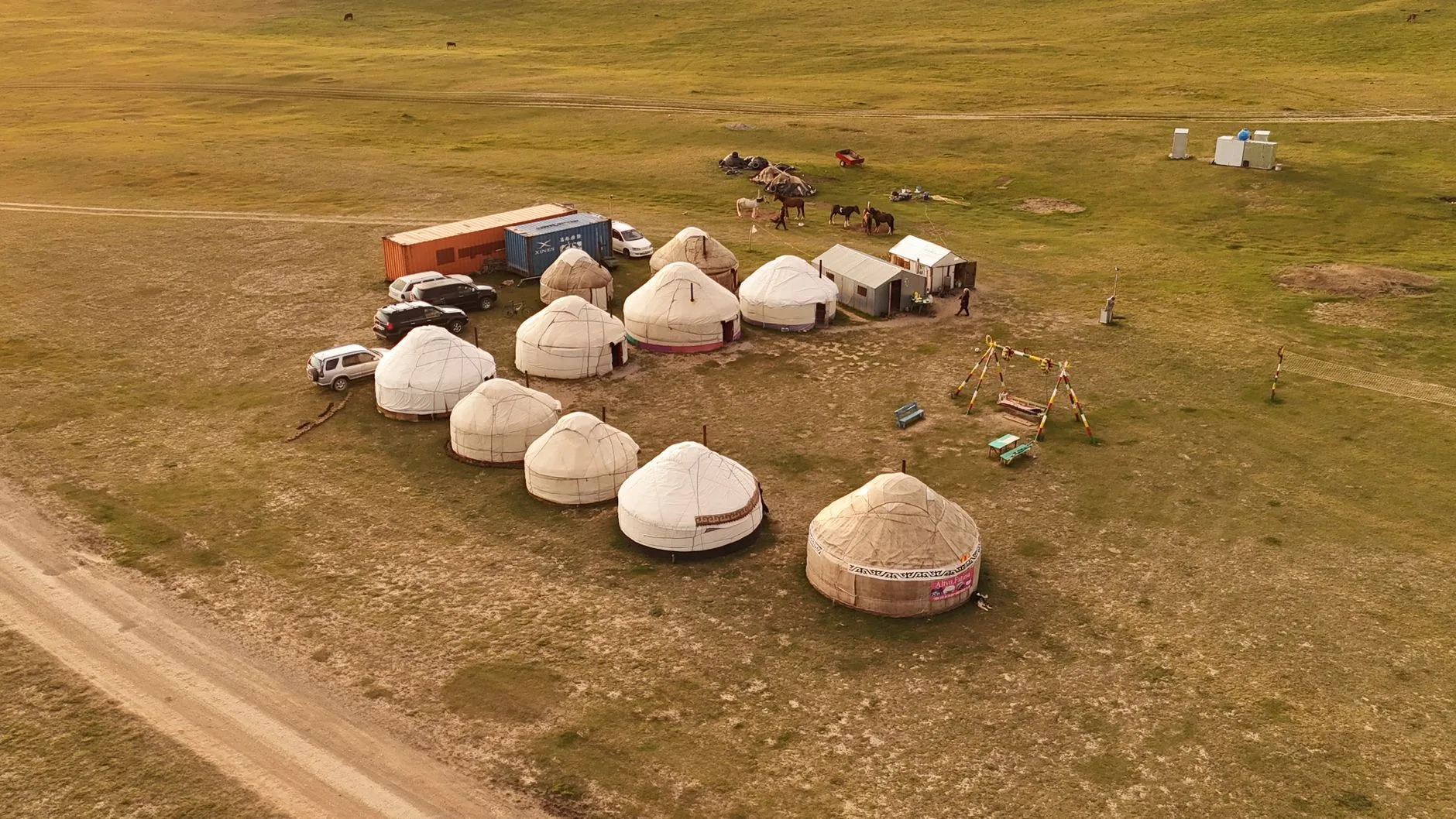
The smoke from the dung-fire finds the gap under the yurt’s felt flap before you’re properly awake, and somewhere outside a horse is chewing grass with the unhurried thoroughness of an animal that has nowhere else to be. It’s just past six on the Song-Kul plateau, 3,000 metres up, and the lake is doing the thing it does at dawn — turning the colour of hammered pewter, dead still, rimmed by hills that haven’t changed shape since anyone started grazing them. A woman in a headscarf is already outside milking, and the smell of boiling milk and woodsmoke is the closest thing this landscape has to an alarm clock.
This is the version of Kyrgyzstan that draws people who’ve grown tired of ticking off cities: a country where roughly 90 percent of the land sits above 1,500 metres, where nomadic pastoralism isn’t a museum exhibit but a working economy, and where you can ride a horse for six days between yurt camps and barely see another vehicle. It is also a country where the toilet is a hole in a wooden shed fifty metres from camp and the shower, if there is one, runs on whatever solar panel someone bolted to the roof that year. Both things are true, and a good trip here depends on knowing that going in.
Why Kyrgyzstan, specifically
Central Asia has several countries with mountains and horses, but Kyrgyzstan is the one that built a tourism infrastructure specifically around getting visitors onto both without requiring them to organise everything from scratch. The Community Based Tourism network — usually just called CBT — has operated since the late 1990s, connecting travellers directly with families who own horses, run yurt camps, and know the passes. It’s not a slick operation. Bookings sometimes happen over a crackling phone call in Russian relayed through a guesthouse owner. But the money goes to the herding families rather than a foreign tour operator, and the standard of horsemanship you’ll get is the real thing, not a paddock loop for photographs.
The other reason is scale without crowding. Song-Kul, the country’s best-known trekking destination, still only fills up with a few hundred yurts across an entire lake basin at the height of summer. Compare that to trekking hubs elsewhere in Asia and the difference is stark — this is discussed in more depth in our piece on community based tourism examples that work, which uses Kyrgyzstan’s CBT network as one of its case studies.
Getting there and the entry logistics
Manas International Airport, just outside Bishkek, is the main gateway, with connections through Istanbul, Moscow, Almaty, and Dubai. Citizens of the EU, UK, US, and many other countries can enter visa-free for up to 60 days, which is generous by regional standards and makes Kyrgyzstan considerably easier to arrange than neighbouring Uzbekistan or Tajikistan.
Overland entry is common too, particularly for people combining Kyrgyzstan with a wider Central Asian or Silk Road route. The Torugart Pass and Irkeshtam Pass both connect to China, though Torugart requires pre-arranged permits and a guide on the Kyrgyz side — it is not a crossing you turn up to casually. From Kazakhstan, the Korday crossing near Bishkek is straightforward; from Tajikistan, the Pamir Highway route through the Alay valley is spectacular but slow, often taking a full day of jeep travel over unpaved switchbacks. For anyone plotting a Central Asian border-crossing itinerary, Caravanistan is the most reliable independent resource for current visa rules and crossing conditions — the situation changes often enough that guidebooks go stale within a year.
Bishkek itself is worth a day, mostly for logistics — this is where you’ll change money, buy a SIM card, and stock up on gear you forgot — but it’s not the reason you came. Most people are through it within 24 hours, heading east toward Karakol or south toward Kochkor.
Song-Kul: the classic route
Song-Kul Lake, in Naryn region, is where most first-time horse trekkers end up, and for good reason. The standard route runs from Kochkor, a small town that serves as the regional CBT hub, over the Kalmak-Ashuu or Moldo-Ashuu pass, and down onto the lake’s northern shore — typically a two-day ride in, two or three days exploring the jailoo (summer pasture) camps around the lake, and two days back out, sometimes via a different pass to vary the scenery.
Yurt camps around Song-Kul are run by families who move up from the valleys each June and pack up again by mid-September, so this is genuinely seasonal, working pastoralism rather than a fixed tourist installation. Meals are simple and repeat a lot: fried bread called boorsok, kaymak (a clotted cream eaten with jam or honey), kurut (salty dried yoghurt balls that taste better than they sound), and in the evenings often beshbarmak — boiled meat and flat noodles, traditionally eaten by hand, though visitors are handed a fork. Kymyz, fermented mare’s milk, appears constantly and is something of a rite of passage; it’s mildly alcoholic, faintly fizzy, and an acquired taste that most people acquire somewhere around day three.
Jyrgalan and the Tien Shan: for more technical terrain
If Song-Kul is the introduction, Jyrgalan, a former coal-mining village east of Lake Issyk-Kul, is the graduate course. The valley system here climbs into proper Tien Shan high country, with multi-day routes crossing passes above 3,500 metres and camps set beside glacial rivers rather than on open pasture. Jyrgalan has developed its own community tourism association separate from CBT, and the guides here tend to be younger and more likely to speak functional English, a legacy of the ski-touring crowd that discovered the valley in winter and stayed to build summer trekking routes too.
Karakol, an hour’s drive away, is the practical base — it has gear shops, a lively Sunday animal market on the town’s outskirts worth an early visit even if you’re not buying livestock, and Dungan-style cuisine reflecting the region’s Hui Chinese Muslim community, notably ashlan-fu, a cold noodle dish with a chili-vinegar broth that cuts through the mutton-heavy diet you’ll otherwise be eating for a week.
What a yurt stay actually involves
The romance of sleeping in a yurt is real, but it helps to know the mechanics. A traditional Kyrgyz yurt (boz üy) is a collapsible wood-lattice frame covered in felt, with a wooden door frame low enough that you will hit your head on it at least once. Inside, sleeping mats and heavy quilts are laid directly on the felt floor, arranged around a central stove that’s lit only if the night is cold — which, at altitude, it usually is, even in July.
There’s no electricity in most camps beyond a solar-charged light bulb or two, and phone signal disappears the moment you’re over the first pass, which is either a relief or a problem depending on your temperament. Toilets are outdoor pit latrines; washing is a bowl of warm water and, occasionally, a solar shower bag if the family has invested in one. None of this is a hardship exactly, but it is a real change of register from a hotel, and travellers expecting anything resembling a glamping experience will be disappointed. Those wanting a gentler introduction to remote, low-infrastructure travel before committing to something this rustic might find it useful to read about budget travel in Georgia, a country that shares some of the same mountain-guesthouse culture with rather more electricity.
Booking: CBT, independent guides, or a tour operator
CBT offices exist in most trekking towns — Kochkor, Karakol, Naryn, Kazarman — and function as a booking desk for local families’ horses, yurts, and guiding services. Prices are fixed and posted, which removes the haggling that can otherwise dominate these transactions.
| Option | Typical cost per day | Best for | Trade-off |
|---|---|---|---|
| CBT-arranged, self-guided route | $30–45 (horse, guide, yurt board) | Travellers wanting authenticity with fixed pricing | Guides often speak limited English |
| Independent negotiation with a family | $20–35 | Fluent Russian speakers, repeat visitors | Requires local contacts, more variable quality |
| Foreign or Bishkek-based tour operator | $80–150 | First-timers wanting full logistics handled | Less money reaches herding families directly |
A horse and guide typically run $25–40 a day depending on region and season; a night’s yurt board with three meals adds roughly $15–20. Multi-day treks are usually quoted as a package. It’s worth asking directly how many nights the guide themselves has spent on the specific route that season — turnover among younger guides is real, and route familiarity varies more than the price list suggests.
Season and what the weather actually does
The trekking season runs roughly mid-June to mid-September, with the shoulder months carrying real risk of snow on passes above 3,000 metres. July and August are the reliable window, though afternoon thunderstorms are common at altitude and can turn a pleasant ride into a genuinely cold, wet slog within twenty minutes — pack a proper waterproof layer, not a windbreaker.
| Month | Conditions | Notes |
|---|---|---|
| May | Cold, passes often still snow-blocked | Not recommended for high routes |
| June | Warming, jailoo camps setting up | Good for lower-altitude routes, fewer people |
| July–August | Peak season, warm days, cold nights | Most reliable, also most booked |
| September | Cooling fast, camps starting to pack down | Beautiful light, but book ahead — season is ending |
| October onward | Camps closed, snow likely | Trekking largely unavailable |
What to pack and what to skip
Layering matters more than any single expensive item. Days can hit 25°C in the sun and drop to near freezing after dark at the same camp. A proper sleeping bag rated to at least -5°C is worth carrying even in July, since the quilts provided vary in warmth. Sunscreen and a hat matter more than people expect — UV at 3,000 metres is fierce and there’s no shade on the jailoo. Bring cash in Kyrgyzstani som; card machines don’t exist once you’re past the last town, and US dollars can be changed in Bishkek or Karakol but not usefully spent in a yurt camp.
Riding experience isn’t strictly required — the horses used on these routes are steady, sure-footed animals more interested in grass than drama — but a few hours in a saddle before departure will save you a genuinely uncomfortable second day. Six or seven hours a day in the saddle is standard on multi-day routes, and there’s no getting around the fact that your legs and lower back will know about it.
The Bottom Line
- Song-Kul suits first-timers and those wanting classic, open jailoo scenery with well-established infrastructure; Jyrgalan suits people wanting steeper terrain and fewer other trekkers.
- Book through CBT for fixed pricing and money that reaches herding families directly, but don’t expect fluent English or five-star polish — that’s not what you’re paying for.
- July and August are the only truly reliable months; anything outside that window risks snow-blocked passes or closed camps.
- Physical comfort will be basic — pit toilets, no power, cold nights — and that’s precisely the point rather than a flaw to route around.
- Pack layers and cash, book ahead for September dates, and don’t skip a few practice hours in the saddle if you haven’t ridden in years.
Keep reading: See how community based tourism works in practice