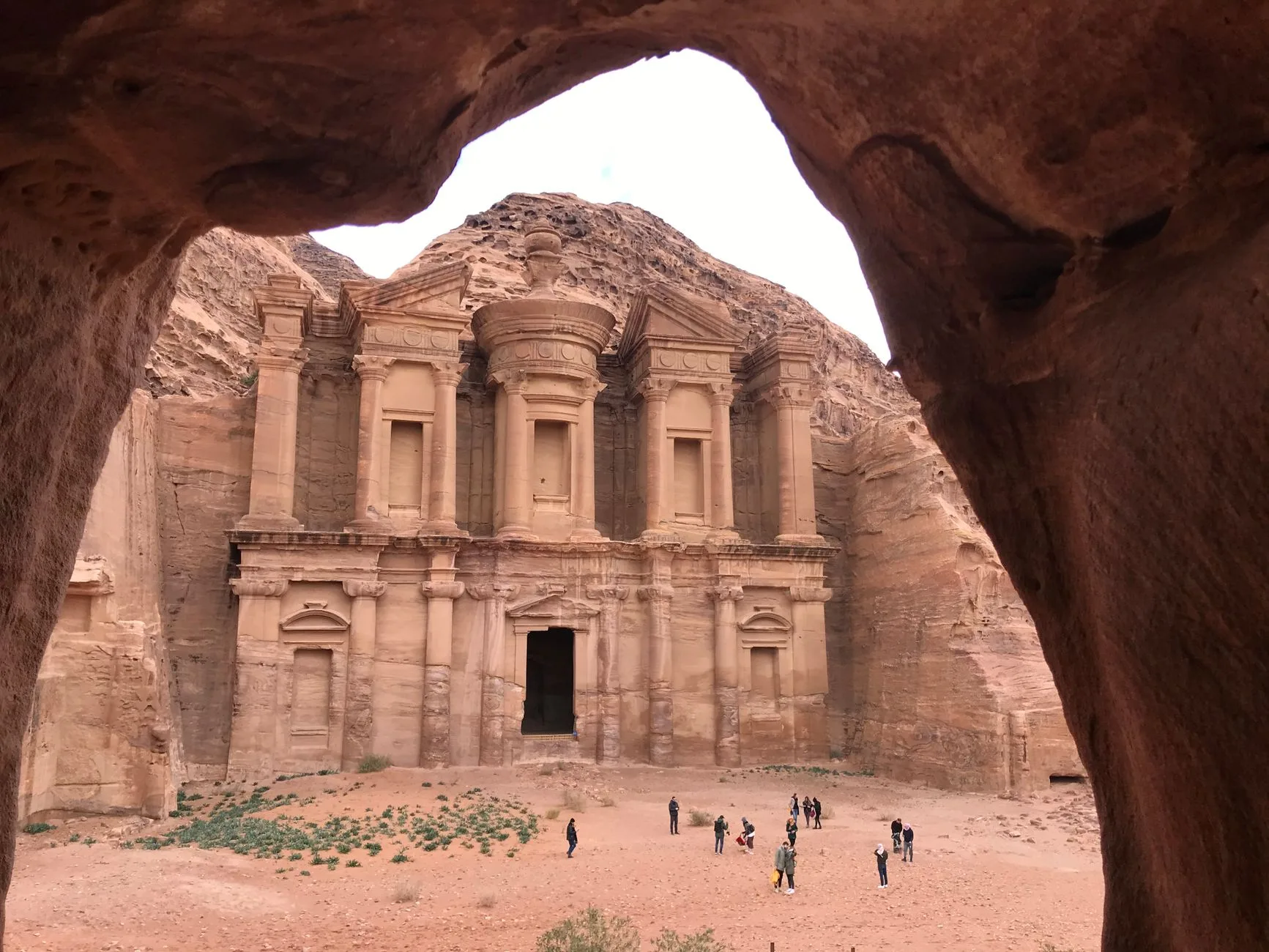
Photo by Pexels User on Pexels
The Siq narrows to barely three metres wide in places, and at six in the morning it’s just you, a sleepy stray cat, and the sound of your own footsteps on stone polished smooth by two thousand years of sandal, hoof, and tyre. The walls rise sixty metres on either side, streaked ochre and rose and grey, and the light doesn’t reach the floor until well after sunrise. Then the gorge opens, and the Treasury appears in the gap like something you weren’t meant to see yet — which, if you’ve timed it before the first tour buses arrive from Amman, is more or less true.
Petra is the reason most people book a flight to Jordan. It is also, frustratingly, the reason many of them never see anything else. The country beyond the Treasury’s facade — Wadi Rum’s red dunes, the cliffside villages of Dana, the King’s Highway’s string of Crusader castles and Byzantine mosaics — rewards exactly the kind of traveller who’s willing to work out a minibus timetable or negotiate a taxi fare in Arabic numerals. None of it requires a guide to access, though a few stretches genuinely benefit from local knowledge. This is what independent travel in Jordan actually looks like once you’re past the airport arrivals hall.
Getting in: visas, the Jordan Pass, and which border to use
Most nationalities can get a visa on arrival at Queen Alia International Airport in Amman, but the smarter move is the Jordan Pass, a government scheme that bundles the visa fee with entry to Petra and over forty other sites, including Jerash and the Dead Sea’s public beaches. Buy it online before you fly — it costs nothing extra over the standalone visa fee once you factor in two or more days at Petra, and it waives the visa charge entirely if you stay five nights or longer.
If you’re coming overland, there are three working border crossings. The King Hussein Bridge (Allenby Bridge) connects to the West Bank and is the slowest and most bureaucratic, with no Jordan Pass visa-on-arrival option — you need a visa sorted in advance here. Wadi Araba, just north of Aqaba, connects to Eilat in Israel and is faster and more straightforward. Jaber, in the north, connects to Syria but has been unreliable depending on the security situation — check your government’s current travel advisory before planning around it. For most independent travellers flying in, none of this matters much, but it’s worth knowing Jordan sits at a genuine crossroads, not a dead end.
Petra: more than a day, less than a guide
Petra deserves two full days minimum, three if you want to breathe. A single-day dash gets you the Siq, the Treasury, and maybe the Royal Tombs before exhaustion and heat win. The site opens at 6am (later in winter), and arriving at opening is the single best piece of advice anyone can give you — not for Instagram reasons, but because by 10am the Siq fills with donkey traffic, cart drivers shouting “taxi, taxi” in good humour, and enough tour groups to make the narrow sections genuinely slow going.
The climb to the Monastery (Ad Deir) is the one most day-trippers skip, and it’s the better monument. It’s roughly 800 rock-cut steps from the Basin restaurant area, starting past a trail of Bedouin tea stalls that make useful rest stops on the way up. Give yourself 45 minutes to an hour each way, more if the heat is up. The High Place of Sacrifice is a shorter, steeper alternative with excellent views back over the Treasury from above — fewer people make the climb, and it’s doable as a loop back down through Wadi Farasa past weathered tomb facades nobody stops for.
Petra by Night — candles lining the Siq floor, Bedouin music at the Treasury — runs three evenings a week (currently Monday, Wednesday, Thursday) and is a separate ticket, not included in daytime entry or the Jordan Pass. It’s atmospheric but crowded and brief; treat it as a bonus, not a highlight.
Little Petra and the walk nobody mentions
Fifteen minutes north of Petra’s main entrance by taxi (around 5-7 JD) sits Siq al-Barid, known as Little Petra — a miniature version of the same carved facades, with none of the crowds and no entry fee. It was likely a suburb or caravan stop for Petra’s Nabataean traders. From here, an unofficial but well-trodden hiking route called the “Petra back door” or Al-Beidha trail leads over the ridge and down into Petra itself near the Monastery, arriving from the opposite direction most visitors never see. It takes two to three hours, crosses open desert with no shade, and is genuinely easy to lose if you haven’t checked a GPS track beforehand — this is one of the few stretches where hiring a local guide in Wadi Musa for the morning (expect 25-35 JD) earns its cost in both navigation and conversation.
The King’s Highway: Jordan’s slow route south
Most tour buses barrel down the Desert Highway between Amman and Petra in under three hours. The King’s Highway, the old Roman and Crusader road, takes most of a day and is far more interesting — it’s the kind of route that rewards readers who enjoy slow travel over distance covered. Hiring a car is the easiest way to do it (Jordan’s roads are reasonably well signed in English, and driving is on the right), though JETT and local minibuses connect the main towns if you’re without one.
Stops worth building in: Madaba, with its sixth-century Byzantine mosaic map of the Holy Land on the floor of St. George’s Church; Mount Nebo, where Moses is said to have viewed the Promised Land, with views stretching to the Dead Sea on a clear day; and Kerak, a Crusader castle town where the fortress itself is free to wander with minimal signage, meaning you half-explore it like a ruin rather than a museum.
Dana Biosphere Reserve and Wadi Rum: the desert interior
Dana is Jordan’s most underused asset. A single stone village clings to a cliff edge overlooking a vast rift valley, and from here a network of trails drops through changing ecosystems — juniper forest at the top, sandstone canyon lower down, desert floor at the bottom near Feynan. The full Dana-to-Feynan trek takes a full day (roughly 14km, six to seven hours) and ends at the solar-powered Feynan Ecolodge, which runs no road access after dark — you arrive by donkey or on foot, and dinner is eaten by candlelight because there’s no electricity to spare for bulbs.
Wadi Rum is the part of Jordan that looks like nowhere else on earth, all red dunes, towering jebels, and silence thick enough to feel. Independent travellers can absolutely do Wadi Rum without a multi-day organised tour: buses and shared taxis run from Aqaba and the Desert Highway to Rum Village, where Bedouin-run camps (Zarb cooked in a sand pit, mattresses under open sky) can be booked directly, often cheaper than through an agency back in Amman. A 4×4 half-day tour of the main sights — Lawrence’s Spring, the Burdah rock bridge, Khazali Canyon’s petroglyphs — costs around 35-50 JD split between a group, arranged on arrival at the visitor centre with no advance booking needed.
Aqaba and the Red Sea
Jordan’s only coastline is a short stretch at Aqaba, and it’s easy to underestimate as “just the port town before the border.” The diving here is genuinely good — coral gardens and wrecks a fraction of the price of Sharm el Sheikh or Dahab across the water in Egypt, and far less crowded, since most divers in the region head straight for the Sinai. If you’re weighing options for extending a Red Sea stretch of the trip, it’s worth reading up on how Sharm el Sheikh compares to Dahab before deciding whether to cross by ferry from Aqaba to Nuweiba.
Aqaba town itself is unglamorous and functional, good for a seafood dinner of grilled sayadieh (spiced rice and fish) at one of the no-frills restaurants near the fort, rather than a destination in its own right.
Getting around without a tour operator
Jordan’s public transport is workable but sparse, and this is the part guidebooks tend to gloss over. JETT buses connect Amman, Petra, and Aqaba on fixed schedules and are comfortable and air-conditioned. Minibuses (servees) fill in the gaps between smaller towns but leave when full rather than on a timetable, which means mornings are more reliable than afternoons. Taxis are cheap by Western standards but almost always require a negotiated fare rather than a meter outside Amman — agree the price before you get in. Renting a car gives genuine freedom for the King’s Highway and Dana, and Jordan’s main roads are in good condition, though mountain village roads can be narrow and poorly marked.
| Region | Highlight | Best season | Getting there | Approx. daily cost (budget) |
|---|---|---|---|---|
| Petra / Wadi Musa | Treasury, Monastery hike, Petra by Night | March–May, Sept–Nov | JETT bus from Amman (3.5 hrs) | $35–55 |
| Little Petra | Siq al-Barid, back-door trail | Oct–Apr (cooler for hiking) | Taxi from Wadi Musa (15 min) | $20–30 |
| King’s Highway | Madaba mosaics, Mount Nebo, Kerak castle | Year-round, avoid midsummer heat | Rental car or minibus | $30–50 |
| Dana Biosphere Reserve | Dana-to-Feynan trek | Oct–Apr | Minibus from Amman via Tafileh | $40–65 (lodge dependent) |
| Wadi Rum | Jeep tours, Bedouin camps, stargazing | Oct–Apr (summer exceeds 40°C) | Bus/taxi from Aqaba or Desert Highway | $30–45 incl. camp stay |
| Aqaba | Red Sea diving, ferry to Egypt | Year-round, autumn ideal | Bus from Amman (4–5 hrs) or Petra (2 hrs) | $35–50 |
The Bottom Line
Petra alone justifies the flight, but treating it as a day trip from Amman is the single most common way travellers shortchange this country. Build in at least ten days if you want Petra, Wadi Rum, Dana, and the King’s Highway without rushing — five is enough for Petra and Wadi Rum if that’s all the time you have.
Independent travel here is entirely workable without a tour company booking every move: buses run, taxis negotiate, Bedouin camps take walk-ins, and the Jordan Pass removes most of the visa and entry-fee friction before you even land. The exceptions are narrow and specific — the Little Petra back-door trail, multi-day desert treks with no marked path — where a half-day local guide is less a concession than good sense.
Budget more for Wadi Rum and Dana lodging than you’d expect; remote doesn’t mean cheap when everything, including water, arrives by truck. And don’t let the Treasury’s famous first glimpse be the only image you bring home — the cliffside trail into Dana at dawn, or the Burdah rock bridge at sunset in Wadi Rum, are the ones that tend to stay longer.
Keep reading: What to see and how to get around on a first trip to Jordan