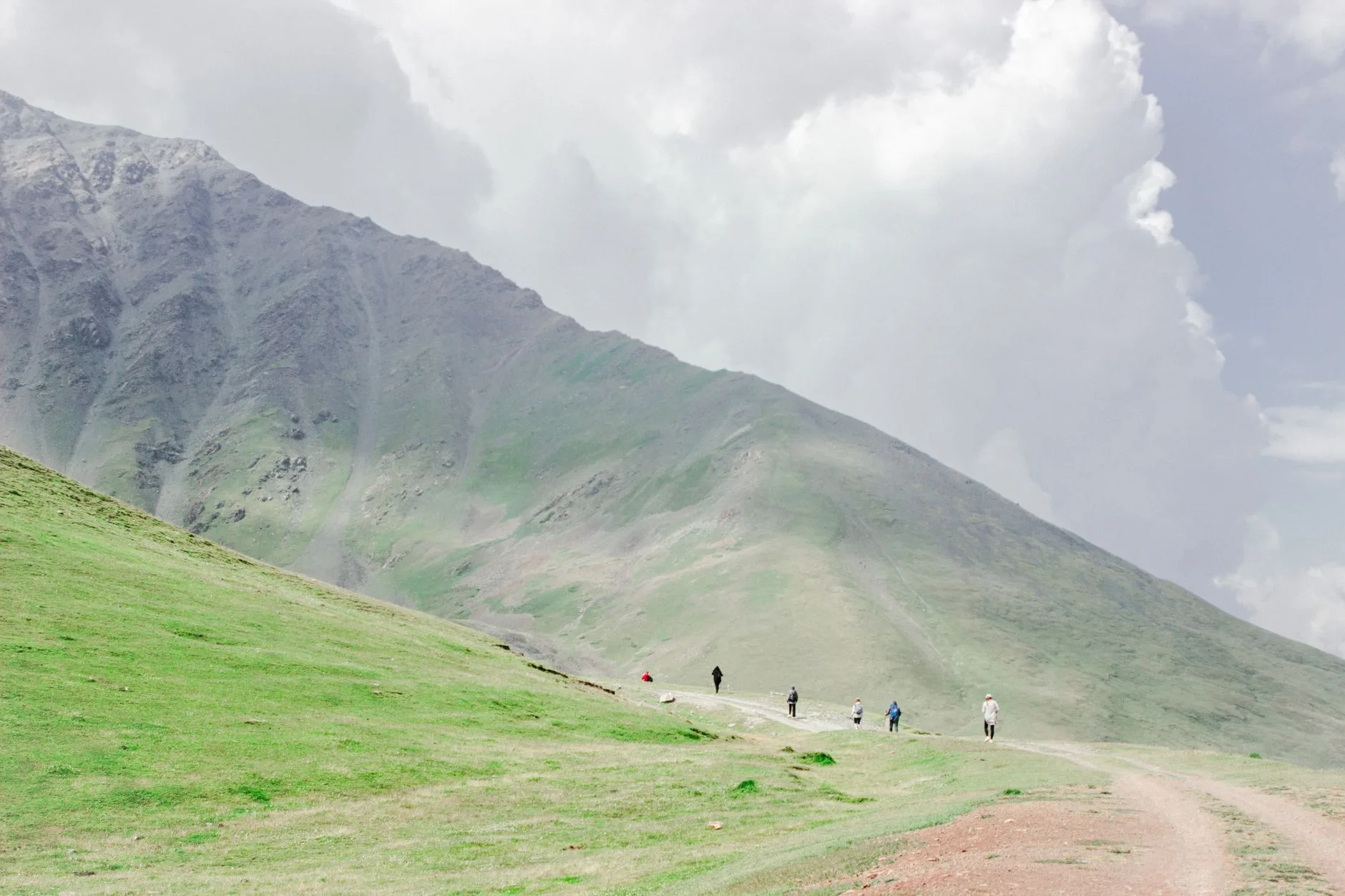
Photo by Olga Zabiiako on Pexels
By six in the morning the lake at Song-Kul is the colour of pewter, and the yurts scattered along its northern shore are still breathing smoke through their tunduks. A shepherd rides past at a trot, not hurrying anywhere in particular, a dog loping beside the horse’s legs. The grass up here at 3,000 metres is cropped short by thousands of grazing animals, and it smells of woodsmoke, wet wool, and something faintly like thyme. There is no fence, no ticket booth, no sign. Just a plateau the size of a small country, and the understanding that you’re welcome to walk or ride across most of it.
This is the pitch Kyrgyzstan makes to independent travellers, and it’s a rare one: a genuinely vast, genuinely empty mountain landscape — the Tien Shan and the western edge of the Pamir-Alay — with an existing infrastructure of community-based tourism that makes it possible to trek and ride for weeks without a package tour, a fixer, or a four-figure budget.
Why Kyrgyzstan works for independent trekkers
Most of the world’s great high-altitude trekking regions require either a guide by law (Bhutan), a permit system that funnels you into group logistics (parts of Nepal), or infrastructure so sparse that going alone is reckless (much of the Pamirs in Tajikistan). Kyrgyzstan sits in a genuinely useful middle ground. There are no trekking permits required for the vast majority of routes, no mandatory guide, and a 20-year-old network of Community Based Tourism (CBT) offices in towns like Karakol, Kochkor, Naryn, and Jyrgalan that will arrange a horse, a homestay, or a guide for a single day or a three-week trek, at prices set by the community rather than by an agency in Bishkek.
That said, “independent” here doesn’t mean “unsupported.” Trails are rarely signposted, mobile coverage vanishes within an hour of leaving most villages, and the weather on the Tien Shan’s 4,000-metre passes turns in minutes, not hours. The useful skill isn’t wilderness survivalism — it’s knowing which five or six organisations to call, which routes genuinely don’t need a guide, and which ones you’d be foolish to attempt without one.
Getting there and getting oriented in Bishkek
Manas International Airport outside Bishkek has direct flights from Istanbul, Moscow, Dubai, and a handful of other hubs; most Western travellers connect through Istanbul. Citizens of the EU, UK, US, Canada, and many other countries get visa-free entry for up to 60 days — check current rules before booking, as Central Asian visa policy shifts.
Bishkek itself is not the draw, but it’s where logistics happen: the CBT Kyrgyzstan head office, gear rental shops along Chuy Avenue, and the marshrutka (shared minivan) stands at the West Bus Station (Zapadny Avtovokzal), from which vans run to Kochkor, Naryn, and Karakol throughout the day for a few hundred som. Budget two or three days in Bishkek at the start of a trip to sort permits (only needed for border-zone treks like Inylchek), buy a local SIM, and withdraw enough cash — ATMs are scarce once you leave the Issyk-Kul region, and almost nothing in the mountains takes cards.
The routes: where to actually go
Ala-Archa National Park, 40 minutes south of Bishkek by taxi, is the easiest overnight trek to do entirely without a guide — a well-marked trail to the Ratsek Hut at 3,300 metres, with views of Korona Peak. It’s a good shakedown hike, not a highlight.
Jyrgalan, a former coal-mining village on the eastern edge of Issyk-Kul, has reinvented itself as Kyrgyzstan’s most useful trekking base, with marked trails, a dedicated guesthouse scene, and CBT staff who speak excellent English. The three-day loop over Boz-Uchuk lakes is manageable solo with a GPS track; longer routes toward the Keskenkyia loop benefit from a local guide, arranged on arrival for roughly $25–35 a day.
Song-Kul, the alpine lake described above, is the classic horse-trekking destination. Routes in from Kochkor or Naryn take two to four days on horseback through the Kalmak-Ashuu pass, with yurt stays along the way. This is where horses make the most sense logistically — the lake basin is enormous, treeless, and genuinely faster covered on horseback than on foot.
Tash Rabat and the Sary-Jaz valley, near the Chinese border south of Naryn, combine a 15th-century stone caravanserai with some of the least-visited high country in the range. The onward trek toward Chatyr-Kul lake crosses a border zone requiring a permit, arranged through CBT Naryn with a few days’ notice.
Inylchek and the Central Tien Shan, toward Khan Tengri and Peak Pobeda, is a different category entirely — glacier travel, serious altitude, and a helicopter or multi-day approach march. This is not an independent trek; it requires a licensed operator and mountaineering experience, full stop.
| Route | Distance/duration | Difficulty | Best season | Guide needed? |
|---|---|---|---|---|
| Ala-Archa to Ratsek Hut | 1–2 days | Easy–moderate | June–September | No |
| Jyrgalan (Boz-Uchuk loop) | 3 days | Moderate | June–October | Optional |
| Song-Kul (Kochkor route) | 2–4 days, often on horseback | Moderate | Mid-June–September | Optional, recommended for horses |
| Tash Rabat–Chatyr-Kul | 3–5 days | Moderate–hard | July–September | Yes (border permit) |
| Inylchek / Khan Tengri area | 10+ days | Hard, technical | July–August only | Yes, licensed operator required |
Trekking with horses: what it actually involves
Horse travel in Kyrgyzstan isn’t a novelty add-on — it’s how the country has moved through its own mountains for a thousand years, and the infrastructure reflects that. Through CBT offices in Kochkor, Naryn, or Kyzart, you can hire a horse with a guide (or occasionally without, if you can demonstrate experience) for anywhere from one day to three weeks, typically priced per horse per day, with a separate daily rate for the guide/wrangler if you want one — budget roughly $20–30 per horse per day, plus $20–25 for a guide, with yurt-stay accommodation and meals bundled in on multi-day routes.
The horses are small, sturdy, and sure-footed on scree and river crossings in a way that unnerves riders used to European or American horses standing calmly on flat ground — they will happily pick their way down a 30-degree slope of loose shale at a walk while you reconsider your life choices. Saddles are a mix of Russian-style and local wooden frames; a sheepskin or felt pad underneath helps on multi-hour days. Basic riding competence is enough for routes like Song-Kul or the Suusamyr valley; the steeper, narrower trails around Jety-Oguz or the Sary-Chat reserve are better attempted with a guide who knows the horse and the ground.
What no one quite prepares you for is the pace of a multi-day horse trek compared to walking: shorter daily distances feel longer in the saddle than on foot, saddle soreness is real and arrives on day two rather than day one, and the rhythm of the whole trip slows to match the animals — tacking up at dawn while the dew is still on the grass, a long midday rest when the sun is highest, moving again in late afternoon.
CBT, private guides, or fully solo — choosing your level of support
CBT Kyrgyzstan, a nationwide network founded in the late 1990s specifically to channel tourism income to rural communities, remains the most useful first stop for any independent trekker. Their community-based tourism model connects travellers directly with local guides, horse owners, and yurt-stay hosts, with transparent, fixed local pricing rather than markup through a Bishkek agency. For a first visit, this is the sensible middle path: independent in spirit, supported in practice.
Fully solo trekking without local support works well on marked, low-altitude routes like Ala-Archa or parts of Jyrgalan, where trail-finding is straightforward and help isn’t far away. It’s a poor choice on border-zone routes, glacier terrain, or anything above 3,800 metres where weather and navigation errors compound quickly. Private guiding companies in Karakol and Bishkek fill the gap for technical routes — Inylchek, the Pobeda base camp approach, ski-touring in winter — and are worth the premium there.
Season, altitude, and weather reality
The trekking season is short and unforgiving of miscalculation: late June through mid-September for anything above 3,000 metres, with July and August the safest window for high passes. Snow can close routes like Ala-Kul or the Tash Rabat pass well into June and return again by late September. Days at altitude swing from short-sleeve warm at midday to below freezing after dark, often within the same 24 hours — pack for both, every day, regardless of the forecast.
Altitude itself is a real factor on routes crossing 3,500–4,000 metre passes (Ala-Kul, Kalmak-Ashuu, Chatyr-Kul), even though summit elevations are modest by Himalayan standards. Acclimatisation days built into Song-Kul or Tash Rabat itineraries aren’t padding — they’re the difference between a good trip and a miserable one.
Food, yurts, and the unglamorous bits
Expect kymyz (fermented mare’s milk, an acquired taste most travellers try once out of politeness), besh barmak (boiled meat over hand-cut noodles, the centrepiece dish at any yurt stay), and endless bowls of fresh bread with jam and butter at breakfast. Yurt camps along Song-Kul and in Jyrgalan run $15–25 per person including dinner, bed, and breakfast — thick felt bedding on the floor, a wood stove lit at dusk, and a walk outside after dark to a sky with no light pollution for a hundred kilometres in any direction. Toilets are outhouses; showers, where they exist at all, are a bucket and a kettle of hot water. This is the trade for the landscape, and most travellers find it an easy one to make.
The Bottom Line
- CBT Kyrgyzstan is the single most useful resource for any independent trekker or rider here — start with their regional offices in Kochkor, Naryn, or Karakol rather than booking a package from abroad.
- Horses aren’t a gimmick in Kyrgyzstan; on routes like Song-Kul they’re genuinely the more practical way to cover ground, and the daily rates ($20–30 per horse) make multi-day riding accessible even on a modest budget.
- Match the route to your actual experience: Ala-Archa and Jyrgalan reward solo trekkers; Tash Rabat and anything in the border zone need a permit and a guide; Inylchek and the Central Tien Shan need a licensed operator, no exceptions.
- July and August are the only reliable months for high passes — don’t plan a tight itinerary around late June or late September without a weather buffer.
- The infrastructure here is community-run and refreshingly transparent on price, a model worth comparing with the independent budget trekking scenes in Georgia or Nepal’s lesser routes beyond Annapurna, where the logistics work differently but the appeal — mountains without the machinery of mass tourism — is much the same.
Keep reading: Budget travel in Georgia, the country’s hidden gem