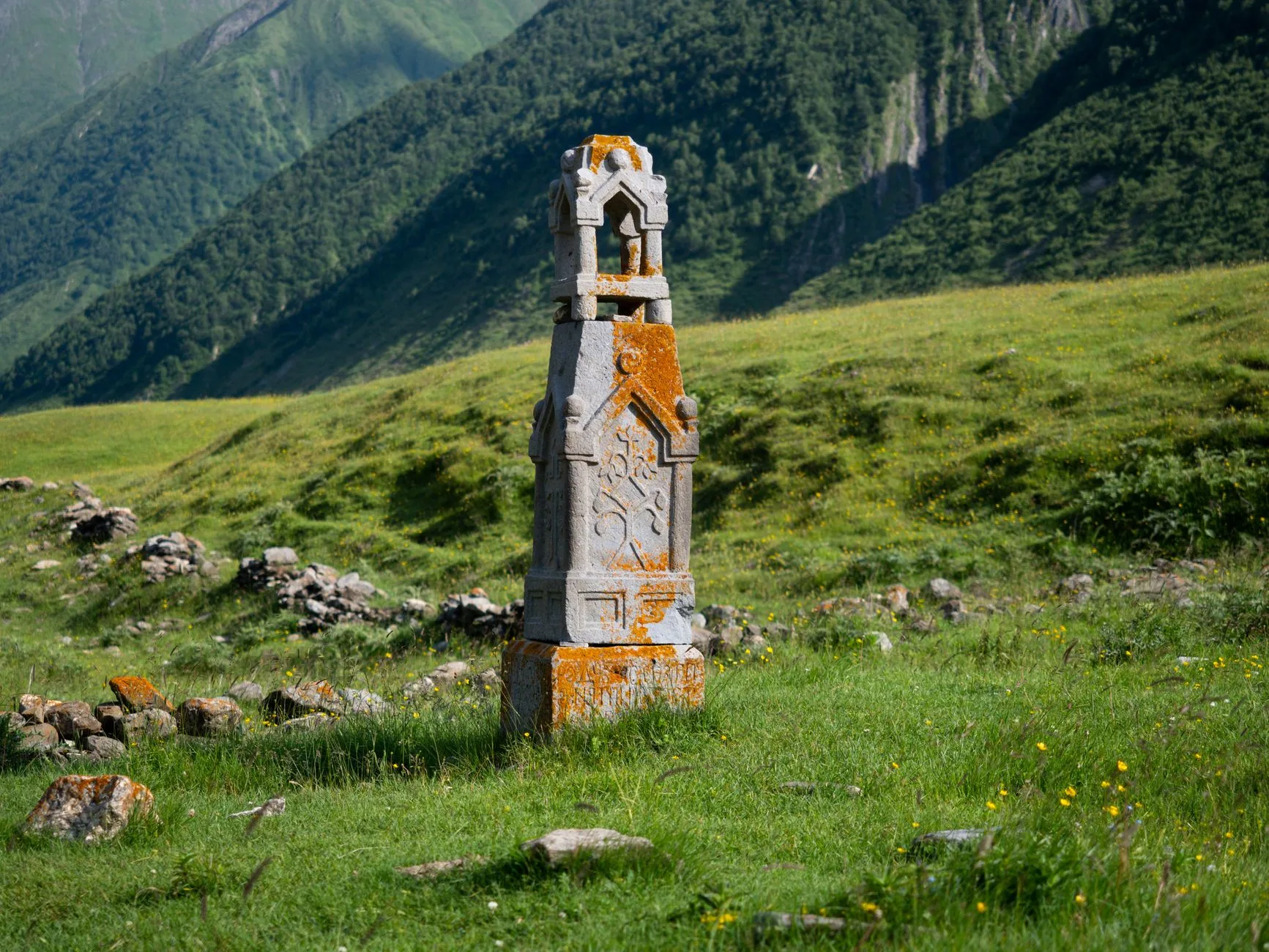
Photo by Genadi Yakovlev on Pexels
In a stone marani outside Kvareli, a woman lifts the lid off a qvevri buried to its neck in the cellar floor and pulls out a plastic jug of last year’s rkatsiteli, amber-coloured and cloudy with sediment. The cellar smells of wet clay, fermenting skins, and the particular mustiness of a room that’s been underground since the Soviet era. Outside, the Alazani Valley stretches flat and green toward a wall of mountains that, on a clear October morning, looks close enough to touch: the snow-capped spine of the Greater Caucasus, with Russia on the other side of it.
That’s the trick of Georgia, and the reason it rewards travellers who want more than a single region. Kakheti, the wine heartland in the east, sits barely three hours from Kazbegi and the high passes of the Georgian Military Highway. Tbilisi, the capital, works as a hinge between the two — a city you can leave in the morning and, depending on direction, be tasting an 8,000-year-old winemaking tradition or hiking toward a glacier by lunchtime. Few countries pack vineyard and alpine landscapes into a space this compressable, or make the transition between them this easy to arrange.
Kakheti: where the wine country actually is
Kakheti is Georgia’s wine region in the way Burgundy is France’s — not the only one, but the one everything else gets measured against. The twin towns of Telavi and Sighnagi anchor it. Telavi is workaday and a little scruffy, with a Soviet-era feel to its main street, but it’s the practical base: guesthouses, wine shops, and easy access to villages like Tsinandali, home to the restored Chavchavadze estate and its wine museum, and Kvareli, where family-run cellars still ferment wine in qvevri — the egg-shaped clay vessels buried underground that give Georgian wine its distinctive amber colour and tannic grip when made with skin contact. UNESCO recognised the traditional qvevri winemaking method as intangible cultural heritage in 2013, and it’s not a museum piece — it’s still how most family producers in Kakheti make their wine.
Sighnagi, by contrast, is the pretty one: a walled hill town with cobbled streets, pastel shutters, and views across the Alazani Valley that have made it a popular weekend trip from Tbilisi, especially since the funicular-adjacent “town of love” marketing push. It’s worth a night, but don’t skip the villages beyond it — Bodbe Monastery just outside town, where St Nino is buried, draws a steady trickle of pilgrims and offers one of the best panoramic views in the region.
For wine specifically, skip the big commercial wineries unless you want a polished tasting room experience, and instead ask your guesthouse host for a family cellar nearby — most will happily arrange an introduction, sometimes over a supra (the ritual Georgian feast table) with a toastmaster, or tamada, who’ll keep the horn cups moving. Budget around 15–25 GEL (roughly $5–9) for a generous tasting at a family producer, more at the polished estates like Tsinandali or Shumi.
Getting between wine country and the mountains
Tbilisi is the hub for almost everything. From the capital’s Ortachala bus station, marshrutkas (shared minivans) run to Telavi roughly every hour through the day, taking about 2–2.5 hours and costing 10–15 GEL. The road climbs over the Gombori Pass, which is scenic but can be slow and occasionally closed by snow in winter.
Heading north instead, marshrutkas and shared taxis to Kazbegi (officially renamed Stepantsminda) leave from Didube station, taking 3–3.5 hours up the Georgian Military Highway. This is the same road Pushkin travelled and wrote about, and it hasn’t entirely shaken off its 19th-century drama — switchbacks, sheer drops, and the Jvari Pass at over 2,300 metres, which closes after heavy snowfall.
Doing both regions in one trip means returning to Tbilisi between them, since there’s no direct road linking Kakheti to Kazbegi without a long loop. Most travellers treat Tbilisi as a two- or three-night base and radiate outward: a few days in Kakheti, back to the capital, then north into the mountains, possibly continuing west to Svaneti by a longer overland or flight route. Renting a car gives more flexibility, particularly for Kakheti’s village-hopping, but Georgian mountain roads demand a confident driver — potholes, livestock, and oncoming trucks on blind curves are standard features, not occasional hazards.
Kazbegi and the Georgian Military Highway
The reason people make the drive is Mount Kazbek, a 5,047-metre dormant volcano that dominates the skyline above Stepantsminda, and the Gergeti Trinity Church perched on a ridge beneath it at around 2,170 metres. The walk up from town takes about 1.5–2 hours on a dirt track (a 4×4 taxi up costs roughly 50–70 GEL return if your legs aren’t in the mood), and on a clear day the church framed against the glacier is the single most photographed scene in Georgia for good reason — though cloud cover rolls in fast and often, so build in a spare day if you can.
Beyond the church, the valley of Juta, about 45 minutes further by road, is the better base for serious walking. From Juta, the trail to the Chaukhi Pass (around 3,300 metres) is a full-day round trip through alpine meadows and scree, with views toward the jagged Chaukhi massif that locals call the “Georgian Dolomites.” It’s unmarked in places, so a GPS track or local guide is worth the small expense.
Don’t rush this region. The Darial Gorge, right at the Russian border, is narrow and dramatic, and the town of Stepantsminda itself — despite the tourist traffic — still has the feel of a frontier outpost, with stray dogs, guesthouses converted from family homes, and khinkali joints serving dumplings the size of a fist.
Svaneti: the deeper mountains
If Kazbegi is the accessible mountain trip, Svaneti is the commitment — and the payoff is proportional. The region’s defensive stone towers, built from the 9th to 13th centuries by families defending against raids and blood feuds, still stand in clusters above villages like Mestia and, further along a rough road, Ushguli, often cited as one of the highest continuously inhabited settlements in Europe. Upper Svaneti’s villages and towers are inscribed as a UNESCO World Heritage Site, and seeing them in person — grey stone against green slopes, with Mount Ushba’s twin peaks behind — makes the designation feel earned rather than bureaucratic.
Getting there is the honest catch. There’s no train; you fly from Tbilisi to the small Queen Tamar Airport near Mestia (weather-dependent, frequently cancelled, and not year-round), or you drive — a genuinely long haul, 8–9 hours by marshrutka from Tbilisi via Zugdidi, much of it on a winding mountain road. Night trains run from Tbilisi to Zugdidi, where you switch to a shared taxi or marshrutka for the final 2–3 hour climb into the mountains. Plan a full day for the journey either direction and don’t schedule anything tight around it.
Once there, Mestia makes a comfortable base with guesthouses, a small but worthwhile ethnographic museum, and a chairlift up Hatsvali for mountain views without the climb. The real draw for walkers is the multi-day trek from Mestia to Ushguli, typically done over three to four days through villages like Zhabeshi and Adishi, crossing a glacial river crossing near Adishi that can be waist-deep and genuinely cold in early summer — guesthouses along the route mean you don’t need a tent, but you do need decent boots and a tolerance for long days.
Tusheti: for those who want it harder
East of Kazbegi and reachable only via a seasonal, notoriously rough road over the Abano Pass, Tusheti is Georgia’s most isolated inhabited mountain region — and it’s only accessible roughly June to September, when the pass is clear of snow. The journey from Alvani (itself reached via Telavi) takes 4–5 hours by 4×4 over a dirt track with drop-offs that have a way of focusing the mind; most travellers hire a shared jeep rather than attempt it independently.
The payoff is the village of Omalo, split between old and new settlements, with stone towers similar to Svaneti’s but far fewer visitors. Shepherds still drive flocks between Tusheti and the lowlands each season, and the region’s isolation has preserved a slower, more self-contained way of life — guesthouses run by families, communal meals, and evenings with no mobile signal worth mentioning. It’s not a place to visit without flexibility; weather and road conditions can extend or shorten plans on short notice.
Food and drink across both worlds
Georgian food doesn’t change dramatically between the lowlands and the mountains, but regional specialities do. In Kakheti, expect khinkali alongside the region’s own bread, shoti, baked in a tone oven, and the ever-present churchkhela — walnuts strung on thread and dipped repeatedly in grape must, sold at every roadside stall. In the mountains, particularly Svaneti and Tusheti, look for kubdari, a meat-filled bread specific to Svaneti, and guda cheese, aged in sheepskin and sharper than the khachapuri filling used elsewhere. Khachapuri itself varies by region — the open-boat Adjaruli style with a raw egg and butter is a coastal import, while Kakheti’s version is simpler and flatter.
Wine, unsurprisingly, belongs to Kakheti, but don’t overlook chacha, the grape pomace brandy that will be offered at almost every meal whether or not you’ve asked for it, often homemade and considerably stronger than its clear appearance suggests.
| Region | Best season | Getting there from Tbilisi | Difficulty | Highlight |
|---|---|---|---|---|
| Kakheti (Telavi, Sighnagi) | May–October, harvest in Sept/Oct | 2–2.5 hrs by marshrutka or car | Easy | Family qvevri wine cellars |
| Kazbegi / Stepantsminda | June–September for hiking; year-round for the drive | 3–3.5 hrs via Georgian Military Highway | Moderate | Gergeti Trinity Church, Chaukhi Pass |
| Svaneti (Mestia/Ushguli) | June–September | 8–9 hrs overland or flight (weather-dependent) | Challenging | UNESCO tower villages, Mestia–Ushguli trek |
| Tusheti (Omalo) | Late June–September only | 5–6 hrs total via Alvani, seasonal 4×4 road | Challenging | Abano Pass, isolated shepherd villages |
Practical logistics
Citizens of the EU, UK, US, Canada, and many other countries can enter Georgia visa-free for up to a year — check current requirements against your own government’s travel advisory before booking, since policy details do shift. The lari (GEL) is the currency, cards are widely accepted in cities and guesthouses but less so in remote mountain villages, so carry cash once you’re off the main routes. Tbilisi’s Metro and marshrutka network make the capital cheap to navigate, and long-distance marshrutkas remain the backbone of budget travel around the country — crowded, a little chaotic about departure times, and reliably cheaper than anything else.
Shoulder seasons (May, September, early October) offer the best balance: wine harvest activity in Kakheti, clearer mountain passes than deep summer’s afternoon storms, and fewer crowds than peak July–August. Winter closes most mountain roads and treks entirely, though Kazbegi remains reachable (conditions permitting) and makes a striking, near-empty destination for those who don’t mind the cold.
The Bottom Line
- Don’t try to see everything in one trip — Kakheti and Kazbegi pair well together in 7–10 days, but adding Svaneti or Tusheti realistically needs two to three weeks given the travel times involved.
- The family wine cellars in Kakheti are more rewarding than the polished tasting rooms, but you’ll need a guesthouse host or local contact to get an introduction — it’s not a walk-in experience.
- Mountain roads here are genuinely rough, and travel times are often longer than distances suggest; build slack into any itinerary that includes Svaneti, Tusheti, or the Abano Pass.
- June through September is the only realistic window for Tusheti and most high-altitude Svaneti trekking — outside that, plan around Kakheti and the lower Kazbegi valley instead.
- If budget and route planning are a bigger concern than itinerary design, it’s worth reading a dedicated guide on budget travel in Georgia before finalising transport choices, since marshrutka schedules and shared-taxi pricing shift more often than official sources suggest.
Keep reading: Budget travel in Georgia: the country’s hidden gem