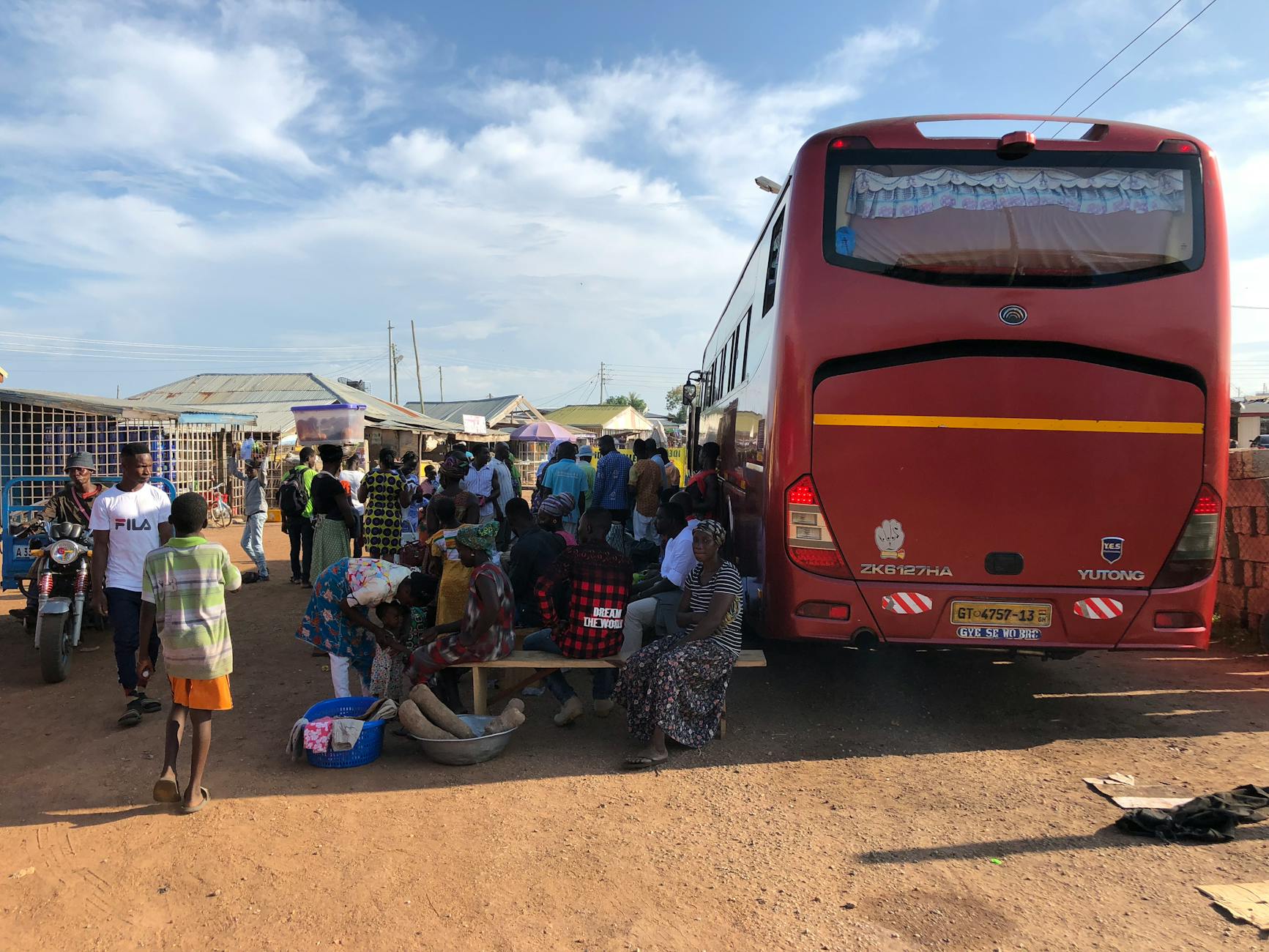
Photo by khanhhoangminh on Pexels
The Dakar garage at Pompiers fills up before dawn. Apprentices in football shirts haul bags onto rooftops, arguing cheerfully about weight. The 7 Plass sept-place — a battered Peugeot 504 estate that has been doing this run since roughly the 1980s — won’t leave until every seat is sold, and you are wedged between a woman with a live chicken under her seat and a man who immediately falls asleep on your shoulder. By the time you clear the city and hit the flat, red-dirt road toward the Gambia, the sun is already punishing. This is the entry point to one of West Africa’s great overland journeys.
The route from Dakar to Accra — roughly 2,400 kilometres through Senegal, the Gambia (optional but worthwhile), Guinea-Bissau, Guinea, Côte d’Ivoire, and Ghana — has no single bus that does it end to end. You build it yourself, leg by leg, crossing borders on foot, finding the next vehicle in the next town. That’s not a flaw. It’s what makes it one of the most textured road trips on the continent.
This guide covers the practical architecture of the journey: which crossings to use, which towns to actually stop in, what transport goes where, and what the whole thing realistically costs and takes.
Before you leave Dakar: documents and timing
Get your paperwork sorted before departure — sorting visas en route costs time and often money. Citizens of ECOWAS member states move freely across most of these borders. Everyone else needs to plan carefully.
Visas to arrange in Dakar:
– Guinea-Bissau: e-Visa available online (around USD 60), but confirm current status before travel — the system has been intermittently functional.
– Guinea (Conakry): visa required for most nationalities; obtain at the Guinean embassy in Dakar on Rue 7 in the Almadies area. Budget two to three working days.
– Côte d’Ivoire: e-Visa available at snedai.com for most nationalities, around USD 73, processed within 72 hours.
– Ghana: visa-on-arrival is available for many nationalities at land borders, but pre-applying through the Ghana Immigration Service online portal is faster and avoids delays at Elubo.
The best travel season is November through February — dry, cooler, and roads are passable. Avoid May through September if you’re transiting Guinea, where the laterite roads between Labé and the Guinean coast become genuinely difficult in the rains.
Dakar to the Gambia: the sept-place system
The backbone of Senegalese ground transport is the sept-place — seven-seat shared taxis that run fixed inter-city routes. They leave from specific gares routières: for southbound travel, you want Gare de Pompiers (also called Gare de Dakar) for long-distance routes, or Gare de Baux Maraîchers depending on the destination.
Dakar to Ziguinchor (the jumping-off point for southern Senegal and Guinea-Bissau) takes 6–8 hours and costs around 6,000–7,000 CFA (roughly USD 10). Alternatively, the Dakar-Ziguinchor ferry — operated by Cosama — crosses overnight through the Casamance and is one of the genuinely pleasant legs of the journey. It departs from the Port of Dakar, costs around 15,000 CFA in second class, and takes 14–18 hours. Book a day or two ahead in high season.
If you want to route through the Gambia, take a sept-place from Dakar to Karang (the Senegal-side border town), cross on foot to Farafenni on the Gambian side, and then take a bush taxi to Banjul or transit directly south to Soma if you’re skipping the capital. The Gambia is tiny — you can cross the whole country in a day — but Banjul’s fish market at Albert Market and the kora music coming from the guesthouses around Senegambia in Kololi are worth at least one night.
Guinea-Bissau: Ziguinchor to Bissau
From Ziguinchor, shared taxis run to the São Domingos border crossing into Guinea-Bissau. This is a straightforward land crossing — relatively relaxed, though expect some bureaucratic theatre about stamp placement. From the Guinean-Bissau side at Joao Landim, onward vehicles go to Bissau city, about 3–4 hours further.
Bissau itself is worth a pause. The Mercado de Bandim in the centre of the city is enormous, chaotic, and sells everything from kola nuts to phone parts. The Portuguese-era Fortaleza d’Amura and the crumbling colonial quarter near the port give the city an elegiac quality — faded buildings, bougainvillea growing through broken windows, the smell of the estuary. The Archipelago dos Bijagós, 70 kilometres offshore, is one of West Africa’s least-visited and most ecologically significant places — a UNESCO Biosphere Reserve of 88 islands where hippos live in saltwater lagoons. Getting there requires a pirogue from Bubaque island, which itself takes a ferry from Bissau port. Add three to four days if you’re going.
Guinea: the hardest leg
This is the section that filters out the half-committed. Getting through Guinea — from Kandika on the Guinea-Bissau border to Conakry, or across to Nzérékoré for the Côte d’Ivoire crossing — involves some of West Africa’s worst roads and most assertive border officials.
The crossing from Bissau side at Kandika/Buruntuma into Guinea at Koubia is doable in dry season. From Koubia, bush taxis run to Labé (4–6 hours), which is a useful overnight stop in the Fouta Djallon highlands. Labé has decent guesthouses around the central market for 80,000–120,000 Guinean francs a night (roughly USD 9–14). The highlands here are genuinely beautiful — cool air, waterfalls, Fulani cattle herders — and the Chutes de la Kinkon waterfall is a short moto-taxi ride from town.
From Labé, you can continue to Conakry (another 6–7 hours, partly on improved tarmac) or head southeast toward Kankan and then Nzérékoré for the Côte d’Ivoire border at Lola/Danané. The southeastern route is longer but positions you better for entering Côte d’Ivoire at Danané, from which transport runs to Man and onward to Abidjan.
A note on Conakry: if you go through the capital, the traffic is legendary. The city sits on a peninsula and at rush hour, moving 10 kilometres can take two hours. Taxis are the standard mode; negotiate before you get in.
Côte d’Ivoire: Abidjan and the road east
Entering Côte d’Ivoire at Danané from Guinea, shared taxis run to Man (1–2 hours), from which you can get connections to Yamoussoukro or go directly toward Abidjan — around 8–10 hours total from Man.
Abidjan is the commercial capital, not the political one (that’s Yamoussoukro), and it functions accordingly: high-energy, expensive by regional standards, and genuinely metropolitan. Plateau is the business district; Cocody has the restaurants and guesthouses favoured by longer-stay visitors; Treichville is the nightlife quarter and home to the Marché de Treichville, one of the best fabric markets in the region. For food, attiéké — a fermented cassava couscous — served with grilled fish and raw onion salad is the street staple, and you’ll find it at roadside spots throughout the city for 500–1,000 CFA.
The most reliable bus company for the Abidjan–Accra leg is CTM or TSR; both run air-conditioned coaches from Abidjan’s Gare de Bassam area to the border at Noé/Elubo, from where Ghanaian vehicles continue to Accra. The full Abidjan–Accra crossing takes 8–10 hours on a good day. Budget for possible waits at the border — Elubo is one of the busier crossings on the coast and can back up.
The route at a glance
| Leg | Route | Transport | Approx. time | Approx. cost (USD) |
|---|---|---|---|---|
| Dakar → Ziguinchor | Sept-place or overnight ferry | Shared taxi / ferry | 7–18 hrs | $10–22 |
| Ziguinchor → Bissau | Shared taxi via São Domingos border | Bush taxi | 4–5 hrs | $8–12 |
| Bissau → Labé (Guinea) | Via Buruntuma/Koubia crossing | Bush taxi | 8–12 hrs | $12–18 |
| Labé → Man (via Nzérékoré) | Southeastern Guinea route | Bush taxi | 12–16 hrs | $15–22 |
| Man → Abidjan | Bush taxi / occasional coach | Shared taxi or bus | 8–10 hrs | $12–18 |
| Abidjan → Accra | Coach via Noé/Elubo border | CTM or TSR bus | 8–10 hrs | $18–25 |
Costs reflect 2025–2026 estimates for budget travel; prices fluctuate with fuel costs and season.
Arriving in Accra: where to land
Crossing into Ghana at Elubo and catching a STC or VIP bus to Accra takes another 5–6 hours. You arrive at Accra Central or the Neoplan Station near Kwame Nkrumah Circle. From there, trotros (minibus shared taxis) go everywhere; Ubers and Bolt are also reliable within the city.
Jamestown, the old colonial fishing neighbourhood at the southern edge of the city, is one of the most visually striking parts of Accra — a lighthouse, brightly painted canoes, net-menders on the beach at dawn. Osu has the restaurants and the Oxford Street stretch (actually called Cantonments Road) for street food at night. For a proper introduction to Ghanaian cooking, find waakye — rice and beans cooked with sorghum leaves, served with stew, fried plantain, spaghetti, and boiled egg — at any of the waakye sellers that set up in Osu and Adabraka in the mornings. It disappears by 10am.
BBC Travel’s guide to Accra’s food scene offers useful context on where the city’s restaurant culture has gone in recent years.
For the bigger picture of overlanding in the region, Lonely Planet’s West Africa overview covers country-specific entry requirements and transport options that shift frequently.
The Bottom Line
- This journey takes 10–18 days minimum to do well — rushing it means missing the reason to go. Build in a buffer for border delays, missed connections, and the places that pull you in.
- The Guinea leg is genuinely difficult — roads, bureaucracy, and logistics all require patience. Go in dry season (November–March) and carry USD cash alongside local currency; it smooths most problems.
- Visas should be sorted before you leave Dakar. Guinea and Côte d’Ivoire in particular are not easy to arrange on the fly, and mistakes cost days.
- Budget USD 400–600 for the full route in shared transport and budget guesthouses, excluding Bijagós island detours or any flights. Add 30–40% if you want private transport through Guinea.
- The Gambia and Guinea-Bissau are optional detours that most people skip — which is exactly why they’re worth considering. The islands, the music, the Portuguese ruins: this is where the journey slows down into something you’ll actually remember.