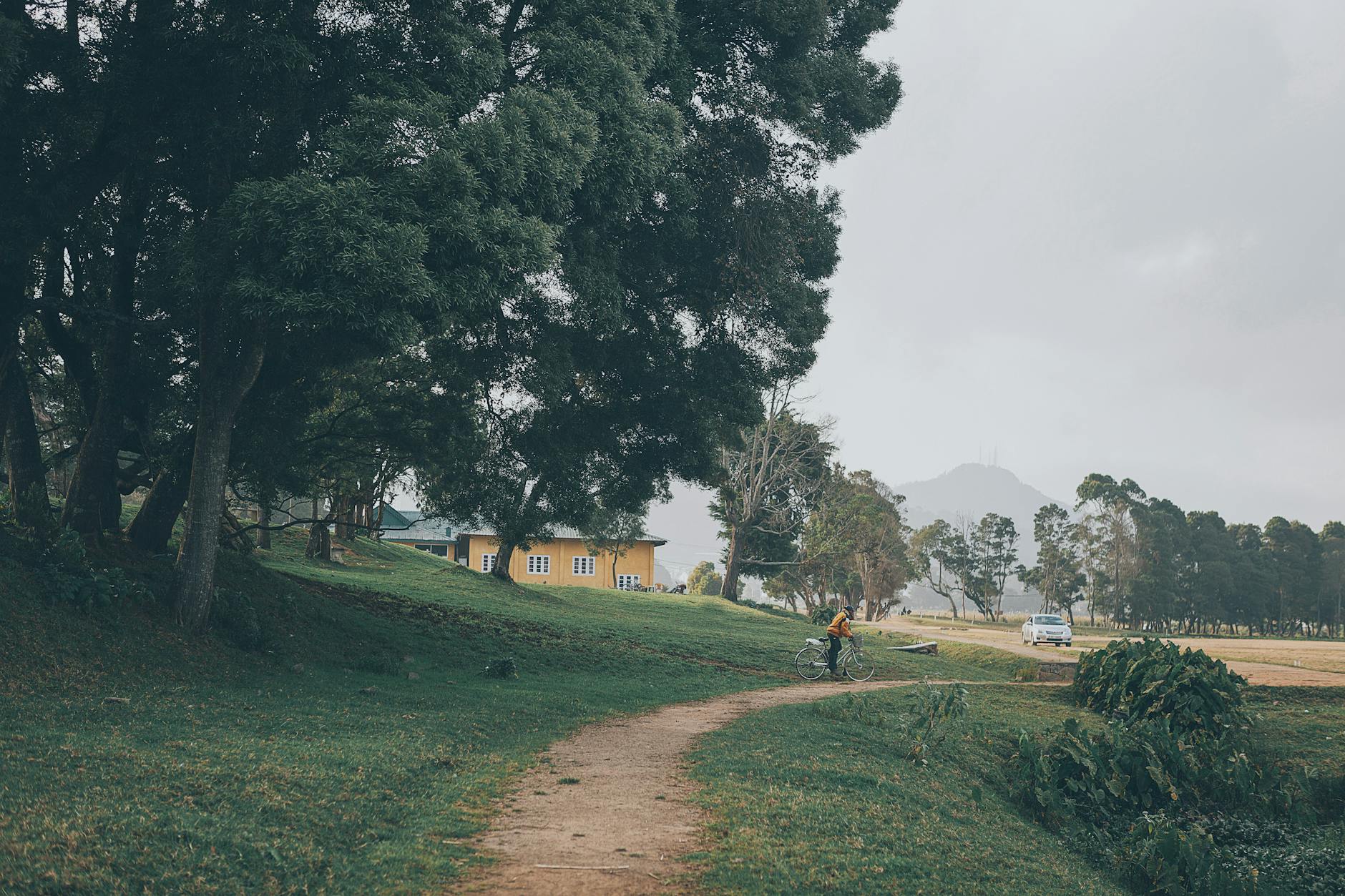
Photo by Elina Sazonova on Pexels
Cycling through Sri Lanka: what to expect
The road out of Kandy drops fast. One moment you’re navigating the city’s chaotic ring road — tuk-tuks threading between buses, horns filling the humid air — and then a left turn takes you south toward Kadugannawa, and the gradient kicks in, and the noise falls away. Roadside stalls selling king coconuts flash past. A man on a bicycle loaded with bananas overtakes you on the flat and disappears. The air smells of rain and diesel and, faintly, of frangipani from a temple entrance you almost miss.
Sri Lanka is a small island — roughly 65,000 square kilometres — but it packs in an almost unreasonable range of terrain: coastal plains, ancient cities on flat scrubland, steep tea-country ridges, and dry-zone forests where the road stretches dead straight for twenty kilometres. Cycling through it connects all of these things in a way that a train window or a tuk-tuk doesn’t. You feel the temperature change as you climb. You stop at the toddy-tapper’s shack because there’s nowhere else to stop.
This is not a country with a developed cycling infrastructure. There are no dedicated lanes, few detailed bike maps, and the word “shoulder” on a Sri Lankan A-road is optimistic. But the rewards — the access, the pace, the conversations that happen when you pull over and someone pulls over with you — make it worth understanding exactly what you’re getting into.
The routes that actually work
Sri Lanka’s cycling routes broadly divide into three categories: the Cultural Triangle in the north-central dry zone, the hill country in the centre, and the coastal circuits in the south and west.
The Cultural Triangle (Dambulla–Sigiriya–Polonnaruwa loop, roughly 120 km return) is the most forgiving for cycling. The terrain is flat to gently rolling, the roads are wide, and the distances between sites are short enough that you can visit Sigiriya Rock in the morning and reach Polonnaruwa by late afternoon. The heat is serious — this is Sri Lanka’s driest, hottest zone — but manageable if you start riding before 7am and rest between noon and 3pm. Dambulla makes the most logical base.
The hill country is the opposite in almost every way: relentless climbing, cooler temperatures, mist that can turn a mountain road into a visibility problem, and some of the most dramatic scenery on the island. The classic route is Kandy to Ella via Nuwara Eliya — approximately 180 km, most cyclists spread over four to six days. You gain over 1,500 metres between Kandy and the summit near Nuwara Eliya, then lose it again on the way down to Ella. The descent from Haputale toward Wellawaya is one of those long, sweeping downhills that justifies the climb.
The south coast between Mirissa and Tangalle (around 50 km) is popular for good reason — flat, scenic, manageable in a day — but the coastal A2 carries heavy traffic, especially on weekends. The more interesting option is to take the inland B-roads through Weligama and Dikwella, which add distance but subtract most of the trucks.
Road conditions: the honest version
Sri Lanka’s A-roads — the main national highways — are paved and generally in reasonable condition, but they are shared with buses that do not give way, trucks that hug the centre line, and tuk-tuks that stop without warning. Riding defensively is not optional; it is the job.
The B-roads and C-roads — the secondary network threading between villages — are where cycling Sri Lanka becomes a genuinely different experience. They’re quieter, slower, and often in rougher condition: potholes, loose gravel on corners, the occasional stretch where the tarmac has simply surrendered. A bike with slightly wider tyres (28–32mm minimum) handles these roads better than a racing setup.
Surfaces in the hill country can deteriorate rapidly after rain, and rain in the hill country can arrive fast and without obvious warning. Carry a light rain layer regardless of the forecast, and be aware that wet mountain descents on worn brake pads are a serious proposition.
The World Bank’s Sri Lanka transport data notes that significant road improvement projects have been ongoing since the early 2020s, which means conditions vary sharply by route — some sections that were rough two years ago are now surfaced, others have been dug up for drainage work. Ask locally before committing to a specific road.
Getting a bike: hire, bring your own, or buy local
Unless you’re a serious cyclist who won’t ride anything else, hiring in Sri Lanka is practical and cheap. Colombo, Kandy, and Ella all have rental shops with a reasonable range:
- Basic mountain bikes: LKR 800–1,500 per day (roughly USD 2.50–5)
- Better-quality hybrid bikes: LKR 2,000–3,500 per day
- Quality road bikes: rare outside Colombo; expect LKR 4,000–6,000 if you find one
The catch is that “quality” is relative. Inspect any hire bike carefully before committing: check the brakes on a hill, not a flat; spin the wheels; test the gears through their full range. Saddle height adjustments are often resisted by staff but are worth insisting on.
Bringing your own bike by air is straightforward — Sri Lanka has no unusual regulations — though most airlines charge a bike fee of USD 50–150 depending on the carrier. Packing it into a bag or box is the norm; hard cases are awkward on Sri Lankan public transport if you need to combine cycling with trains.
Buying a secondhand bike in Colombo (check around Pettah market) and selling it before you leave is a legitimate option for longer trips, though the quality of what’s available is unpredictable.
What to eat and where to stop
One of the genuine pleasures of cycling Sri Lanka at road speed rather than tour-bus speed is access to the roadside economy that most visitors never stop at.
Kade — small village shops — are scattered every few kilometres on most routes and reliably stock water, biscuits, and short eats: the pastry-wrapped fish cutlets and lentil rolls that Sri Lankans eat constantly and that happen to be excellent cycling fuel. They cost almost nothing (LKR 30–80 each) and are freshest between about 7am and noon.
Rice and curry at a local restaurant (not the tourist-facing versions) typically runs LKR 300–600 for a full spread: rice, three or four curries, sambol, papadum. In the hill country, look for small canteens near bus stands in towns like Haputale, Bandarawela, and Welimada — these are working-people’s restaurants and the food is better and cheaper than anything aimed at visitors.
In the dry zone, tender coconuts (pol) are sold from roadside carts for LKR 60–100 and are the single most effective hydration tool on a hot day.
Seasonal planning: when to go and what it changes
Sri Lanka has two monsoon seasons, and they affect different parts of the island at different times — which means there is no universally bad time to cycle here, but you need to know which part of the island you’re riding in.
| Region | Best months | Avoid | Why |
|---|---|---|---|
| Hill country | Jan–Mar, Jul–Sep | Apr–Jun, Oct–Nov | Southwest monsoon soaks the hills May–Sep; northeast monsoon less severe |
| South & west coast | Nov–Mar | May–Sep | Southwest monsoon brings heavy rain to the coast |
| Cultural Triangle (north-central) | Oct–Mar | Apr–Jun | Heat peaks Apr–Jun; some rain Oct–Nov but manageable |
| East coast (Arugam Bay area) | May–Sep | Nov–Jan | Northeast monsoon hits the east harder in winter months |
The hill country in January and February — clear skies, temperatures in the low 20s°C at altitude, dry roads — is the closest thing to ideal cycling conditions Sri Lanka offers. December is good but busier with visitors; March starts to warm up quickly in the lowlands.
Combining cycling with trains
Sri Lanka’s rail network and cycling work together better than you might expect, partly because the island is small and partly because the trains are genuinely scenic. The Kandy–Ella train — one of the most celebrated rail journeys in Asia according to Lonely Planet — passes through the same hill country you’d be cycling, which means you can ride in one direction and train back, or split a longer route across both modes.
Bikes are carried in the goods van on most routes for a small additional fee (LKR 200–500 depending on distance). Book at the station rather than online; the online system does not always accommodate bike reservations. Arrive at least 30 minutes before departure to load. On busy routes — particularly Kandy to Ella on weekends — the trains run crowded and bike loading can be chaotic; mid-week is easier.
Safety, traffic, and navigating cities
Colombo is difficult to cycle through and not worth attempting unless you’re specifically interested in the city. The traffic is dense and the road culture is aggressive. If you’re starting a hill-country route, take a train or bus to Kandy and begin there; Kandy’s ring road is no picnic but it’s navigable, and you’re out of the city quickly.
Navigation is simpler than it looks. Sri Lanka’s road network is numbered and signposted in Sinhala, Tamil, and English. Google Maps works well in most areas; download offline maps before remote sections of the hill country where data coverage is patchy.
Dogs are a genuine hazard on rural roads, particularly at dusk. They tend to lunge rather than chase — a sharp shout and a burst of speed usually resolves it. Cycling after dark is not recommended anywhere on the island; the combination of unlit roads, unlighted vehicles, and free-roaming animals makes it genuinely dangerous.
Helmets are not legally required but are sensible. Sri Lankan roads are not forgiving of falls.
Costs and budgeting realistically
A rough daily budget for a self-organised cycling trip, excluding bike hire:
- Guesthouse (basic, non-AC): LKR 3,000–6,000 (USD 9–18)
- Food (three meals, eating locally): LKR 1,200–2,500 (USD 3.50–7.50)
- Water and snacks on the road: LKR 500–800
- Minor repairs/tubes: allow LKR 500–1,000 per day as a buffer
Total per day, excluding bike hire: roughly USD 15–30. Hire a decent bike for USD 5–8 and you’re at USD 20–40 per day all-in — significantly less than comparable cycling in Southeast Asia’s more tourist-developed corners.
Entry to Cultural Triangle sites is the main cost spike: Sigiriya alone is USD 30 for foreign visitors. Budget for two or three major sites rather than trying to see everything.
The Bottom Line
- The hill country Kandy–Ella route is the most rewarding cycle in Sri Lanka, but it earns that reputation — the climbing is sustained and the roads are not always kind. Give it five days minimum, not three.
- Flat doesn’t mean easy in the dry zone. The Cultural Triangle is manageable terrain, but the heat between April and June is genuinely dangerous for endurance cycling. Start early, carry more water than you think you need, and treat midday as rest time.
- Hire bikes are affordable but require inspection. Don’t accept a bike with soft brakes on a hill-country route. Insist on a test ride before you commit.
- Train and bike combinations are practical and underused. The goods van takes bikes on most routes; mid-week travel is easier than weekends.
- The roads are shared, busy, and unforgiving. Cycling Sri Lanka rewards riders who are comfortable in traffic and honest with themselves about their risk threshold — it is not a country for nervous cyclists, but it is a genuinely extraordinary one for confident ones.