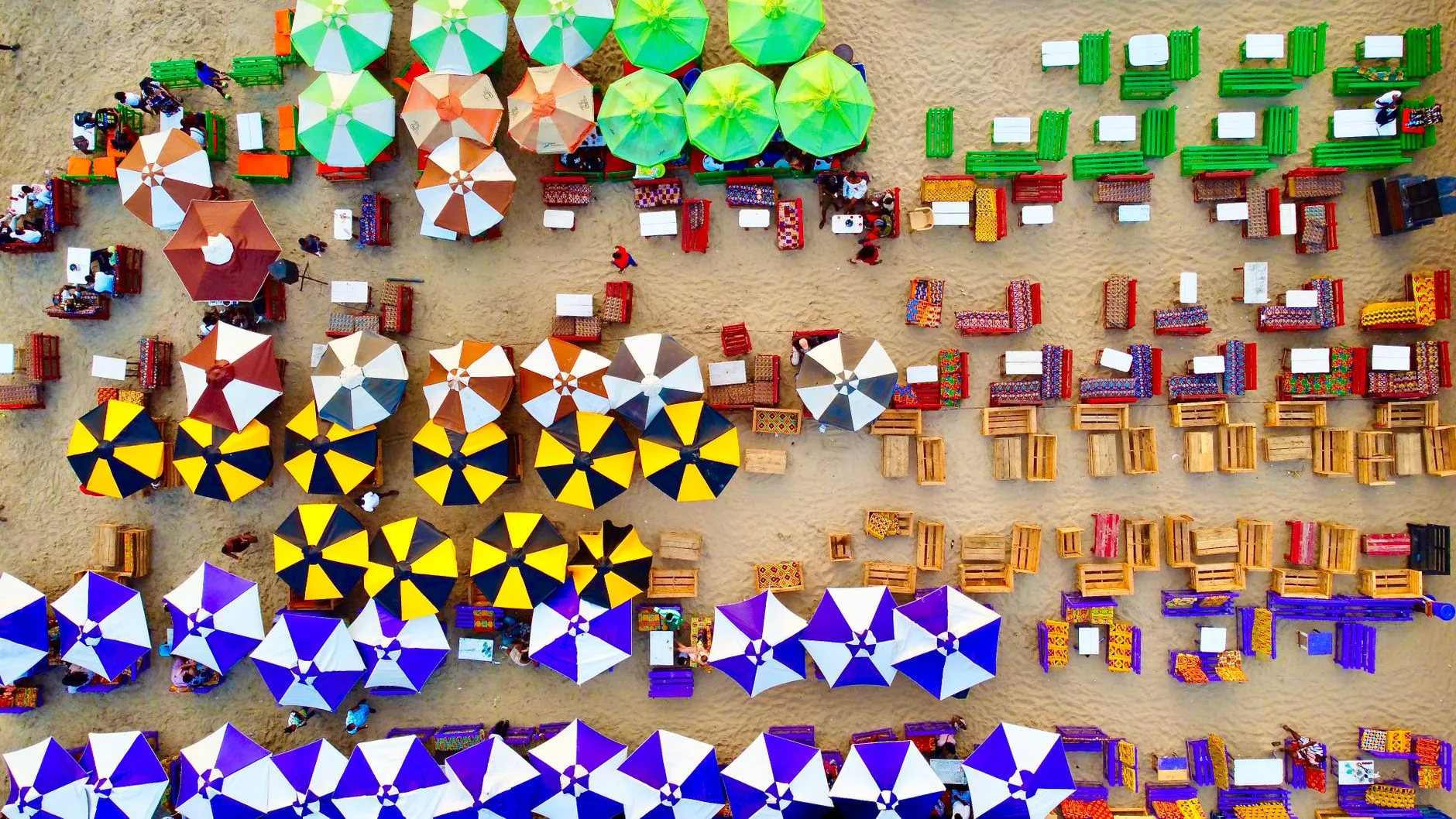
Photo by Perry Tintin on Pexels
By six in the morning, Jamestown in Accra already smells of woodsmoke and frying plantain. Fishermen haul in nets along the beach below the old lighthouse while women balance enamel bowls of kenkey on their heads, weaving between goats and the first tro-tros grinding into gear outside the Mallam Atta junction. A mate hangs half out of the sliding door, slapping the roof and shouting the destination — “Circle, Circle, Circle!” — before the van has even come to a full stop. This is the rhythm you’ll move through for most of a trip in Ghana: loud, unhurried in its own way, and far cheaper than almost anywhere else on the Atlantic coast of Africa.
Ghana has a reputation, partly deserved, as West Africa’s easier entry point — English-speaking, politically stable, with decent roads on the main corridors and a tourism infrastructure that, while modest, doesn’t require you to speak French or navigate a land border held together by hope. None of that means it’s effortless. Budget travel here means tro-tros with no air conditioning in 34°C heat, ATMs that occasionally eat your card, and a currency, the cedi, that has had a volatile decade. It also means some of the best-value beach guesthouses and street food on the continent.
Getting In: Visas, Flights, and Land Borders
Most nationalities now apply for a Ghana e-visa online before arrival rather than visa-on-arrival, which was phased out for most countries. Processing typically takes a few business days and costs in the range of $100–150 depending on nationality — not cheap, and worth factoring into your budget before you get excited about $2 bowls of waakye. A yellow fever vaccination certificate is mandatory for entry; border and airport officials do check this, and it’s not negotiable.
Kotoka International Airport in Accra is the main entry point, with direct flights from London, Amsterdam, and a growing number of US cities. If you’re already moving through West Africa, overland entry is possible via Aflao on the Togo border (a busy, slow crossing near Lomé), via Elubo from Côte d’Ivoire, or via Paga in the far north from Burkina Faso — though Burkina Faso’s security situation means most governments currently advise against travel there, so check your government’s travel advisory before planning that route.
Getting Around: Tro-Tros, STC Buses, and the Art of Patience
Tro-tros — shared minivans that leave only when full — are the backbone of budget travel in Ghana. A trip from Accra to Cape Coast costs roughly 40–60 cedis and takes about three hours, though “about” is doing a lot of work in that sentence. They’re cramped, they stop constantly, and the mate will often try to seat one more passenger than physically seems possible. They are also a genuine way to see the country at ground level, and at a fraction of the cost of a private taxi.
For longer hauls — Accra to Kumasi, or Accra to Tamale in the north — the STC (State Transport Corporation) buses are a worthwhile upgrade: fixed departure times, assigned seats, and air conditioning, for maybe double the tro-tro price. Book a day ahead at the terminal if you can; seats sell out on Fridays and around holidays. Within Accra itself, Uber and Bolt both operate reliably and are the easiest way to avoid the haggling that comes with unmetered taxis.
| Route | Transport | Cost (approx.) | Time |
|---|---|---|---|
| Accra to Cape Coast | Tro-tro | 40–60 GHS | 3 hours |
| Accra to Kumasi | STC bus | 100–150 GHS | 4.5–5 hours |
| Accra to Ho (Volta Region) | Tro-tro | 50–70 GHS | 3 hours |
| Tamale to Mole National Park | Shared taxi/tro-tro | 60–90 GHS | 3–4 hours |
| Within Accra | Uber/Bolt | 20–60 GHS | Varies |
Cape Coast and Elmina: History That Doesn’t Soften Itself
The forts strung along Ghana’s southern coast are among the most important and most difficult historical sites in Africa. Cape Coast Castle and nearby Elmina Castle — both part of a UNESCO-recognised group of forts and castles along this coastline — were central to the transatlantic slave trade, and the tours through their dungeons are deliberately unsentimental. Entry runs around $15–20, with guided tours included, and you should budget a full morning for either one rather than rushing through on a day trip.
Cape Coast town itself is worth lingering in beyond the castle. The fishing harbour below Elmina Castle is one of the most photographed, and least staged, scenes in the country — wooden canoes painted in fading blues and yellows, nets drying on racks, the whole economy of a town built around the catch. A short tro-tro ride inland brings you to Kakum National Park, where a series of swaying rope bridges strung between emergent rainforest trees — the canopy walkway — gets you up into the forest ceiling at around 30–40 metres, well before the midday heat and crowds arrive. Go for the 7am entry slot if you can manage it.
Busua, Akwidaa, and the Western Beaches
West of Takoradi, the coastline turns into a string of low-key beach towns that have quietly become the budget traveller’s answer to Ghana’s lack of an obvious beach resort scene. Busua has a stretch of sand good for swimming and a modest surf break, with guesthouses running $10–20 a night for a simple room. A few kilometres further along, Akwidaa is quieter still — fewer guesthouses, fewer generators running at night, more hammocks.
None of this is polished. Power cuts happen. The seafood, grilled red snapper or barracuda with a side of jollof, is caught that morning and cooked on charcoal braziers a few metres from where you’re eating it, which is either the most honest supply chain you’ll encounter or a mild health gamble depending on your constitution. Most travellers find it’s worth it.
Kumasi and the Ashanti Heartland
Kumasi, Ghana’s second city and the historic seat of the Ashanti Kingdom, moves at a different pace than Accra — denser, more commercially intense, built around Kejetia Market, one of the largest markets in West Africa. It’s a genuinely overwhelming place: tens of thousands of stalls under corrugated roofing, selling everything from kente cloth to motorbike parts, with narrow aisles that flood with people by mid-morning. Go early, go with cash in small denominations, and don’t expect to see all of it in one visit.
The Manhyia Palace Museum, former residence of the Ashanti king, gives useful context for the kente weaving you’ll see for sale throughout the city, and a half-day trip to Bonwire village lets you watch the cloth being woven on traditional looms — a slower, more deliberate craft than the market stalls suggest.
Mole National Park and the North
Ghana’s north is a different country in feel — drier, flatter, more sparsely populated, and far less visited by budget travellers simply because it takes effort to reach. Mole National Park, accessible from Tamale, is the payoff: walking safaris (genuinely on foot, with an armed ranger) bring you close to elephants, warthogs, and antelope for a fraction of the cost of East African safari parks. Entry and guided walks together run around $30–40 for a half-day, and the Mole Motel, perched on an escarpment overlooking a waterhole, is worth the splurge for one night even on a tight budget, purely for the view of elephants bathing below at dusk. Readers drawn to this kind of low-cost, high-reward wildlife encounter will find useful comparisons in guides to the continent’s other protected parks.
Food: What to Actually Eat
Ghanaian street food is some of the best budget eating in West Africa, and most dishes cost between 10 and 30 cedis. Waakye — rice and beans cooked together with sorghum leaves that stain it a deep reddish-brown, served with gari, boiled egg, fried plantain, and a scoop of spicy shito pepper sauce — is a breakfast and lunch staple sold from roadside stands everywhere. Banku, a fermented corn and cassava dough, pairs with grilled tilapia and a fiery pepper sauce at places like the row of tilapia joints along the Accra–Tema stretch. Fufu, pounded cassava and plantain served in a light soup with goat or fish, is the dish most travellers either love immediately or need a second attempt to appreciate — the texture is closer to a dense dumpling than bread, and it’s eaten by hand, swallowed rather than chewed.
Red red — black-eyed peas stewed in palm oil with fried plantain — is widely available and vegetarian-friendly. Kelewele, spiced fried plantain cubes sold from evening street carts, is the closest thing to a national snack. Bottled water is the safer default everywhere; tap water is not recommended for travellers.
Money, Costs, and the Cedi Question
The Ghanaian cedi has had a rough run of inflation and depreciation over the past several years, which cuts both ways for budget travellers: costs in dollar terms can shift noticeably between the time you research a trip and the time you take it. Carry US dollars or euros in cash as backup, since ATMs (most reliably from GCB Bank, Ecobank, and Stanbic) occasionally run out of cash or reject foreign cards without warning. Mobile money, run through MTN and Vodafone, is used constantly by Ghanaians for everything from market purchases to tro-tro fares, though setting it up as a short-term visitor is more hassle than it’s worth for most trips.
A realistic daily budget for a backpacker staying in guesthouses, eating street food, and using tro-tros runs $25–40. Travellers wanting private rooms, the occasional STC bus upgrade, and a few guided excursions like Kakum or Mole should budget closer to $50–70 a day. This puts Ghana in similar territory to parts of Southeast Asia’s less-visited routes for cost, though the infrastructure is noticeably less built out for independent travellers.
Wli Falls and the Volta Region
East of Accra, the Volta Region offers a cooler, greener counterpoint to the coast. Wli Falls, near the town of Wli close to the Togo border, is Ghana’s tallest waterfall, reached via an easy 45-minute walk to the lower falls or a steeper two-hour hike to the upper falls, where fruit bats roost in the cliffside caves by the thousands. Entry costs around 20–30 cedis with a guide included, and the region’s guesthouses, mostly family-run and clustered around Hohoe and Ho, are some of the cheapest in the country. Combined with the Tafi Atome Monkey Sanctuary, where mona monkeys are genuinely habituated rather than performing for tourists, this is a quieter corner of a trip that otherwise moves fast.
The Bottom Line
Ghana rewards travellers who build in slack — tro-tros run on their own schedule, not yours, and trying to pack the coast, Kumasi, and the north into ten days will mean spending most of that time in transit. If time is tight, pick one region properly rather than skimming three.
Budget for the e-visa and yellow fever requirements before you budget for anything else; they’re fixed costs that catch first-timers out. Carry more cash than feels natural, since card infrastructure outside Accra and Kumasi is thin. The coast delivers history and beaches in equal measure, while the north, especially Mole, offers wildlife encounters at a fraction of East Africa’s prices for those willing to add two extra travel days. And eat from the street stalls without hesitation — waakye in the morning and kelewele at night are the cheapest, best meals you’ll have in the country, not a compromise on the “real” restaurant experience.
Keep reading: Explore more of Africa’s protected wilderness