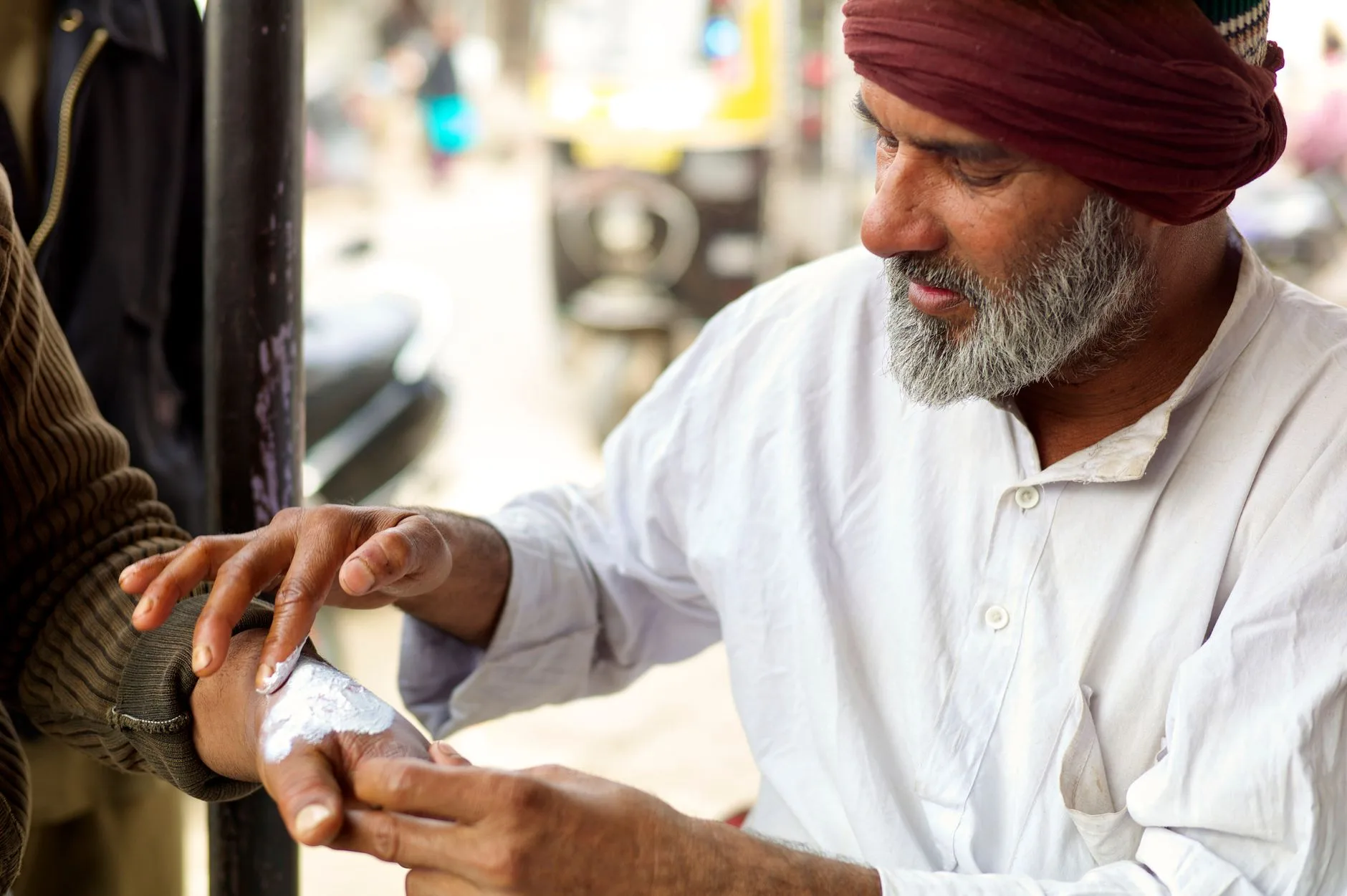
Photo by Ian Taylor on Pexels
By seven in the morning, the lane behind Hawa Mahal in Jaipur’s Pink City is already working: a man stacking marigold garlands outside a shuttered shrine, a cow investigating a pile of vegetable peelings with the unhurried confidence of an animal that knows it will not be moved, and a chai stall owner pouring tea the colour of strong tea should be, in small glass cups that burn your fingers until you learn to hold them by the rim. The sandstone of the building above turns from rose to gold as the sun clears the rooftops, and the crenellated screens of the Hawa Mahal’s 953 windows — built so royal women could watch the street below without being seen — catch the light one by one.
This is the Rajasthan most people picture, and it is real. What’s less obvious from guidebook covers is how much work goes into reaching that moment: navigating overnight trains booked three tiers of comfort apart, haggling over an auto-rickshaw fare that should cost 60 rupees but is quoted at 300, figuring out which Jodhpur guesthouse rooftop actually has a clear view of the Mehrangarh Fort and which just claims to. Independent travel in Rajasthan rewards patience and a reasonably thick skin, and it gives back more than a guided tour ever could, because you’re the one deciding to stay an extra night in Bundi instead of ticking off Udaipur on schedule.
When to Go and How to Get In
Rajasthan has one comfortable season and a few that test your resolve. October through March is when most people go, with December and January bringing cool mornings (sometimes down to 5–8°C in Jaisalmer and the desert) and warm, clear days — ideal for walking cities and riding camels without dehydrating. April to June turns brutal: Jaisalmer and Bikaner regularly hit 45°C, and even locals retreat indoors by late morning. The monsoon (July–September) is humid and unpredictable but genuinely beautiful in the Aravalli hills around Udaipur, with lakes full and green hillsides — if you don’t mind the occasional washed-out road.
Entry requires an e-visa for most nationalities, applied for online in advance through the official Indian government portal rather than any third-party agency charging a markup. Processing typically takes a few business days, so apply at least two to three weeks before departure. Most travellers fly into Delhi and either head straight to Jaipur (a five-to-six-hour train ride or a slightly faster but less scenic highway drive) or spend a day or two in Delhi first to adjust before Rajasthan’s intensity.
The Golden Triangle Trap — and a Better Route
Jaipur, Agra, Delhi — the “Golden Triangle” — is the default circuit for a reason: it’s efficient and the sights (Taj Mahal, Amber Fort, Red Fort) are legitimately extraordinary. But treating Rajasthan as a side trip from that triangle means missing the state almost entirely. Rajasthan rewards a west-and-south loop that takes in the desert, the lakes, and the hill forts, ideally over twelve days to three weeks.
A route that works well for first-timers: Jaipur → Pushkar → Jodhpur → Jaisalmer → Jodhpur (backtrack) → Udaipur, finishing with a flight out of Udaipur or a long train back to Delhi. This avoids constant backtracking except the one unavoidable stretch between Jodhpur and Jaisalmer, where the desert line only runs one way conveniently.
Pushkar deserves more time than it gets. Built around a sacred lake with 52 bathing ghats, it’s one of the few places in India where Brahma himself is said to have a temple, and the town empties of camel traders except during the November Pushkar Camel Fair, when it fills spectacularly and prices triple overnight.
Getting Around: Trains, Buses, and Hired Cars
Indian Railways remains the backbone of Rajasthan travel, and sleeper classes are worth understanding before you book. AC 3-tier (3A) is the realistic comfort/cost sweet spot for first-timers — bunks, curtains, air conditioning, and fares a fraction of equivalent European rail travel. Sleeper class (non-AC) is cheaper still and more atmospheric, but means open windows, desert dust, and no guaranteed quiet. Overnight trains between Jaipur and Jodhpur, or Jodhpur and Jaisalmer, are routine and generally reliable, though delays of an hour or two are normal rather than exceptional.
For shorter hops — Pushkar to Jodhpur, say — state transport buses are frequent and absurdly cheap, though the roads can be rough and the horn gets a workout. Private AC buses booked through local agents cost more but are considerably more comfortable for longer daytime stretches.
Hiring a car with a driver for a week or ten days is the most comfortable option and remains affordable by Western standards — typically a flat daily rate covering fuel and the driver’s lodging, often negotiated directly with a guesthouse owner who has a cousin with a Toyota Innova. This is worth it if you’re travelling with family, carrying a lot of luggage, or simply tired of station chaos. It does remove some of the texture of independent travel, though — the overheard conversations, the chai-stall waits, the small negotiations that are, honestly, part of the point.
| City | Best for | Ideal stay | Approx. daily budget (mid-range) | Getting there from Jaipur |
|---|---|---|---|---|
| Jaipur | Forts, markets, Hawa Mahal | 3 nights | ₹2,500–4,000 | Entry point |
| Pushkar | Lake ghats, temples, calm | 2 nights | ₹1,500–2,500 | 3–4 hrs by bus |
| Jodhpur | Mehrangarh Fort, blue old city | 2–3 nights | ₹2,000–3,500 | 5–6 hrs by train |
| Jaisalmer | Desert fort, camel safaris | 2–3 nights | ₹2,500–4,000 | 5 hrs by train from Jodhpur |
| Udaipur | Lakes, palaces, Aravalli hills | 3 nights | ₹2,500–4,500 | 7–9 hrs by train/road from Jaisalmer |
Where to Stay: Havelis Over Hotels
Rajasthan’s great accommodation trick is that its mid-range options are often more interesting than its expensive ones. Converted havelis — old merchant mansions with carved stone facades, interior courtyards, and narrow stone staircases — are common in Jodhpur’s old city and Jaisalmer’s fort area, often family-run, with rooftop restaurants that serve breakfast with a direct view of the fort walls. Prices for a clean double room with attached bathroom in these haveli guesthouses generally run modest by international standards, especially outside peak December–January weeks.
One honest caveat: staying inside Jaisalmer Fort itself, while atmospheric, has drawn criticism for straining the fort’s ancient drainage system, which wasn’t built for modern plumbing. Many conscientious guesthouses now operate just outside the fort walls instead, a five-minute walk from the same views without the structural impact — worth asking about when you book.
What to Eat: Beyond the Thali
Rajasthani food evolved in a dry, water-scarce region, which explains its reliance on lentils, millet, and buttermilk rather than fresh vegetables. Dal baati churma — hard wheat rolls baked over coals, crumbled and drenched in ghee, served with spiced lentils and a sweet crumbled wheat-jaggery churma — is the dish to seek out in Jodhpur or Bikaner rather than a tourist-facing restaurant in Jaipur, where it’s often softened for foreign palates. Laal maas, a fiery red mutton curry built on Mathania chillies, is a Jodhpur specialty worth ordering with rice rather than naan to properly catch the sauce.
Street food is where Rajasthan gets playful: pyaaz kachori from Jaipur’s Rawat Misthan Bhandar near the railway station, a flaky pastry stuffed with spiced onion, best eaten standing up and slightly burnt-fingered; and ghewar, a disc-shaped, honeycombed sweet soaked in sugar syrup, sold everywhere during the Teej festival in August. For a controlled first experience with Indian street food, pair it with the general safety habits covered in guides on eating at local markets in Southeast Asia — the same core rules (busy stalls, high turnover, cooked hot in front of you) apply here as much as anywhere.
Money, Bargaining, and Being Approached Constantly
Cash still rules outside major hotels and restaurants, though UPI payment apps are increasingly common even at small stalls — a foreign card linked to a UPI-enabled app can simplify a lot of transactions, though setup from outside India has its own bureaucratic hurdles. ATMs are widespread in city centres but can run dry in smaller towns on weekends, so carry more cash than feels strictly necessary.
Bargaining is expected in markets — Jaipur’s Bapu Bazaar for textiles, Johari Bazaar for jewellery — and the honest approach is to research a rough fair price beforehand (ask your guesthouse owner, not the first shopkeeper) and negotiate firmly but without theatre. You will be quoted inflated prices constantly, for everything from rickshaws to camel rides, and this isn’t a special indignity reserved for tourists — it’s simply the opening move in a conversation. Walking away, literally, remains the single most effective negotiating tool anywhere in the world, and Rajasthan is no exception.
Being approached by touts, unofficial guides, and shop “commission” schemes (where a rickshaw driver takes you to a shop that pays him for the visit) is near-constant in Jaipur and Jodhpur’s old cities. A polite, firm “nahi, dhanyavaad” (no, thank you) and continued walking works better than engaging in debate. None of this should discourage solo travel here — Rajasthan is, by most measures, one of India’s more manageable regions for a first independent trip, and readers weighing it against other options might find it useful to compare against the broader landscape in guides to the best countries for solo travel.
A Two-Week First-Timer Itinerary
Days 1–3: Jaipur — Amber Fort at opening time (7am, before the tour buses), City Palace, Hawa Mahal, Bapu Bazaar. Day trip option to Abhaneri’s stepwell, Chand Baori, 95km east.
Days 4–5: Pushkar — lake ghats at sunrise, Brahma Temple, a day hike up Pap Mochani hill for the view over the whole valley.
Days 6–8: Jodhpur — Mehrangarh Fort (the audio guide here is genuinely excellent), the blue-washed lanes of the old city, Sardar Market’s spice stalls.
Days 9–11: Jaisalmer — the fort, Patwon ki Haveli, and an overnight camel safari into the Thar Desert from Sam or the quieter, less-visited Khuri dunes.
Days 12–14: Udaipur — Lake Pichola by boat at dusk, the City Palace complex, and a day trip up into the Aravalli hills to Kumbhalgarh Fort, whose perimeter wall is second in length only to the Great Wall of China.
The Bottom Line
- Build in slack days. Rajasthan’s trains run late, its heat drains energy faster than expected, and a schedule with zero buffer turns delays into crises rather than minor inconveniences.
- Go west before you go north-south. The Jaipur–Pushkar–Jodhpur–Jaisalmer–Udaipur loop shows you the state’s range — desert, lakes, forts, markets — far better than the Golden Triangle alone.
- Choose AC 3-tier trains for overnight journeys unless you’re specifically chasing the sleeper-class experience; the price difference is small and the sleep quality difference is not.
- Expect to be a target for sales pitches constantly, and don’t let that colour the whole trip — it’s background noise, not a reflection of how most interactions here actually go.
- Rajasthan is forgiving for a first solo trip through India, but it isn’t effortless — the reward is proportional to the patience you bring to the queues, the heat, and the haggling.
Keep reading: Riding the rails from north to south India