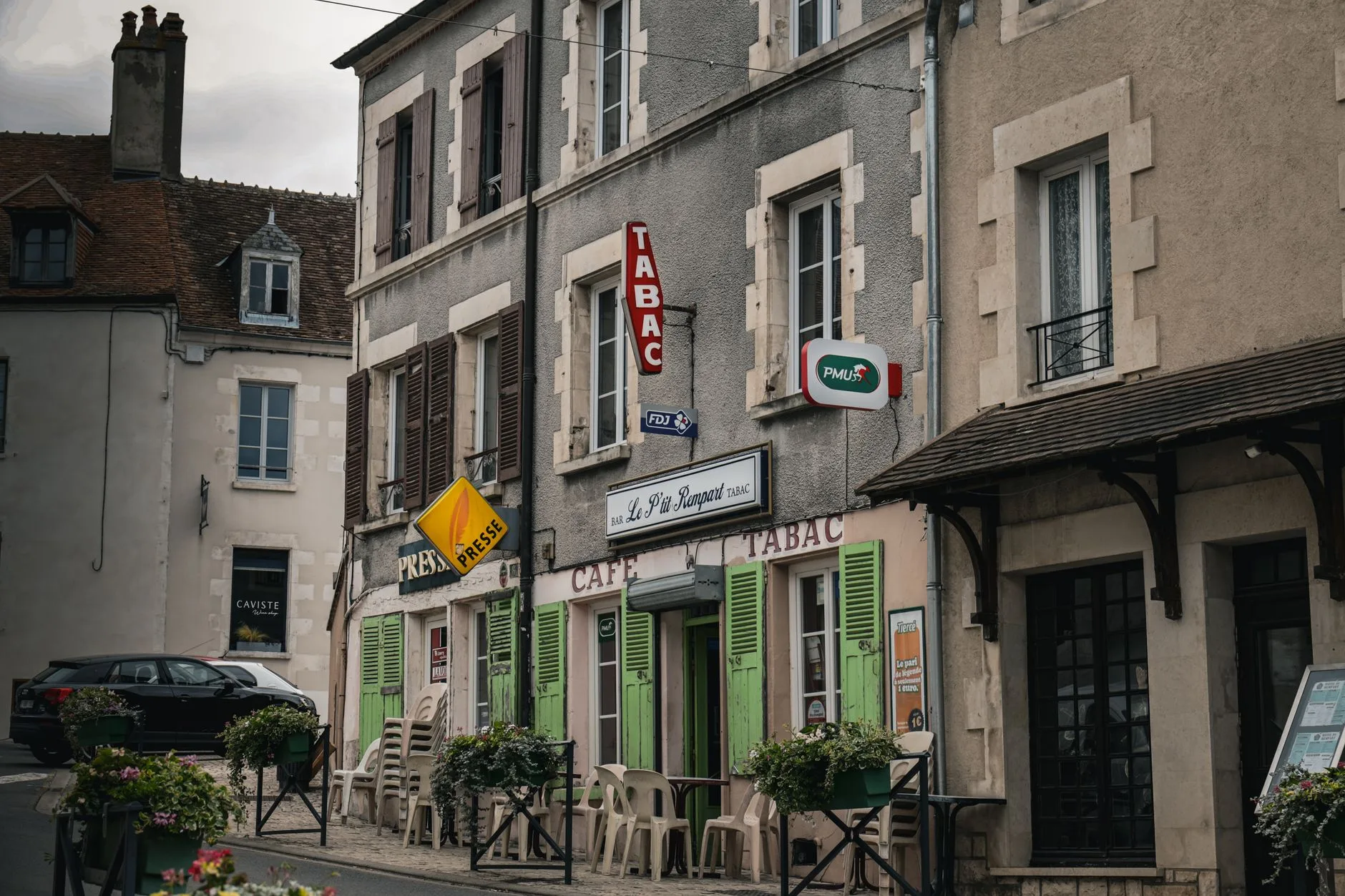
Photo by Carl-Emil Jørgensen on Pexels
The bells of Issigeac’s medieval church strike nine, and the Sunday market is already in full swing along the circular street that still follows the shape of the old bishop’s palace walls. A woman in rubber boots sells six varieties of goat cheese from the back of a Renault van, stacked on straw. Someone’s selling honey labelled only with the name of the hamlet it came from — no brand, no barcode. By ten, the café tables under the plane trees fill with people who clearly know each other, and the pace of the whole village seems to drop by half.
This is rural France at its most legible: a place where the week still has a shape, dictated by which village holds its market on which day, when the boulangerie closes for its weekly rest, and when the mairie’s noticeboard gets a new poster for the autumn vide-grenier. Slow travel here isn’t a philosophy you import — it’s a structure that already exists, and the traveller’s job is to fit into it rather than override it with an itinerary built for speed.
Picking a Region That Matches Your Pace
France’s countryside is not one thing. The Dordogne and the Lot move at the pace of stone — bastide towns, limestone cliffs, walnut orchards — and reward slow walking and long lunches. The Gers, deep in Gascony, is flatter, quieter, and built almost entirely around duck, armagnac, and bastide markets with almost no English spoken. The Ardèche gorges pull a younger, more outdoor-minded crowd with canoeing and wild swimming. The Aveyron, up on the Causses plateau, is the least visited of the lot and the most rewarding for anyone willing to drive or cycle a bit further.
| Region | Pace | Best base village | Best season | Getting around without a car |
|---|---|---|---|---|
| Dordogne/Lot | Gentle, scenic | Monflanquin or Issigeac | May–June, Sept | Hard; local buses are sparse, cycling works |
| Gers (Gascony) | Very slow, quiet | Lectoure or Condom | May, Sept–Oct | Difficult; renting a car still recommended |
| Ardèche | Active, outdoorsy | Vallon-Pont-d’Arc | June, Sept | Moderate; summer shuttle buses to gorges |
| Aveyron / Causses | Remote, dramatic | Conques or Rodez | May–June, Sept | Train to Rodez, then local buses or taxi |
| Burgundy’s Morvan | Wooded, rural | Saulieu or Vézelay | June, Sept–Oct | TER train to Avallon, limited onward buses |
None of these regions is set up for the car-free traveller the way, say, a European city is — this is the honest trade-off of rural France. If you want to go deep and avoid renting a car entirely, the Aveyron and Burgundy give you the best shot, because both have a workable train spine (the Paris–Toulouse line via Rodez, or the Paris–Lyon line via Avallon) that a regional bus or a week of an e-bike can extend.
Getting There Without Owning the Whole Trip to a Rental Car
The French regional train network, run by SNCF under the TER brand, reaches further into the countryside than most visitors assume, though the frequency thins out fast once you’re off the main lines. A TER from Bordeaux to Sarlat-la-Canéda, for instance, runs a handful of times a day and takes close to two hours for a journey that would be forty minutes on a motorway — slow by design, and genuinely scenic once it crosses the Dordogne river near Siorac.
The honest logistics: if your base village has a station, you can build a car-free month around it, supplementing the train with an e-bike (widely available for weekly rental in tourist offices across the Dordogne and Lot) and the occasional taxi for groceries. If your village doesn’t have a station — and many of the most beautiful ones don’t — you’re looking at a car, at least for the arrival and departure legs. Renting one for a single week to get settled and then returning it is a reasonable middle ground many slow travellers use.
Where to Actually Stay for a Month, Not a Weekend
Gîtes — self-catering rural cottages, often converted barns or outbuildings — are the backbone of long-stay rural French travel, and they behave very differently from short-term rentals. Many gîte owners offer a meaningful discount for stays of two weeks or more, and the best ones come with a vegetable garden you’re invited to use, a wood-burning stove, and an owner who lives next door and will, within a week, start leaving you extra tomatoes on the doorstep.
Look for gîtes registered with Gîtes de France, the long-running national network that grades properties on comfort (one to five “épis,” or wheat-sheaf symbols) and vets them in person — a useful filter in a market that’s otherwise unregulated. Chambres d’hôtes (bed and breakfasts) work well for shorter stints or for travellers who want the social contact of shared breakfast tables; gîtes work better for anyone planning to cook, which, in rural France, is most of the point.
The Market as the Week’s Organising Principle
Each village has its market day, and locals plan their week around it the way office workers plan around Monday. Lalbenque in the Lot has one of the most specific markets in France — a truffle market every Tuesday from December to March, conducted almost in code between growers and buyers, with prices never openly discussed and the whole affair over within forty minutes. Monflanquin’s Thursday market fills the central bastide square with producers from a thirty-kilometre radius. In the Gers, Mirande’s Monday market is where you’ll find armagnac producers selling directly from unlabelled bottles, happy to talk for twenty minutes about the barrel it came from.
The unwritten rule of these markets: arrive early for the good cheese and the best bread, but don’t expect to rush. Vendors chat with regulars at length, and barging that queue to save ten minutes marks you instantly as someone in a hurry — which, in rural France, is close to an insult. The slower you move through a market, the more of it opens up to you; ask a cheese seller which one is best “pour ce soir” (for tonight) and you’ll usually get an honest, specific answer rather than a sales pitch.
The Unwritten Rules of the Village
Rural France runs on rhythms that aren’t posted anywhere. Most shops, including the boulangerie, close for lunch between roughly noon and 2 or 2:30pm, and nearly everything — shops, markets, even some restaurants — shuts on Sunday afternoon and all day Monday, a hangover from the week when Sunday was reserved for family and Monday was the baker’s day off. Greeting shopkeepers with “Bonjour, madame” or “Bonjour, monsieur” before asking for anything isn’t a courtesy, it’s closer to a requirement; skip it and you’ll be met with a coolness you won’t understand the source of.
The mairie — the village town hall — is often the actual information centre in places too small for a tourist office, and the mayor’s secretary usually knows which gîte has a vacancy, which farmer sells eggs, and when the next fête votive (village festival) is happening. These festivals, usually in summer, are genuinely worth timing a stay around: trestle tables in the square, a brass band or a DJ depending on the generation running it, and a meal that costs a fraction of a restaurant and tastes considerably better.
Food Worth Building a Week Around
Rural France is organised by terroir in a way that rewards eating locally almost by default. In the southwest — Dordogne, Lot, Gers — the dish to plan a week around is confit de canard, duck leg cured in salt and slow-cooked in its own fat, usually served with sautéed potatoes cooked in the same fat (pommes de terre sarladaises). Cassoulet belongs further east, around Castelnaudary, a white bean stew with duck, sausage, and sometimes pork, baked slowly enough that good versions take genuine advance planning at a restaurant.
The Aveyron’s signature is aligot — mashed potato whipped with Tomme fraîche cheese until it forms a single elastic, stretching mass, traditionally served with sausage and usually prepared tableside in the more traditional buronniers (mountain dairy restaurants). In Burgundy, the obvious anchors are boeuf bourguignon and the village markets selling Époisses cheese so pungent it’s famously banned from some public transport. None of this is exotic or hard to find — it’s what’s already on the menu in small-town bistros that haven’t changed their offering in decades, which is exactly the point.
A Sample Slow Week in the Lot
A useful way to think about pacing a rural stay is to resist the urge to see everything and instead let one village become a hub. A week based in Puy-l’Évêque or Prayssac on the Lot river might look like this: Tuesday market in nearby Lalbenque or Prayssac itself, a slow afternoon walk along the GR36 long-distance trail that threads the Lot valley (worth comparing against the other options covered in our guide to France’s best hiking trails), a Wednesday spent doing nothing more ambitious than reading by the river, a Thursday trip by kayak downstream to Cahors, and a Friday evening at the village’s weekly outdoor film screening, a tradition in many Lot communes through summer. The point isn’t efficiency. It’s letting the week have slack in it, the same slack the village itself runs on.
This approach to travel — picking one place and staying long enough to understand its rhythm rather than its highlights — sits alongside the logic covered in our broader look at the best cities in Europe for slow travel, and anyone weighing rural France against other slow-travel destinations might also want to see how it compares with slow travel in rural Portugal, which runs on a similarly market-driven, lightly-connected rhythm but at a noticeably lower cost.
What It Actually Costs
A gîte for two in the Dordogne or Lot runs roughly €500–900 a week in shoulder season (May, June, September), dropping meaningfully for stays of a month. Groceries from a village market for two people run €40–60 a week if you’re cooking most meals, considerably less than eating out, where a simple lunch menu at a village bistro typically costs €15–20 including a glass of wine. The real cost variable is the car: renting one for the full stay can add €250–400 a week, which is why basing yourself somewhere with train access and leaning on an e-bike for local trips meaningfully changes the budget of a longer stay.
For anyone curious about how the terroir system behind these markets actually works, Slow Food International documents many of the small producer networks — cheese, charcuterie, wine — that define rural French eating, and the organisation’s presidia projects have helped keep several near-extinct regional products alive. The Causses and Cévennes landscape, which stretches across parts of the Aveyron and Lozère, is also recognised by UNESCO as a World Heritage cultural landscape, shaped by centuries of agro-pastoral farming still practiced today — worth knowing if that region is on your shortlist, since it adds context to what looks, at first glance, like simple grazing land.
The Bottom Line
- Pick one region and stay somewhere between two weeks and a month rather than touring several — rural France rewards depth over distance, and the market and shop rhythms only start to make sense after the first week.
- Accept the car trade-off honestly: a handful of regions (Aveyron, Burgundy) allow a largely car-free stay via train and e-bike, but most of the Dordogne, Lot, and Gers will require at least a short-term rental.
- Let the market day, not a checklist, set your week’s schedule — arriving at a village market without an agenda is usually more rewarding than arriving with one.
- Budget for the slow version of the trip: lower daily restaurant costs are offset by gîte rental and, in most regions, a car, so the savings come from staying longer rather than spending less per day.
- Learn the closing hours before you learn the sights — a Monday arrival in a village with no restaurant open and a boulangerie shut until Tuesday is the single most common disappointment first-time visitors report.
Keep reading: Best local food markets in Europe for travellers