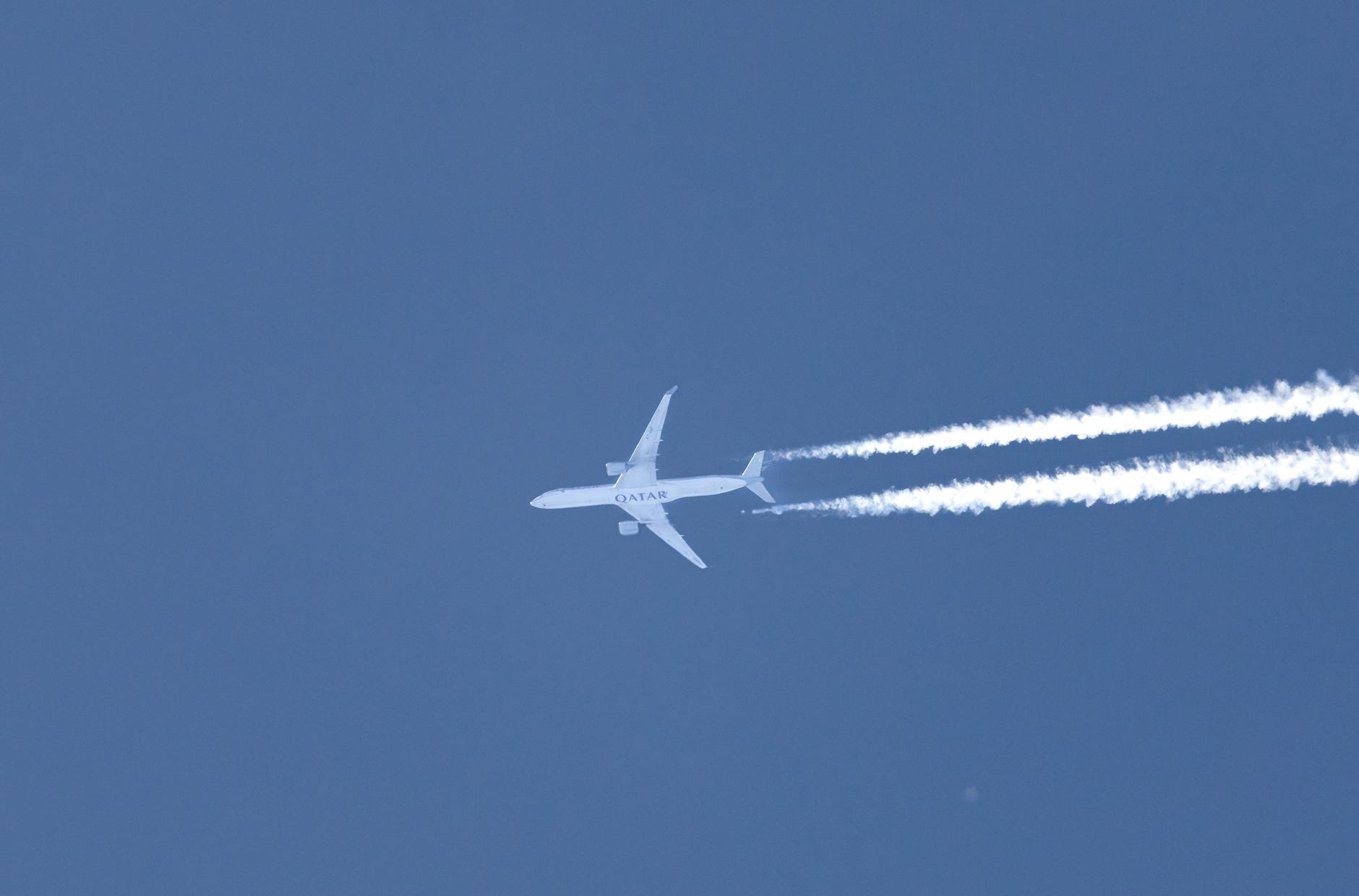
Photo by Andrew Cutajar on Pexels
How to reduce carbon footprint when flying in 2026
The departure board at Istanbul’s Sabiha Gökçen flickers at 5 a.m. Forty-three gates, all lit. A man beside you is flying to Dubai to catch a connection to Singapore. Behind him, a family is routing through Frankfurt to reach Nairobi. The air smells of strong tea and jet fuel. Nobody here is pretending this is zero-emission transport — but some of these journeys are burning roughly twice the carbon of others, for reasons the passengers may never have considered.
Flying is, by some distance, the most carbon-intensive thing most people do in a year. A return economy flight from London to New York emits approximately 1.7 tonnes of CO₂-equivalent per passenger — close to the annual per-capita carbon budget recommended to stay within 1.5°C of warming. This article won’t tell you not to fly. It will tell you how to fly with significantly less damage, using specific, verified choices rather than vague appeals to conscience.
The difference between a thoughtful and a careless itinerary can easily be 40–60% in emissions. That gap is worth understanding.
Choose your route architecture carefully
The biggest lever you have is the route itself, before you touch seat class or offsets. Direct flights almost always beat connections — not because stopovers add distance, but because takeoff and landing burn disproportionate fuel, and because the radiative forcing effect (the additional warming impact of contrails and NOx emissions at altitude) is concentrated in the climb phase.
London Heathrow to Tokyo Haneda direct on a JAL Boeing 787 Dreamliner produces roughly 1.05 tonnes CO₂e per economy passenger. The same trip routed through Dubai on an older Airbus A380 with a two-hour stopover runs closer to 1.45 tonnes. Same destination. Same traveller. Very different footprint.
Use ICAO’s carbon calculator before you book — it allows aircraft-type comparisons and accounts for radiative forcing at a multiplier of around 2x the direct CO₂. This is the most honest publicly available tool.
Pick the right aircraft and airline
Not all planes are equal in fuel burn. The Boeing 787 Dreamliner and Airbus A350 are genuinely 20–25% more fuel-efficient per seat than the aircraft they replaced. The A321neo, used widely on short-haul European routes, is significantly cleaner than an older A320.
When booking, Google Flights now displays CO₂ estimates per flight — imperfect but directionally useful. Filter by “lower emissions” and you’ll often find the aircraft type in the fine print. Avoid older Boeing 767s and A330-200s on long-haul where alternatives exist.
Airlines with the strongest verified efficiency records on long-haul routes as of 2026: Finnair (Helsinki hub, Nordic routes), SAS (strong load factor management), and Japan Airlines. Budget carriers like Ryanair and easyJet, counterintuitively, often have lower per-seat emissions on short-haul because they pack planes tightly and fly newer fleets.
Seat class is not a minor detail
Business class doesn’t just cost more money — it costs substantially more carbon. A business-class seat on a wide-body aircraft typically occupies 3–4x the floor space of an economy seat. Since emissions are allocated by space, not just weight, flying business London to Sydney generates roughly 5–6 tonnes CO₂e versus 1.3 tonnes in economy.
First class — where it still exists — can reach 9–10 tonnes per passenger for the same route.
This isn’t a moral judgment about comfort. It’s arithmetic. If you choose to fly business for a long trip, carbon offsetting becomes genuinely necessary rather than optional, and the offset needs to be high-quality (see below).
Understand what good offsetting actually means
Carbon offsets have a credibility problem, and rightly so. Investigations in 2023 found that over 90% of Verra-certified rainforest credits issued to major airlines didn’t represent real emissions reductions. Buying a £12 offset during checkout is almost certainly not doing what it claims.
What does work, at least partially: contributions to projects under the Gold Standard certification that involve direct carbon removal (biochar, enhanced weathering, direct air capture) rather than avoided-deforestation promises. These are more expensive — typically £50–120 per tonne of CO₂e genuinely removed — but the accounting is cleaner.
The Guardian’s 2023 investigation into offset credibility remains essential reading before you spend money on any offset scheme. Read it before you click “add offset” at checkout.
For a London–New York economy return at ~1.7 tonnes CO₂e, expect to pay £85–200 for a credible Gold Standard removal offset. Not trivial, but real.
Time your travel to reduce radiative forcing
This is underappreciated: contrails formed at night and in cold humid air at high altitude have a stronger short-term warming effect than daytime contrails. Research from Imperial College London suggests that a small fraction of flights — perhaps 2% — are responsible for around 80% of contrail warming, because of specific atmospheric conditions.
You cannot easily predict contrail formation from your laptop. But you can: choose daytime flights where possible (especially eastward transatlantic routes that depart morning UK time and arrive afternoon New York time); avoid polar routing in deep winter where contrail persistence is highest; and where airlines publish routing data (Finnair and KLM have trialled contrail-avoidance routing in 2025), prefer them.
The overland alternative: when it’s genuinely viable
Before treating every journey as a fixed flight, run the numbers on overnight trains. The Eurostar London–Paris emits approximately 6kg CO₂e versus 103kg for the equivalent flight including airport transfers. The gap is not trivial.
Routes where the train is competitive in time and dramatically better in carbon:
- London → Amsterdam: 4h Eurostar, ~6kg CO₂e vs ~95kg flying
- Paris → Barcelona: 6.5h TGV, ~12kg CO₂e vs ~120kg flying
- Tokyo → Osaka: 2h20 Shinkansen, negligible emissions vs 65kg flying
- Berlin → Warsaw: 6h IC/EC train, ~20kg CO₂e vs ~110kg flying
The ferry from Portsmouth to Santander (Brittany Ferries, 24 hours) is not fast, but at around 45kg CO₂e for a foot passenger — with a cabin, a meal, and the Bay of Biscay at dusk — it is an experience as much as a transit. For a driving holiday in northern Spain, it eliminates a flight and a car rental entirely.
Practical comparison: route choices and their carbon cost
| Route | Method | Duration | Approx. CO₂e (economy/2nd class) | Approx. Cost (2026) |
|---|---|---|---|---|