How to plan an independent trip to Bhutan
The smell hits you before the view does. Juniper smoke drifting from a whitewashed lhakhang, pine resin off the forest floor, and the cold, thin air of the Paro Valley at 2,200 metres. You’ve just landed at one of the world’s most technically demanding airports — pilots need special certification to fly into Paro — and already Bhutan is announcing itself on its own terms.
This country does not do casual. It has never done casual. And if you’re planning an independent trip, you need to understand that “independent” here has a specific, legally bounded meaning — one that is workable, genuinely rewarding, and not nearly as restrictive as the headlines suggest. But you have to get the paperwork right before you book a single flight.
Understand what “independent” actually means in Bhutan
Bhutan requires every international tourist (except citizens of India, Bangladesh, and Maldives) to pay the Sustainable Development Fee (SDF), currently set at USD 100 per person per night. This replaced the old minimum daily spend package in 2022. The SDF is a government levy, not a tour operator fee — you pay it directly to the Tourism Council of Bhutan when applying for your visa.
What changed is significant: you no longer need to book through a licensed Bhutanese tour operator or travel with a mandatory guide. You can, since late 2022, arrange your own accommodation, hire a driver independently, and move through the country at your own pace — provided your SDF is paid and your visa is in order. You still cannot trek independently in restricted areas without a licensed guide, but day walks and general travel around Thimphu, Paro, and Punakha are yours to organise.
Your visa is issued online through the Tourism Council of Bhutan’s official portal. Processing takes roughly 72 hours. You cannot get a visa on arrival. Print the approval letter — immigration at Paro Airport checks it physically.
Getting in: flights, land borders, and entry points
By air: Druk Air and Bhutan Airlines are the only carriers authorised to fly into Paro. You’ll connect through Delhi, Kolkata, Kathmandu, Bangkok, or Singapore. Delhi is the most frequent connection; flights take around 90 minutes. Fares are not cheap — expect USD 300–500 return from Delhi depending on season.
By land (Indian nationals and some others): The Phuentsholing crossing in southern Bhutan connects to Siliguri and the broader Darjeeling region. Indian nationals can cross here with just a national ID; other nationalities still need the standard visa and SDF paid in advance. From Phuentsholing, it’s a 4–5 hour drive up to Thimphu on a winding mountain road — uncomfortable but dramatic.
Where to go: the western circuit and beyond
Most first-time visitors move through the western valleys: Paro → Thimphu → Punakha. This corridor is the easiest, best-connected, and most serviced — which is not a reason to dismiss it. These are genuinely extraordinary places.
Paro is where you land and where you should spend at least two nights. The valley floor is wide and quiet, dotted with apple orchards and farmhouses. The National Museum of Bhutan (Ta Dzong, the old watchtower above Rinpung Dzong) holds a surprising collection of thangkas, medieval armour, and natural history. The hike to Taktsang Monastery — the Tiger’s Nest — takes 2–3 hours return from the lower car park. Leave by 7am to beat the midday heat and the tour groups.
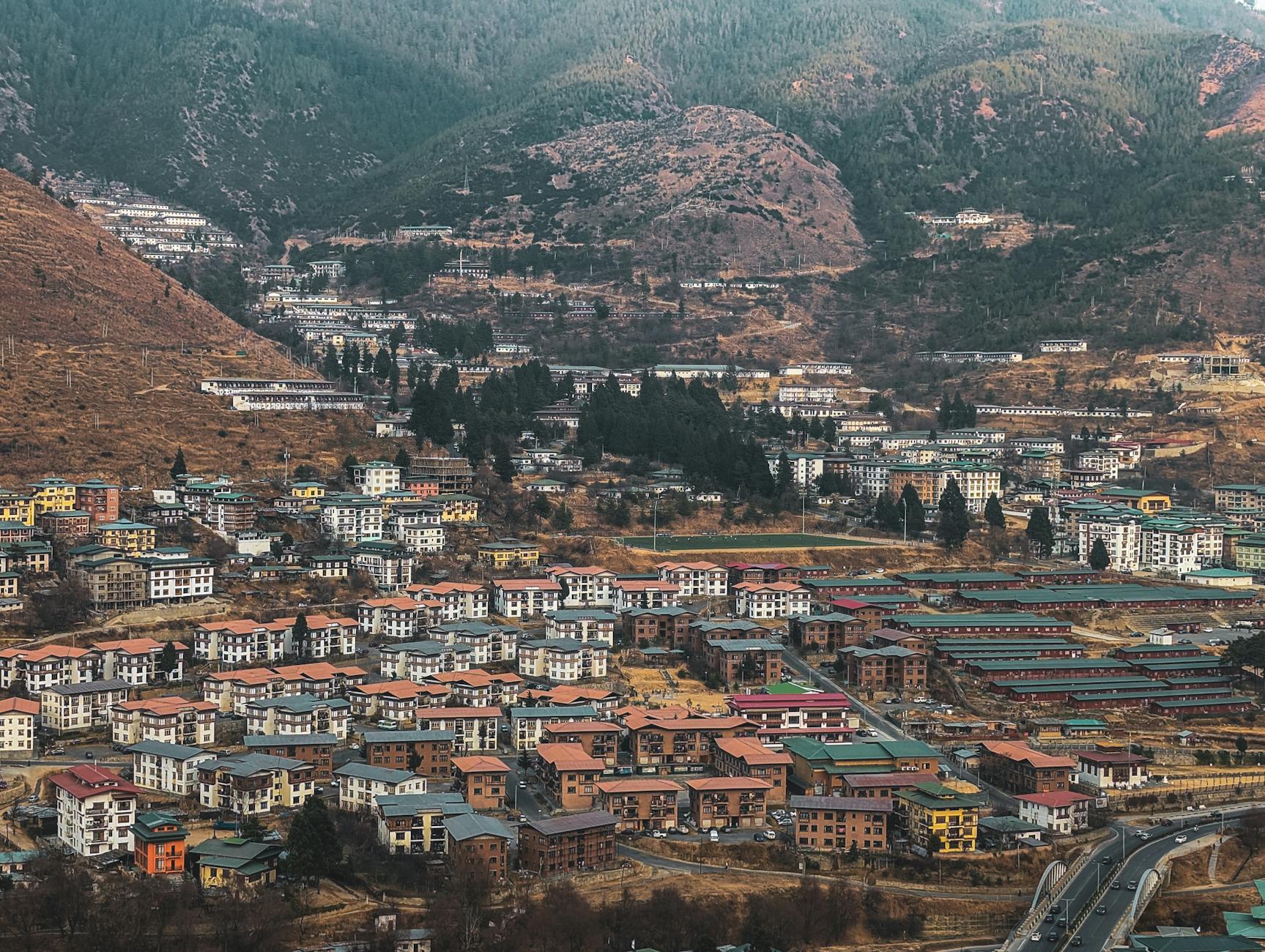
Thimphu, the capital, is 1.5 hours east of Paro. It’s a small, walkable city — no traffic lights, famously, though roundabouts now do the work instead. The Centenary Farmers’ Market near the river runs Thursday through Sunday; get there Saturday morning when the stalls from outlying districts are fullest. Look for datshi — the generic name for Bhutanese cheese dishes — and the dried yak meat that gets sliced to order. The National Memorial Chorten on the south side of town draws local worshippers circling clockwise all day; this is worth an hour of quiet observation.
Punakha, two hours northeast of Thimphu over the Dochula Pass (3,100m), sits at a warmer 1,200m. The Punakha Dzong, at the confluence of the Mo Chhu and Pho Chhu rivers, is arguably the most architecturally spectacular building in the country. Visit in morning light. The road up to Gangtey Valley continues further — two more hours — and drops you into a glacially wide valley where the black-necked cranes winter from November to February.
Food and where to eat it
Bhutanese food is built around ema datshi — dried red or green chillies cooked in a soft yak cheese sauce. It is eaten with red rice at almost every meal. It is genuinely spicy. Phaksha paa is a pork and chilli dry-fry worth seeking out. In Thimphu, Zombala 2 in the Norzin Lam area is the kind of unadorned local canteen where you’ll eat well for under USD 5. For something more considered, Bukhari at Uma by COMO in Paro is expensive (mains USD 25–35) but sources ingredients carefully and prepares Bhutanese dishes with more technique than you’ll find elsewhere.
Practical logistics table
| Item | Detail | Approximate cost (2026) |
|---|---|---|
| SDF levy | USD 100/night, paid at visa application | USD 100 per night |
| Visa fee | Single fee at application | USD 40 |
| Paro flight (Delhi return) | Druk Air / Bhutan Airlines | USD 300–500 |
| Guesthouse (mid-range) | Paro, Thimphu, Punakha | USD 50–120/night |
| Local taxi (Paro–Thimphu) | Shared or private | USD 20–40 private |
| Meal at local canteen | Thimphu / Paro town | USD 3–6 |
| Taktsang entry fee | Monument fee | USD 15 |
| Sim card | B-Mobile at Paro airport | USD 3–5 |
When to go
Spring (March–May) brings rhododendrons in flower along the higher trails and clear air before the monsoon. Autumn (September–November) is the other peak window — skies are crystalline after the rains and the Gangtey cranes arrive in November. Winter (December–February) is cold at altitude but uncrowded and serene in Punakha. Avoid June–August unless you’re prepared for rain and occasional road closures from landslides; the Dochula Pass can close for days.
[Lonely Planet’s Bhutan guide](https://www.lonelyplanet.com