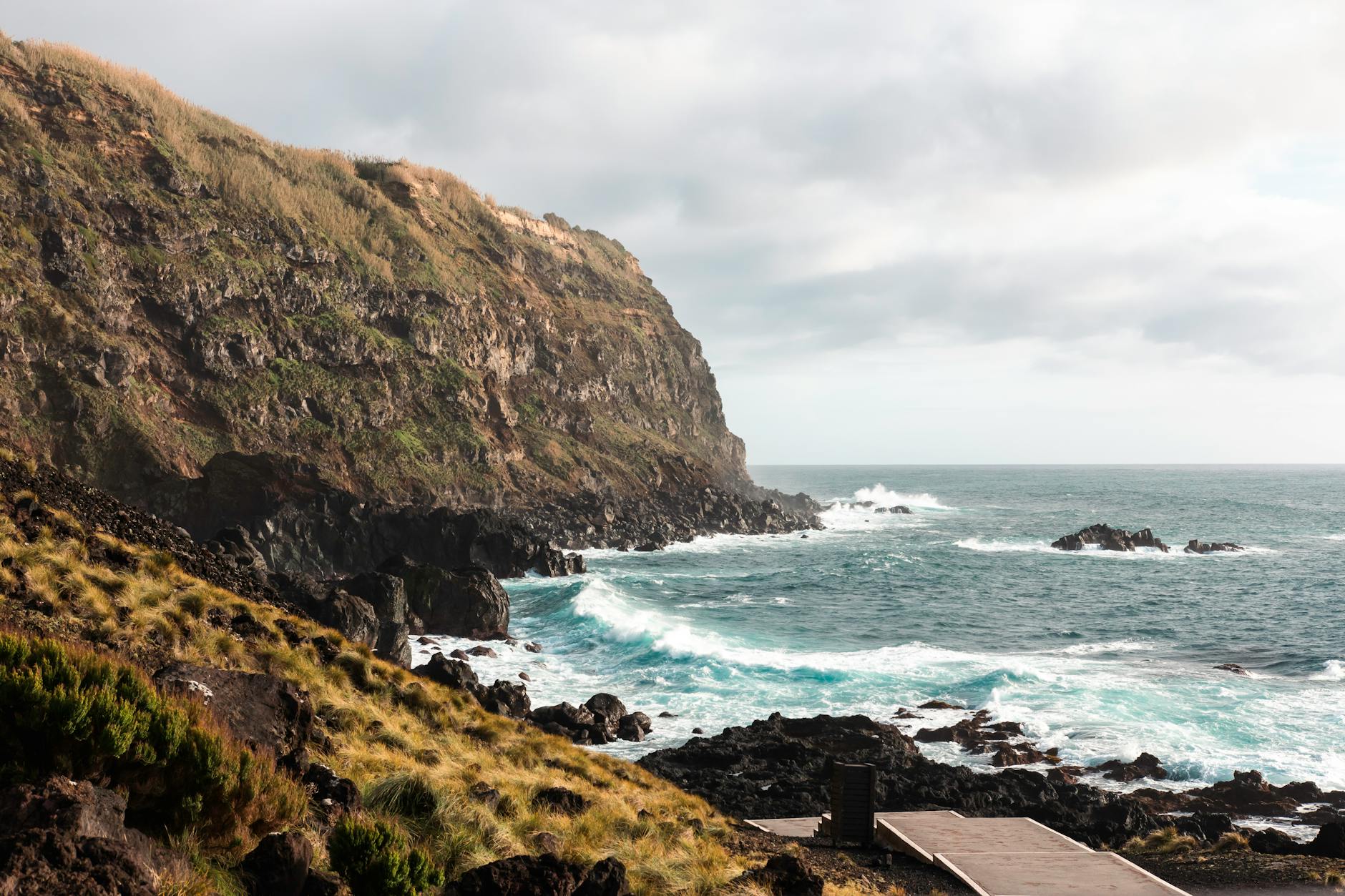
The smell hits before anything else: sulphur, wet fern, and something faintly sweet from the hydrangeas that line every road in July. You’re standing at the rim of Sete Cidades, looking down into a caldera that holds two lakes — one green, one blue, separated by a narrow bridge — and the silence is the kind that has texture. Wind. A distant cowbell. The creak of a wooden gate from the farm behind you.
São Miguel is the largest island in the Azores archipelago, a Portuguese autonomous region sitting roughly 1,500 kilometres west of Lisbon in the middle of the North Atlantic. It’s about 65 kilometres long and 15 wide, with a population of around 137,000. You can drive its perimeter in a long afternoon. You can also spend a month here and still find yourself surprised.
That’s the proposition this article is built around. Not a weekend whirlwind through crater lakes and geysers — which is how most people experience São Miguel — but a proper month-long stay on one island, with enough time to understand its weather, its rhythms, and the particular quality of its light on a Tuesday morning when the fog hasn’t lifted yet.
Why São Miguel, and why a full month
The Azores archipelago has nine islands. Most travellers fly into São Miguel, see Sete Cidades and the Furnas hot springs, eat a cozido das Furnas (more on that shortly), and leave. Some island-hop. Very few stay long enough to notice that the weather changes four times in a single morning, that the northeast coast feels like a different island from the south, or that the small city of Ponta Delgada has a genuinely good daily life — markets, bakeries, a working harbour — that reveals itself only after the first week.
A month is the right unit of time for São Miguel because it matches the island’s pace. Things close on Sundays. The fishing boats go out early and come back by mid-morning. The queijadas at the bakery on Rua do Município in Ponta Delgada sell out by 10am. These rhythms become legible when you’re not racing to fit them into three days.
The practical case is also strong. São Miguel has a rental market that rewards longer stays. Apartments in Ponta Delgada that cost €130–€160 per night as tourist lets often drop to €800–€1,100 per month on longer-term agreements — ask directly through local Facebook groups (Ponta Delgada Arrendamentos, for instance) rather than booking platforms. A base here puts you within 30–45 minutes of every major point on the island by car.
Getting there and getting around
TAP Air Portugal flies Lisbon–Ponta Delgada (PDL) daily; Ryanair and easyJet have seasonal routes from London, Porto, and several European cities. From Lisbon, the flight is about two hours. SATA Air Açores connects the islands if you want a side trip to Faial or Terceira.
São Miguel has no train network. The bus system — operated by Rede de Expressos and local routes — connects Ponta Delgada to Ribeira Grande, Furnas, and Vila Franca do Campo, but frequencies are low (sometimes two or three services a day) and routes don’t reach the western lakes or the northeast coast well. For a month-long stay, a rental car transforms the experience. Budget around €400–€550 per month for a small automatic; local agencies like Ilha Verde Rent a Car tend to undercut the international chains. Fuel is comparable to mainland Portugal.
If you don’t drive, an e-bike is a serious alternative for a flat week of exploration around Ponta Delgada, but the interior roads — particularly the ascent to Sete Cidades or the ridge road above Furnas — have gradients that earn their reputation.
Where to base yourself
Ponta Delgada is the obvious choice and the right one. It’s the largest city on the island and the only one with genuine urban infrastructure: a supermarket open late, a hospital, good coffee, a waterfront, and the kind of neighbourhood bakeries and neighbourhood arguments that make a place feel inhabited rather than staged. The old town around Portas da Cidade (the white baroque gates on the harbour) is compact and walkable. The Mercado da Graça, a covered market two blocks inland, is where you buy your week’s vegetables, smoked chouriço, and local cheese.
For a month, aim for an apartment in the streets between the market and the Igreja Matriz — central without being on the tourist drag. The neighbourhood around Rua de Lisboa and Rua do Canal has good bones: a family-run tasca (ask about the daily fish special), a pharmacy, and a minimarket run by a couple who have been there since before tourism arrived.
Furnas is worth considering as a secondary base for a week of your month. It’s a volcanic valley in the island’s east, home to geysers that bubble in the middle of a public park, a thermal lake ringed by botanical gardens, and Caldeiras, the famous outdoor cooking pits where restaurants slow-cook cozido underground using geothermal heat. Accommodation here is quieter and cheaper than Ponta Delgada; the Terra Nostra Garden Hotel has thermal pools accessible to non-guests for a day fee (around €20) — an experience that’s genuinely unlike anything else in Portugal.
How to structure four weeks
The temptation is to plan every day. Resist it. São Miguel’s weather makes rigid schedules frustrating; cloud cover rolls in fast, and the crater lakes at Sete Cidades and Lagoa do Fogo are frequently socked in. Better to build a loose framework and move with conditions.
| Week | Focus area | Key experiences |
|---|---|---|
| 1 | Ponta Delgada and surroundings | Get oriented; walk the city; visit Mercado da Graça daily; drive to Lagoa das Sete Cidades on a clear morning |
| 2 | The east — Furnas and Nordeste | Furnas valley and cozido; Poço da Alagoinha swimming hole; Nordeste cliffs and lighthouse |
| 3 | The north coast and interior | Ribeira Grande town; Caldeirão viewpoint; Ribeira dos Caldeirões waterfall park; Paul da Praia wetlands |
| 4 | Slow down — revisit, deepen | Repeat the walks you loved; go to the same café enough that they recognise you; take the ferry to Vila Franca do Campo islet (seasonal) |
What to eat, and where
The food on São Miguel is not flashy, but it’s specific. Cozido das Furnas is the headline dish: a stew of beef, pork, chicken, black pudding, chouriço, and root vegetables, cooked in clay pots submerged in the geothermal soil near the Furnas caldeiras for six to eight hours. Tony’s Restaurant and Restaurante Miroma in Furnas village both serve it; you need to book ahead (especially at weekends) and arrive knowing you won’t want dinner.
In Ponta Delgada, Alcides on Rua Hintze Ribeiro has been serving grilled lapas (limpets with garlic and butter), tuna steaks, and pão de milho (corn bread) since the 1940s. It’s not cheap by local standards — expect €25–€35 per person with wine — but it’s the real article.
For daily eating: the fish van that parks at the Mercado da Graça on weekday mornings sells chicharro (horse mackerel) and wrasse caught that morning. An older woman named — or at least known as — Dona Fátima sells queijadas de Vila Franca from a bag near the market entrance on Tuesdays; they’re not the same as the Furnas version, thinner and less sweet, and they’re worth seeking out. The bread at Padaria Espírito Santo on Rua de Lisboa is worth the slight detour every morning.
The Azores produce excellent dairy — queijo de São Jorge technically comes from a different island but is widely available — and a local pineapple grown in heated greenhouses near Ponta Delgada that tastes nothing like the imported variety. Find them at the Mercado da Graça or at the roadside stalls along the EN1-1A between the city and Lagoa.
The trails worth your legs
São Miguel has around 30 marked trails (percursos pedestres), ranging from short circular walks to full ridge traversals. The Azores official trails database lists them all with difficulty ratings and GPX downloads.
The Sete Cidades circuit (PR1 SMG) is the one everyone does — 12 kilometres around the rim of the western caldera, with views into the lakes and across to the Atlantic. Do it on a clear morning; the fog burns off by around 10am most days. Allow four hours.
Less walked but more rewarding for sustained effort: the Lagoa do Fogo trail (PR3 SMG), which descends from the ridge road to the crater lake at the island’s centre. The lake sits inside a nature reserve; swimming is permitted and surreal — black-sand shore, volcanic rim, cold water. The descent takes about 45 minutes; add another 20 to find the right path back.
The northeast corner of the island, around Nordeste, gets a fraction of the visitors that the western lakes receive. The coastal path between Nordeste village and the Ponta do Cintrão lighthouse passes through fajãs — small coastal platforms formed by lava flows — with unobstructed Atlantic views and no other walkers on a weekday.
Honest logistics: weather, cost, difficulty
São Miguel’s weather is the thing nobody warns you about adequately. It rains frequently, sometimes heavily, and the interior is almost always cloudier than the coast. The Azores sits in a belt of Atlantic weather systems; Portugal’s IPMA meteorological service issues island-specific forecasts. The best months for sustained visibility are June through September, but even in summer you should plan for at least a week of overcast or rainy days. This is not a bug — the green is green because of the rain, and the island looks extraordinary in low cloud — but it does affect trail planning.
Budget roughly: for a month on São Miguel with rented apartment, daily food from markets, one restaurant meal every two or three days, car rental, and occasional entry fees — expect €1,800–€2,600 for a solo traveller, €2,200–€3,200 for two. This includes no flights. It’s meaningfully cheaper than a month in Lisbon.
EU citizens need no visa. Non-EU nationals travelling on the Schengen agreement’s 90-day allowance should be aware that the Azores counts toward that total, as it is Portuguese territory. Entry requirements for other nationalities follow standard Portugal/EU rules — check current requirements before booking.
The island is not particularly challenging to navigate for first-time travellers to Southern Europe. Portuguese is the language; English is widely understood in Ponta Delgada and in any business dealing with visitors. In villages and markets, a few words of Portuguese go a long way — por favor, obrigado/a, tem mesa? (do you have a table?) will cover most situations.
The Bottom Line
- Base yourself in Ponta Delgada for most of your month, but spend at least five to seven nights in Furnas to experience the valley at different hours. The geothermal park is different at 7am with no one in it.
- Rent a car. The bus system is workable for day trips from Ponta Delgada, but the north coast, the Nordeste headland, and the Lagoa do Fogo trailhead are difficult to reach without your own wheels.
- Shop at the Mercado da Graça on weekday mornings. This is where the real food economy of the island operates. The tourist restaurants are fine; the fish van is better.
- Don’t fight the weather. Book your big crater-lake walks for clear mornings (check IPMA the night before) and use foggy days for the city, the markets, and the covered geothermal pools at Terra Nostra.
- A month is enough time for the island to become ordinary in the best sense — familiar roads, a café that knows your order, a Tuesday ritual. That’s what slow travel here actually delivers. Not constant revelation, but the deeper satisfaction of a place that stops performing for you.