Photo by Jorge Tung on Unsplash
Serengeti Migration: Timing, Positioning, and Costs
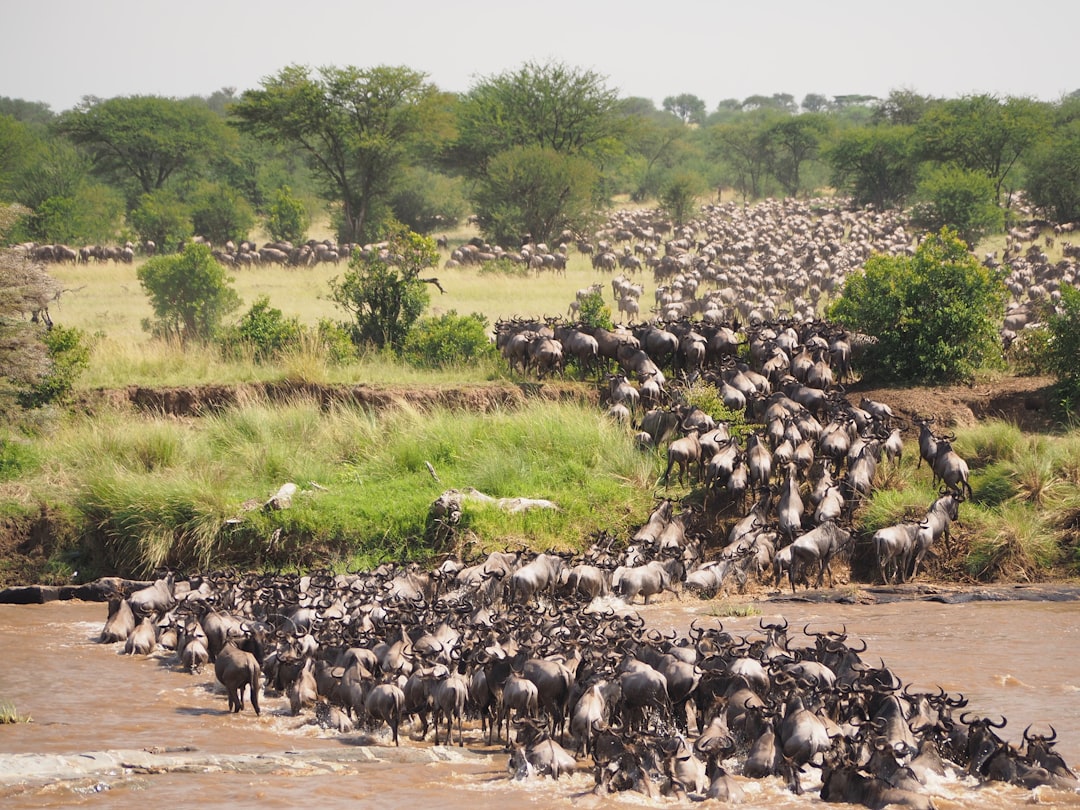
The river crossing is violent and chaotic. Hundreds of wildebeest are pressed together at the riverbank, some falling, some being swept downstream, the water churning. Crocodiles and lions are waiting. From your vehicle (ideally positioned 50–100 meters away), the crossing unfolds — survival, death, instinct. This is the Serengeti Migration, and it happens annually on a trajectory that follows rainfall and grass growth. The mechanics are predictable. The exact timing is not, which is why positioning yourself correctly matters enormously.
The Serengeti Migration involves 1.5 million wildebeest, zebras, and other animals moving in a circular pattern through the Serengeti National Park (Tanzania) and Masai Mara National Reserve (Kenya). The route is determined by grass and water — animals follow resources. The river crossings (at the Grumeti River and Mara River) happen when the herds reach water barriers. These crossings are the famous moments. But positioning for them requires understanding where the herds actually are and being willing to move.
Month-by-Month Breakdown: Where the Herds Are
| Month | Location | River Crossing | Crowds | Cost | Best For |
|---|---|---|---|---|---|
| Jan–Feb | South Serengeti | No | Low | Cheapest | Calving, budget safaris |
| Mar | South Serengeti | No | Low–Med | Cheap | Calving, fewer tourists |
| Apr–May | West Serengeti | No | Med | Moderate | Rain, green landscape |
| Jun–Jul | West/North | Grumeti (Jun–Jul) | High | Peak | River crossings, migration |
| Aug–Oct | Masai Mara (Kenya) | Mara River (Aug–Oct) | High | Peak | Mara River crossings |
| Nov | Central/South | No | Med | Moderate | Returning south |
| Dec | South Serengeti | No | Low | Cheap | Calving begins |
Key timing:
– Calving season (January–February): Wildebeest calves are born. Herds are concentrated in the south Serengeti. Easy to see predators (lions hunting young). Fewer tourists, cheapest costs.
– Grumeti River crossing (June–July): The herds cross the Grumeti River in western Serengeti. It’s less famous than the Mara River crossing but equally dramatic.
– Mara River crossing (August–October): The herds cross the Mara River at the Serengeti-Kenya border. This is the most famous and most crowded period. August is the peak (highest water, most dramatic crossings), September–October still has crossings but slightly fewer.
Specific River Crossing Timing and Where to Position
Mara River crossings (August–October):
The herds approach the Mara River from the south (Tanzania side). The river is a barrier — animals need to cross to reach new grass. Crocodiles and lions wait. The crossing is a predator feeding event.
August: Peak crossing month. The river is high (from rain), making crossings dramatic. Herds might cross multiple times in a day. You might witness 3–5 actual crossings if positioned correctly. But this is also peak tourism — every lodge is full, multiple vehicles surround each crossing, costs are highest (peak season pricing).
September–October: Still excellent for river crossings but water level drops slightly (fewer herds might use this river as the main crossing point). You’ll still see multiple crossings but slightly fewer than August. Fewer tourists than August (schools back in session in Western countries). Costs are slightly lower than August.
November onwards: River crossings become sporadic. The herds have mostly crossed. The migration momentum shifts south as animals follow the rains.
The Positioning Strategy for Serious Migration Viewing
To see river crossings, you need to be in the right place at the right time. This requires understanding the migration logistics and sometimes moving camps.
Option 1: Static positioning (book one camp for the full period)
– Choose a camp near a known crossing point (Serengeti camps on the Mara River)
– Stay for 7–10 days
– See multiple crossings (if you’re lucky with timing)
– Minimum cost, minimum stress
Option 2: Moving positioning (follow the herds, change camps)
– Book camps in different locations as herds move
– Track where the herds are (ask guides, check online reports)
– More expensive (multiple camp bookings), more complicated
– Higher chance of seeing active herds
For most people, static positioning is realistic. You pick one camp, stay a week, hope for river crossings. Some people see multiple crossings; others see fewer. The exact timing is unpredictable despite the migration being generally predictable.
Central Serengeti vs. Northern Serengeti: Which Area to Choose
Central Serengeti (around Seronera):
– The tourism hub, most lodges/camps
– Good year-round wildlife viewing (not just migration)
– During migration, herds are concentrated here before river crossings
– Access: Fly into Seronera airstrip
Northern Serengeti (closer to Mara River):
– Specific positioning for August–October (Mara River crossings)
– Fewer camps, more remote feel
– Best for focused crossing viewing
– Access: Fly into Ndutu or Kogatende airstrip
Masai Mara (Kenya):
– Same system, Kenya side
– Same migration, same crowds
– Crossing often more visible here (open plains, fewer trees block views)
– Costs are higher than Tanzania side
– Same timing (August–October for crossings)
For best value and reasonable experience: Book central Serengeti for August 15–25, then re-evaluate based on herd location reports. This timing catches peak Mara River activity with reasonable (though not minimum) crowds.
Getting There: The Actual Process
From Kilimanjaro Airport:
1. Fly Kilimanjaro → Arusha (road, 1 hour)
2. Fly Arusha → Serengeti (approximately 2 hours, small aircraft)
3. Direct flights Kilimanjaro → Serengeti exist (3 hours) but are less frequent
From Nairobi (Kenya):
1. Fly Nairobi → Serengeti (2 hours) via scheduled airlines
2. Or Nairobi → Masai Mara (1.5 hours)
Flights: Domestic flights in Tanzania are expensive (Tanzania, Northern Air, Precision Air). One-way flights range from $150–300. Most tourists book flights as part of a safari package, which adds significant cost but handles logistics.
Alternative: Overland from Arusha
– Drive Arusha → Serengeti (5–6 hours, rough roads)
– Requires a vehicle and driver (expensive if not included in package)
– Saves flight costs but adds driving time
Safari Accommodation: Camps vs. Lodges vs. Budget Options
Luxury lodges and tented camps ($300–800+ per person per night):
– All-inclusive (accommodation, food, game drives)
– Fixed departure time for game drives (usually 6–7am and 3–4pm)
– Good positioning for migration events
– Examples: Singita, Serengeti Pioneer, &Beyond camps
Mid-range camps and lodges ($150–300 per person per night):
– All-inclusive or meals included
– Game drives usually included or minimal extra cost
– Solid positioning, slightly less premium than luxury
– Examples: various regional camps, decent but not high-end
Budget camps and hostels ($40–100 per person per night):
– Self-catering or meals optional
– Game drives extra (usually $50–100 per person per game drive)
– May not have guaranteed positioning or dedicated guides
– You arrange drives independently
The actual cost breakdown (for a 7-day safari):
| Accommodation type | Nightly | Food | Drives | Total (7 nights) |
|---|---|---|---|---|
| Luxury camp | 500 USD | Included | Included | 3,500+ USD |
| Mid-range | 200 USD | Included | Included | 1,400+ USD |
| Budget camp | 75 USD | 100 USD | 350 USD | 1,075 USD |
Best value: Mid-range camps ($150–250 per person per night). They’re all-inclusive, positioning is good, guides are reasonable quality, and you’re not paying luxury markups.
Park Fees and Permits
Serengeti National Park entry: $60 per person per day (non-resident rates). You pay this at the park gate or it’s included if booking through a lodge. A 7-day safari costs $420 in park fees alone.
Masai Mara National Reserve (Kenya): $80 per person per day (similar principle).
Permits are non-negotiable — you cannot enter the parks without paying. Budget this as a fixed cost.
Guide Quality and What Matters
A good guide makes or breaks a safari. They find animals, explain behavior, position the vehicle for viewing, and answer questions.
What to look for in a guide:
– Familiarity with the park (they know where animals typically are by season)
– Patience (they’ll wait for wildlife without rushing to the next spot)
– Knowledge (they can explain animal behavior beyond “that’s a lion”)
– Respect for animals (they don’t stress wildlife to get photos)
How to assess a guide: Ask the lodge about your assigned guide’s experience. Ask other safari groups about their guides (reputation spreads). If you have a bad guide, request a change.
Guide costs: Usually included at lodges/camps. Tipping is customary (10–20 USD per day is standard).
The Reality of River Crossings
What actually happens: A river crossing is not guaranteed. You might position yourself perfectly and have no crossing happen that day. Or you might be at the wrong location and miss a major crossing nearby.
What you’ll see instead: Game drives reveal animals regardless of crossings. Lions, elephants, giraffes, zebras — there’s plenty of wildlife even if you don’t witness a river crossing. The crossing is the dramatic moment but it’s not the only content.
Probability: If you’re in the central Serengeti for 7 days during peak August, you have a high chance (70%+) of seeing at least one river crossing. But guarantee it isn’t possible.
Ethical Considerations for Serengeti Safaris
Serengeti tourism operates similarly to Kenya (see responsible safari article). Vehicle density, animal stress, and guide ethics matter.
Good practices:
– Choose camps with limited vehicle access (fewer vehicles = less stress on animals)
– Support camps that employ local guides and staff
– Don’t request the guide to break park rules (off-track driving, approaching animals too close)
– Tip fairly and respect guide expertise
Red flags:
– Camps that guarantee specific animal sightings (unrealistic, often involves breaking rules)
– Guides who drive dangerously or stress animals for photos
– Budget camps that cram vehicles around every sighting
The Bottom Line
Best time to visit: August 15–October 31 for Mara River crossings, with August being peak activity and crowds/costs.
Cost reality: $1,500–2,000 per person for a 7-day mid-range safari (mid-range camp, all-inclusive, flight from Kilimanjaro).
Booking: Book 2–3 months in advance during peak season. Later bookings risk full camps and higher prices.
Expectation setting: You’ll see amazing wildlife. River crossings, if they happen, are dramatic. But the safari’s value is in the entire experience — the landscape, the animals, the guides, the rhythm of game drives — not just the single moment of a crossing.
The Serengeti Migration is real and worth experiencing. Position yourself thoughtfully, understand the seasonality, book a decent mid-range camp with good guides, and expect wildlife abundance. If river crossings happen, that’s the bonus.