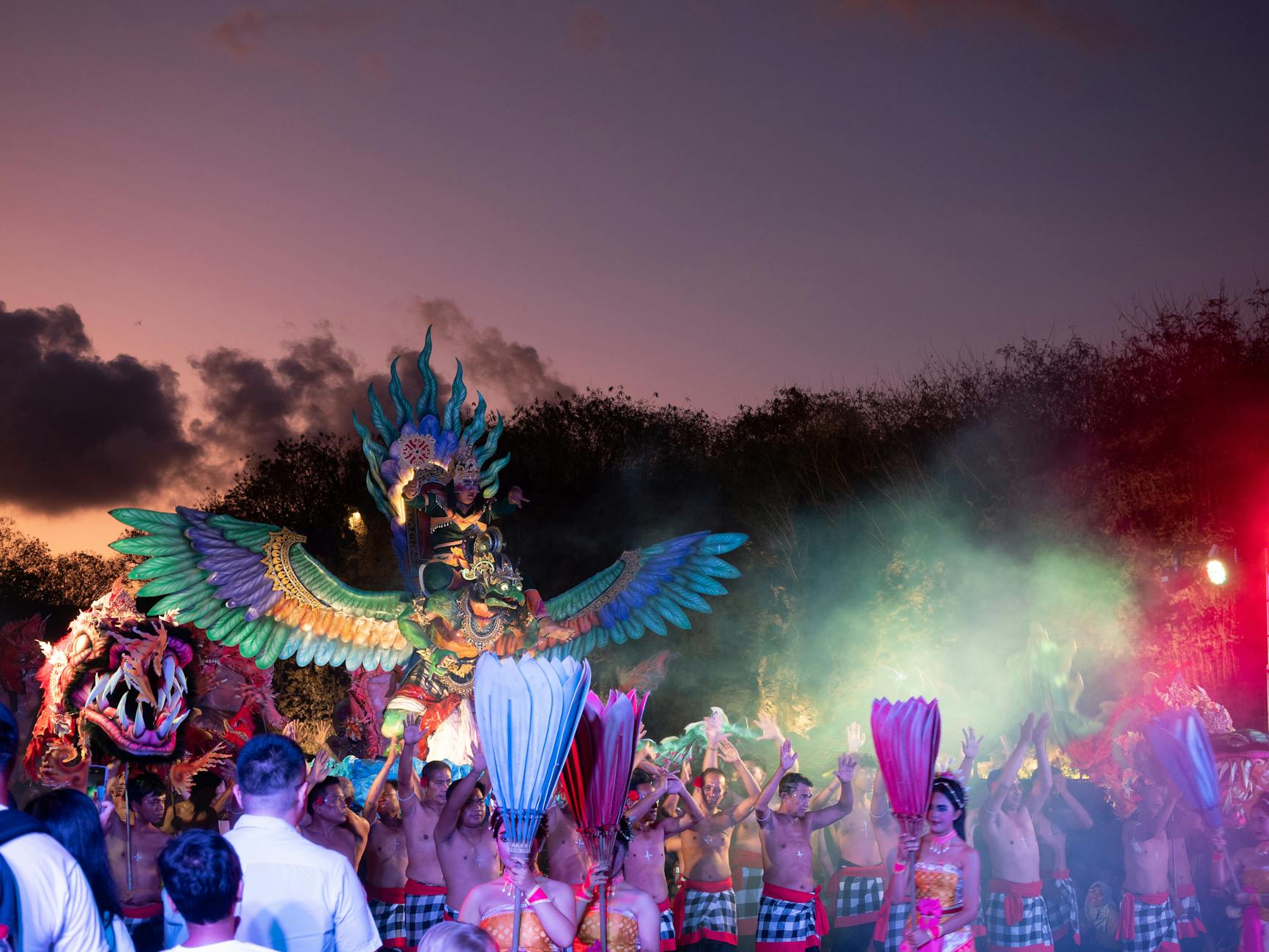
Photo by Isnania Isnania on Pexels
Attending a local festival in Bali as an outsider: an honest guide
The smell arrives before anything you can see. Frangipani, incense, and something faintly smoky drifting down a lane in Ubud’s Padangtegal neighbourhood, where a ngaben — a cremation ceremony — is moving through the street at midday. Thirty men carry a tall, lacquered tower of bamboo and cloth on their shoulders, rotating it at every intersection to confuse the spirit inside and prevent it from finding its way home. Children sit on walls eating jaja rice cakes. A gamelan ensemble keeps time from somewhere behind the procession. Nobody asked you to leave.
Bali’s ceremonial calendar is genuinely dense — UNESCO recognises Balinese Hinduism’s ritual arts as intangible cultural heritage — and on any given week, something significant is happening in a village you could walk to. The question isn’t whether you can attend. It’s whether you show up with any understanding of what you’re entering.
Understanding the calendar before you arrive
Balinese Hinduism runs on two overlapping cycles: the Saka lunar calendar and the 210-day Pawukon cycle. Major ceremonies cluster around full moons (purnama) and new moons (tilem), with the largest — Galungan, Kuningan, Nyepi, Saraswati — fixed within the Pawukon. In 2026, Galungan falls in mid-April and again in late November; Nyepi (the Day of Silence) falls on 19 March.
Download the Balinese Calendar app before travelling — it’s straightforward and shows ceremony types by date. Cross-reference with your specific district: a temple’s odalan (anniversary festival) in Gianyar won’t appear in a tourist pamphlet, but it’s often the most immersive event within a five-kilometre radius of wherever you’re staying.
Where to find ceremonies without being steered there
Avoid the packaged “ceremony experience” tours out of Seminyak or Kuta. They’re typically staged, truncated, or reliant on a guide who performs the role of cultural buffer rather than letting you actually observe.
Instead, stay in villages with working temple complexes: Penglipuran (near Bangli), Tenganan Pegringsingan (east Bali, near Karangasem), or the streets around Pura Besakih, Bali’s mother temple on the slopes of Gunung Agung. Tenganan is one of the last Bali Aga (pre-Hindu) villages and hosts the extraordinary Usaba Sambah festival in June and July, during which men engage in ritual mekare-kare (pandanus leaf combat). This is a real event in a living village, not a performance — spectators are permitted but expected to sit quietly at the perimeter.
In Ubud, the Padangtegal and Peliatan neighbourhoods hold odalan ceremonies regularly. Walk east of the Monkey Forest on Jalan Hanoman in the early morning during a full moon week and you’ll likely encounter offerings being laid and gamelan rehearsals starting before dawn.
What to wear and how to behave
This is non-negotiable, and most visitors get it wrong by degrees rather than catastrophically. The minimum requirement for entering any temple or joining any procession:
- Sarong (kamen) covering the knees, wrapped at the waist
- Sash (selendang) tied around the waist over the sarong
- Shoulders covered — a simple shirt or kebaya suffices
You can rent or buy both at most village entrances (10,000–20,000 IDR, roughly USD 0.60–1.25). If you’re attending an ngaben on the street, a sarong is still expected even though you’re technically in a public road.
Behaviour is a matter of spatial awareness. Stand at the outer courtyard (jabaan) unless explicitly invited further in. Do not position yourself above priests or offerings — sit on the ground if others are sitting. Switch your phone to silent and limit photos to the periphery; if you’re pointing a camera at someone’s face during prayer, you’ve misread the room. Bali’s provincial government has issued specific guidelines on visitor conduct at ceremonies, emphasising that the ceremony is not a performance and attendance carries a quiet obligation of respect.
Nyepi: the one festival you attend by staying still
Nyepi — the Balinese New Year, usually in March — is the inverse of every other festival. The island goes completely silent for 24 hours. No lights, no movement outside, no vehicles, no noise. Ngurah Rai Airport closes. Even the internet is throttled.
The night before Nyepi, ogoh-ogoh — enormous papier-mâché demon effigies — are paraded through every town and village, then burned at crossroads. The best place to watch in 2026 is along Jalan Gajah Mada in Denpasar, where dozens of banjar (neighbourhood associations) converge in a competitive procession after dark. Arrive by 7pm and stand near the Kumbasari Market side of the road for an unobstructed view.
During Nyepi itself, you stay in your accommodation. This is genuinely enforced by pecalang (customary police). Book a guesthouse or small family compound rather than a resort — a compound in Sanur or Sidemen will have family members who’ll explain the customs, share a meal, and let you observe the quiet in a way that actually means something.
Eating around ceremonies
Ceremonial food in Bali is specific and worth understanding. Lawar — a mixture of minced meat, vegetables, grated coconut, and fresh blood — is prepared communally by men before major ceremonies and is rarely available in restaurants. If you’re staying in a family compound during Galungan, you may be offered some. Eat it.
Babi guling (suckling pig) is the ceremonial centrepiece, and the version you eat at Ibu Oka in central Ubud is a tourist-adapted approximation. For the real context, find a warung in Gianyar town — try Warung Babi Guling Men Tempeh on Jalan Ngurah Rai — where it’s eaten in the morning by families returning from temple. Around 35,000–50,000 IDR for a full plate.
Costs, logistics, and timing
| Item | Cost (IDR) | Cost (approx. USD) | Notes |
|---|---|---|---|
| Sarong + sash rental | 10,000–20,000 | $0.60–$1.25 | Available at most temples |
| Guesthouse in Penglipuran |