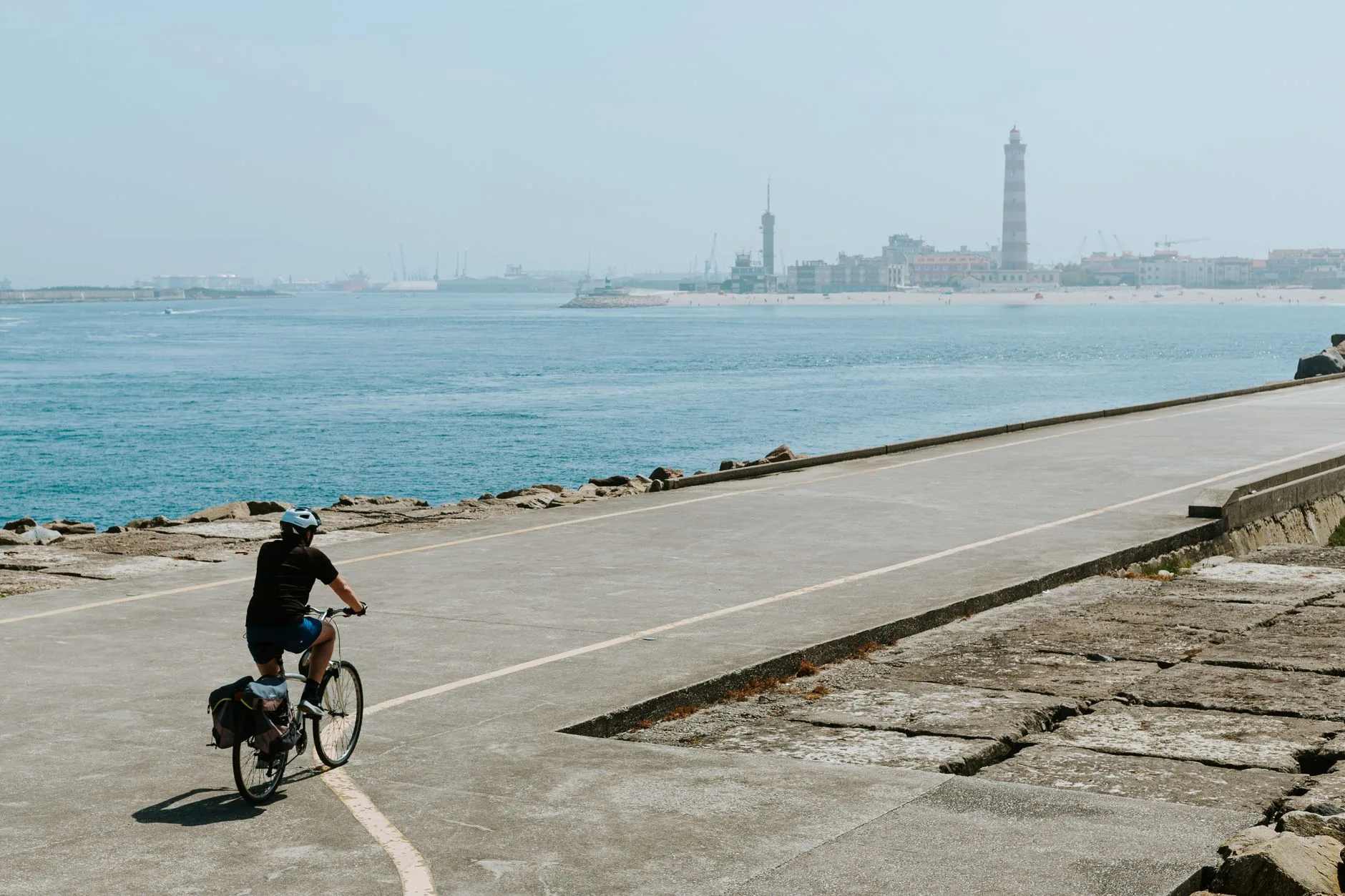
Photo by Tiago Chaves on Pexels
At Foz do Douro, where the river gives up and the Atlantic takes over, the cycle path runs right along the seawall. Surfers wait outside the break near Praia do Ourigo, the wind smells of salt and grilled sardines from the kiosks behind the dunes, and the asphalt is smooth enough that you barely notice you’ve left Porto’s cobbles behind. This is where most people’s coastal cycling in Portugal begins, whether they mean it to or not — the city’s riverside path simply dissolves into open coast, and the coast keeps going for over 900km.
Portugal’s western edge is one of the more underrated cycling destinations in Europe: mostly flat, well served by rail for the awkward bits, and threaded with dedicated paths that don’t require nerves of steel on shared roads. It is not, however, uniformly easy. The wind off the Atlantic is a near-constant companion, surfaces shift from silky asphalt to loose gravel without warning, and some of the prettiest stretches — particularly in the Alentejo — have no services for 20km or more. This guide breaks the coast into its three practical corridors and tells you what each one actually involves.
The Three Coastal Corridors
Portugal’s coastline splits naturally into three cycling zones, each with a different character, surface, and difficulty level.
The North (Porto to Caminha): Flat, paved, well-signed, dense with small towns. This is the easiest and most forgiving stretch — good for a first coastal cycling trip or a long weekend.
The Centre (Porto to Lisbon, via Aveiro and Nazaré): Longer distances between services, more varied terrain, and the highest concentration of genuinely striking scenery — lagoons, fishing villages, towering dunes.
The Algarve (Sagres to Vila Real de Santo António): Flat and fast, but exposed to crosswinds and, in July and August, considerable tourist traffic. Best tackled outside peak summer.
All three link, loosely, to the Atlantic Coast Route — EuroVelo 1 — Europe’s long-distance cycling corridor that runs from Norway to Portugal’s southern tip. You don’t need to ride the whole thing, or even know it exists, to follow its Portuguese sections, but it’s worth knowing the EuroVelo 1 route exists as infrastructure, because signage along much of the coast carries its green-and-blue markers.
Ecovia do Litoral Norte: Porto to Viana do Castelo
This is the single best introduction to coastal cycling in Portugal, and arguably the best-maintained stretch in the country. The Ecovia do Litoral Norte runs roughly 70km from Porto’s Foz district up through Vila do Conde, Póvoa de Varzim, Esposende, and on to Viana do Castelo, almost entirely on dedicated, paved cycle path separated from traffic.
Vila do Conde, about 25km in, is worth a deliberate stop rather than a blur — its aqueduct and the Convento de Santa Clara sit above a working fishing harbour, and the pastry counters sell a version of the local doce de ovos that’s less famous than Lisbon’s pastéis de nata but arguably better. Esposende, further north, marks the edge of the Parque Natural do Litoral Norte, where the path cuts through pine-stabilised dunes and the Cávado river estuary opens up to birdlife rather than beach bars.
The route ends logically at Viana do Castelo, a graceful riverside town with a funicular up to the Santuário de Santa Luzia for a view back down the coast you’ve just ridden. Most people do this stretch in two unhurried days, stopping overnight around Póvoa de Varzim or Esposende, though fit riders manage it in one long day of six to seven hours including stops. The gradient barely registers — this is pancake-flat riding, which makes the headwind, when it comes (and it often does, particularly in the afternoon), the only real physical challenge.
South from Porto: Aveiro, Nazaré, and the Longer Middle Stretch
South of Porto, the coastal cycling gets less continuous and more interesting. The ride down to Aveiro follows a mix of dedicated ecovias and quieter N-roads through pine forest, and Aveiro itself — Portugal’s “Venice,” a slightly overused comparison that nonetheless holds up around its canals — makes a natural overnight stop, with moliceiro boats gliding past art nouveau façades and ovos moles sold in wooden barrel-shaped boxes at nearly every corner shop.
South of Aveiro, the character of the ride changes. The path (where it exists) runs through the Ria de Aveiro’s salt pans and then along a long, exposed stretch of coastline toward Figueira da Foz, where dedicated infrastructure thins out and riders are often on quiet local roads instead. This section rewards slow travel over speed — if you’re building a longer trip rather than racing the kilometres, it’s worth reading up on slow travel in Portugal before committing to a tight schedule, because the towns along here reward a night or two rather than a drive-through.
Nazaré, further south again, is known internationally for winter big-wave surfing at Praia do Norte, but outside the giant-wave season (roughly October to March) it’s a working fishing town with a funicular up to the Sítio clifftop and women still selling dried fish laid out on racks along the seafront. Peniche, another 40km on, is the departure point for ferries to the Berlenga Islands and has become a serious surf hub in its own right — expect wetsuits drying on balconies and a noticeably younger, more international crowd than in towns further north.
This middle section — Porto to Lisbon in full — runs around 300km and typically takes experienced cyclists five to seven days at a relaxed pace with rest stops, though the lack of continuous dedicated path means more route-planning and more time on shared roads than the northern Ecovia.
The Algarve’s Ecovia do Litoral
The Algarve has its own dedicated long-distance cycle path, the Ecovia do Litoral, running roughly 214km from Sagres in the west to Vila Real de Santo António on the Spanish border. It’s largely flat, mostly paved or well-packed gravel, and passes through or near most of the region’s resort towns — Lagos, Portimão, Albufeira, Faro, Tavira — which means good infrastructure but also, in July and August, heavy foot and bike traffic in the central section.
The western end, from Sagres through Lagos, is the most dramatic — cliffs, the Ponta da Piedade rock formations, and views out toward the same Atlantic that eventually becomes the open ocean with nothing between you and Newfoundland. The eastern half, past Faro toward Tavira and the Ria Formosa lagoon, is flatter, quieter, and genuinely pleasant for cycling precisely because it draws fewer crowds.
Spring (March–May) and autumn (September–October) are markedly better than summer here: temperatures sit in the comfortable low-to-mid 20s°C rather than the mid-30s, and the path isn’t competing with beachgoers and rental scooters. Winter, outside of storm days, is also viable and popular with cyclists escaping colder climates further north.
Getting Bikes There: Trains, Rentals, and the Honest Logistics
Comboios de Portugal, the national rail operator, allows bikes on most regional and inter-regional trains, usually for a small supplementary fee, though space is limited and not guaranteed on the faster Alfa Pendular and Intercidades services without a reservation. This matters more than it sounds: the practical way to tackle Portugal’s coast without cycling every single kilometre is to ride the scenic, dedicated sections — the Ecovia do Norte, the Algarve’s Ecovia — and take the train for the long, service-sparse connectors in between, particularly through the Alentejo coast south of Lisbon, where genuine dedicated cycling infrastructure is thin.
Bike rental is straightforward in Porto, Lisbon, and most Algarve towns, with both standard hybrids and e-bikes widely available; e-bikes are worth the extra cost if headwinds or longer daily distances are a concern, and several outfits offer one-way rentals that let you drop the bike in a different city from where you picked it up. Bringing your own bike is also entirely feasible — airlines generally accept bikes as checked luggage in bike bags for a fee, and Portugal’s roads outside major cities are generally calm enough for touring bikes with panniers.
| Route | Distance | Surface | Difficulty | Best Season | Typical Duration |
|---|---|---|---|---|---|
| Ecovia do Litoral Norte (Porto–Viana do Castelo) | ~70km | Paved, dedicated path | Easy | April–October | 1–2 days |
| Porto–Lisbon (via Aveiro, Nazaré, Peniche) | ~300km | Mixed paved/shared road | Moderate | May–June, Sept | 5–7 days |
| Ecovia do Litoral (Algarve, Sagres–VRSA) | ~214km | Paved/packed gravel | Easy–Moderate | March–May, Sept–Oct | 4–6 days |
| Alentejo coast (Lisbon–Sines–Algarve link) | ~250km | Shared roads, limited path | Moderate–Hard | Spring/Autumn | 4–5 days |
What No One Mentions Until You’re Riding Into It
The wind deserves more respect than most pre-trip research gives it. The Nortada — a persistent north-to-northwest wind that strengthens through spring and summer, particularly in the afternoons — can turn an easy flat ride into a grind, especially heading north. Most experienced riders plan routes to go south with the wind where possible, and start early to beat the afternoon strengthening.
Water and food gaps matter more south of Aveiro and through the Alentejo, where villages can be 15–20km apart with nothing but farmland and cork oaks between them; carry more water than feels necessary. Surfaces also shift without warning — a smooth ecovia can become washed-out gravel after a bridge or a river crossing, particularly after winter storms, so touring tyres with some tread beat slick road tyres for anyone riding the full coast rather than just the northern Ecovia.
For those building this into a wider Portuguese trip rather than a dedicated cycling holiday, it’s worth noting that much of this coastline overlaps with towns covered in guides to backpacking in Portugal beyond Lisbon — meaning accommodation, food, and onward transport options are generally well established even outside the main tourist centres. And for anyone weighing cycling against walking the same stretches, several sections double as highlights in roundups of Europe’s best coastal walks, worth a look if you’re deciding which pace suits the trip better.
The Bottom Line
- The Ecovia do Litoral Norte is the easiest, most rewarding entry point — do this first if you’re unsure about coastal cycling in Portugal generally.
- Use trains strategically rather than riding every kilometre; CP’s bike allowance on regional services makes it genuinely practical to skip the connector stretches with least infrastructure, particularly south of Lisbon.
- Plan around the Nortada, not just the calendar — afternoon headwinds heading north are a bigger factor in daily distance than hills, since there mostly aren’t any.
- Shoulder seasons (April–June, September–October) beat summer on every metric that matters: temperature, wind, and crowding on shared sections of the Algarve’s Ecovia.
- Budget for gaps, not just distance — carry water and snacks through the Alentejo and between the Centre coast’s smaller towns, where services thin out considerably compared to the north.
Keep reading: Pair it with slow travel in Portugal once you’re off the bike