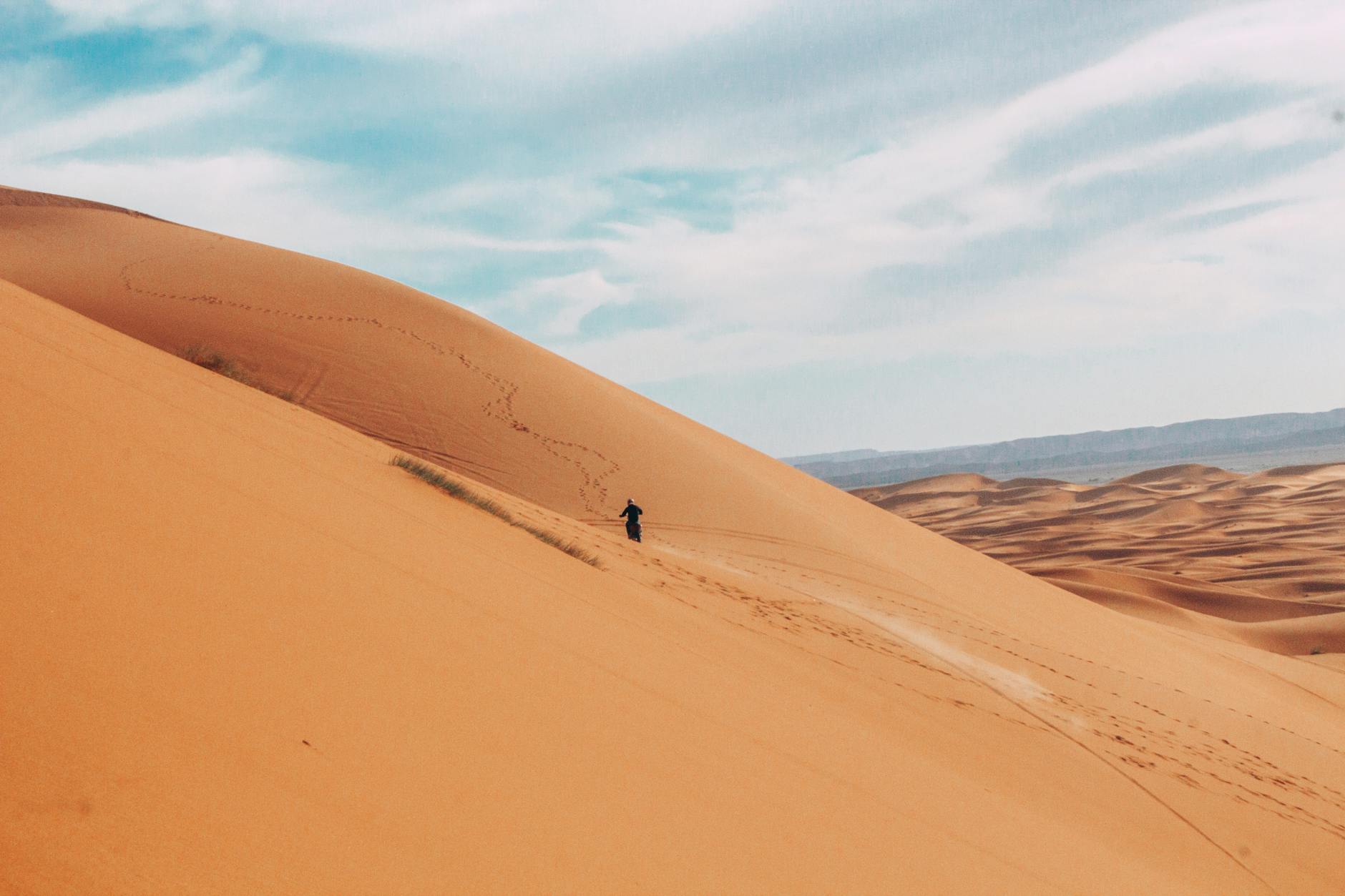
Photo by Abdelaziz Baba on Pexels
How to cross the Sahara Desert responsibly
The Agadez Grand Mosque rises above the roofline before dawn, its mud-brick minaret catching the first grey light while the smell of wood smoke and motor oil drifts from the direction of the caravan quarter. By 5am, Toyota Land Cruisers are already idling in the dust, loaded with jerricans, spare tyres, and sacks of millet. This is still a working crossing point — not a tourist theatre — and that distinction matters before you decide to attempt any Saharan route in 2026.
The Sahara is roughly the size of the continental United States. It contains active conflict zones, collapsed smuggling corridors, and some of the most disorienting terrain on earth. It also contains Tuareg silver traders, fossilised sea beds, and silences deep enough to feel physical. Crossing it responsibly means understanding the difference between a managed desert expedition and a reckless road trip — and being honest with yourself about which one you’re equipped for.
Choose your route honestly
Three overland corridors exist in 2026 with any realistic degree of viability for independent travellers:
The Hoggar Route (Algeria): Tamanrasset south to Assamaka at the Niger border, then on to Agadez. This is the most historically documented crossing — the old Trans-Saharan Highway — and Algeria has invested in the sealed road between Tamanrasset and the border. The Algerian side is relatively stable. The Niger side, however, remains genuinely dangerous. The region around Agadez has seen armed group activity, and the UK Foreign Office and French Quai d’Orsay both maintained elevated advisories through 2025. Check current guidance before committing.
The Atlantic Route (Mauritania): Enter from Morocco at Guerguerat, drive the N1 south through Mauritania to Nouakchott. This is the most accessible and most frequently completed route for vehicle travellers. The road is mostly paved, border crossings are functional (if slow), and the stretch through the Adrar plateau near Atar offers genuine desert scenery. Crossing time: three to five days driving, longer if you explore.
The Nile Corridor (Sudan/Egypt): Aswan to Wadi Halfa by ferry across Lake Nasser, then south by train or bus into Sudan. This is not a west-to-east crossing but a north-south one. Sudan’s political situation in 2026 requires careful monitoring — fighting between the SAF and RSF has displaced millions. Do not attempt this without thorough, current intelligence.
For most travellers in 2026, the Atlantic/Mauritanian route is the only one to seriously consider.
Hire a licensed local guide — not an optional extra
The single most important responsible travel decision you will make is this: hire a Tuareg or Sahrawi guide with documented regional knowledge, not a fixer scraped from a hostel noticeboard in Marrakech.
In Mauritania, guides registered with the Fédération Mauritanienne du Tourisme in Nouakchott carry liability and training. In Algeria, the Office du Parc National de l’Ahaggar in Tamanrasset can connect you with certified Tuareg guides for the Hoggar massif. Expect to pay €80–€120 per day for an experienced guide with their own vehicle.
This matters ethically, not just practically. Unemployment in these border communities is severe. Circumventing local guides to save money flows cash away from the people who understand, maintain, and have legal claim to this landscape.
Water, fuel, and the logistics that will actually kill you
A standard 4WD in desert conditions consumes roughly 20 litres of fuel per 100km. Distances between fuel points on the Mauritanian N1 can exceed 400km. The math is unforgiving.
Carry minimum 1.5x your calculated fuel requirement. Water: 5 litres per person per day is survival-level; carry 8. A GPS device with offline maps (Garmin inReach or equivalent) is not luxury kit — it is the mechanism by which rescue services locate you when the Land Cruiser sinks to its axles in a sebkha salt flat at noon.
Inform someone of your exact route and check-in schedule before departure. The Mauritanian gendarmerie posts at Bir Moghrein and Zouerate register transit vehicles — use them. It is not bureaucratic friction; it is a paper trail that means someone looks for you if you disappear.
Environmental responsibility in specific terms
UNESCO’s Saharan heritage framework covers the Tassili n’Ajjer plateau in Algeria, one of the world’s densest concentrations of prehistoric rock art. Do not touch the engravings. Do not camp within 100 metres of a marked site. This is not aesthetic guidance — skin oils and micro-abrasion are measurably destructive over decades of visitor contact.
For waste: carry out everything you carry in. This sounds obvious until day four, when you’re tired and there’s a convenient gully. The central Sahara has almost no decomposition — plastic buried in sand in 1990 still looks like 1990 plastic. Pack a sealed rubbish bag per person per week.
Buy food and water in towns rather than bringing everything from the Moroccan or Algerian border. A bag of dates in Atar, flatbread from a woman selling from a tarpaulin near the Chinguetti piste, dried camel meat from the Agadez market — these purchases matter economically to the communities you’re passing through.
Costs, seasons, and route comparison
| Route | Start–End | Approx. distance | Best season | Guide cost/day | Risk level (2026) |
|---|---|---|---|---|---|
| Atlantic (Mauritania) | Dakhla → Nouakchott | ~1,100km | Oct–Feb | €80–€100 | Moderate |
| Hoggar (Algeria→Niger) | Tamanrasset → Agadez | ~700km | Nov–Mar | €90–€120 | High (Niger side) |
| Nile Corridor (Egypt→Sudan) | Aswan → Wadi Halfa | ~350km water + land | Nov–Feb | Variable | Very high (2026) |
| Adrar Circuit (Mauritania) | Atar → Chinguetti → Ouadane | ~400km loop | Oct–Mar | €70–€90 | Low–Moderate |
Fuel costs in Mauritania run approximately €1.20–€1.40/litre (2025 prices). Budget €150–€200 per person per day all-in for a guided expedition including fuel, food, and accommodation. Independent vehicle crossings with a guide cost less per day but require capital expenditure on the vehicle and recovery equipment.
What to eat, and where to buy it
Desert travel nutrition is not glamorous, but it is specific. In Atar, the market near the central mosque sells fresh bread at dawn, dried dates, canned sardines, and tea. Learn to make Mauritanian attaya — the three-glass ceremonial tea sequence