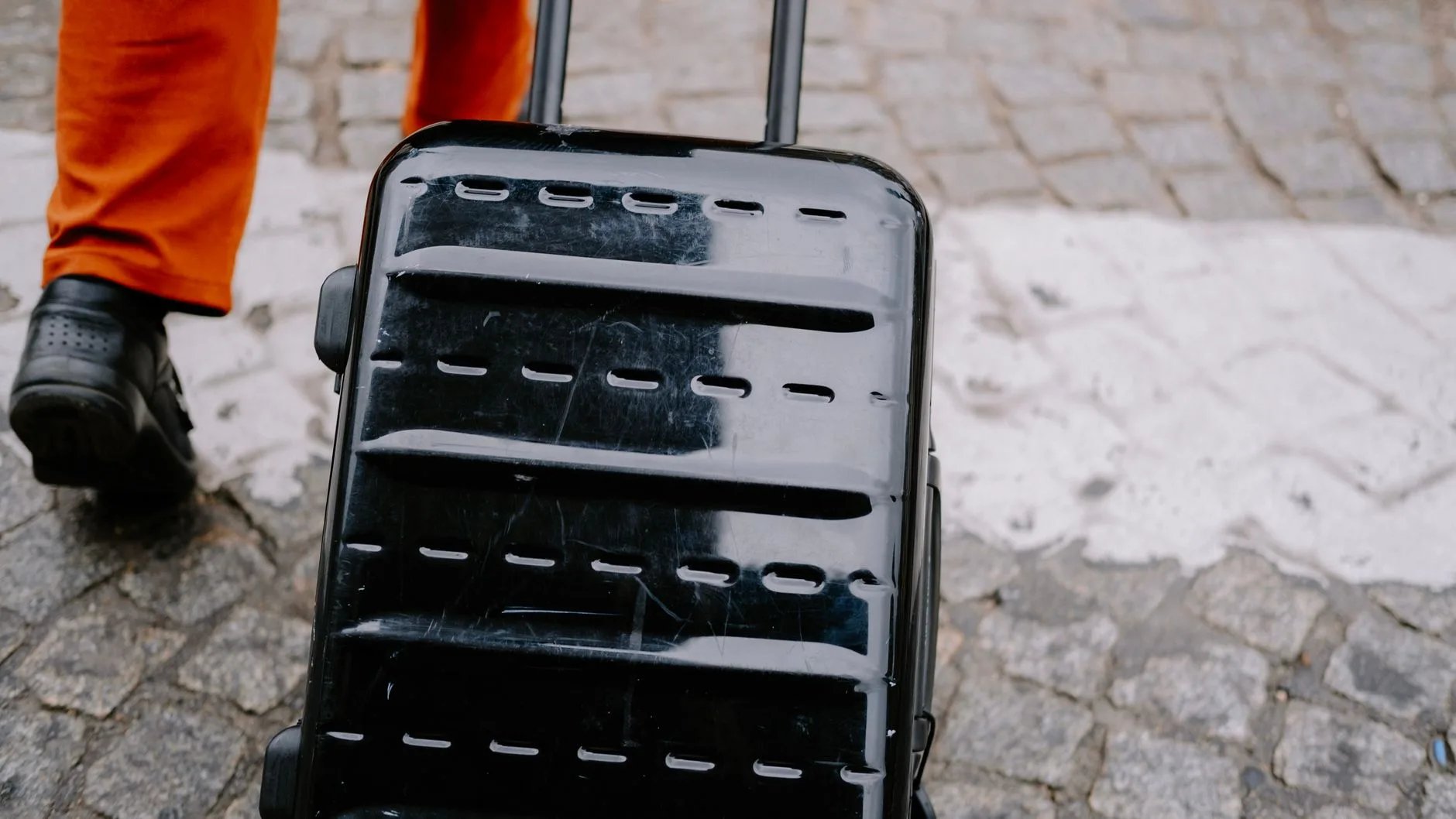
Photo by Mathias Reding on Pexels
The departure board at Ljubljana train station flickers over to platform 4, and the woman next to you hauls a suitcase the size of a filing cabinet up the stairs, one jolting step at a time, because the escalator has been “temporarily out of service” since at least last Tuesday. You walk past her with a 38-litre backpack slung over one shoulder, not smug exactly, but aware that the next three weeks — Ljubljana to Zagreb to Split, a ferry, a bus that may or may not show up — are going to be considerably easier because you’re not dragging a wheeled case over cobblestones that were laid for horses, not luggage.
This is the actual case for carry-on-only travel: not minimalism as a personality trait, but logistics. No baggage carousel limbo, no lost-luggage forms filled out in a language you don’t speak, no taxi required just to get from the airport to the hostel because your suitcase won’t fit on the metro turnstile. It is also, to be honest, more work upfront — you will do laundry more often than you’d like, and you will leave something useful at home at least once. This guide covers the bag, the rules, the packing logic, and the parts nobody puts in the brochure.
Choosing the bag: size rules before brand loyalty
Before anything else, the bag has to clear the actual size restriction of the airline you’re flying, and this is where most carry-on strategies collapse before they’ve started. “Carry-on size” is not a universal standard — it is a patchwork of airline-specific rules that change by fare class and occasionally by mood.
A bag in the 38–45 litre range, with dimensions around 40 x 20 x 25 cm, clears most full-service carriers without argument. Budget carriers in Europe are stricter and more punitive: Ryanair’s free personal item is small enough that a filled daypack will sometimes fail to fit their sizing cage at the gate, and the fee for getting caught out runs considerably higher than it would have cost to check the bag properly at booking. If your trip involves a mix of full-service and budget legs — common on a route through the Balkans or Southeast Asia — pack to the strictest limit on the itinerary, not the most generous one.
| Airline/Region | Free carry-on allowance (approx.) | Notes |
|---|---|---|
| Ryanair | Small bag only (40x20x25cm, fits under seat) | Larger cabin bag now a paid add-on; gate sizing is strictly enforced |
| easyJet | Underseat bag free; larger cabin bag often paid | Fee at the gate is higher than pre-booking it |
| Major US carriers (Delta, United, American) | One carry-on + one personal item | Size roughly 56x36x23cm for the main bag |
| Lufthansa / full-service EU carriers | One carry-on + one personal item | 55x40x23cm typical, weight limit often 8kg |
| Budget Asia (AirAsia, VietJet) | Personal item only, 7kg | Weight is checked, not just size — a dense 40L bag can still get flagged |
A soft-sided backpack, rather than a hard-shell roller, earns its keep here: it compresses to squeeze under a sizing frame, and it survives being wedged into an overhead bin, lashed to the roof of a minivan on a mountain road, or shoved under a bunk bed in a hostel dorm. Bags from Osprey, Tortuga, and Peak Design all sit in a sensible range for this kind of travel, and none of them require you to look like you’re about to summit something.
The packing list that actually works
The honest version of a capsule wardrobe isn’t seven identical black t-shirts — it’s a small number of pieces that cover a wide range of temperatures and situations, built around layering rather than variety. For a three-week trip spanning, say, coastal heat and a cooler mountain stretch, that typically means:
- 4–5 tops (a mix of t-shirts and one long-sleeve), 2 bottoms (one that converts or rolls up), one light insulating layer, one rain shell, underwear and socks for 5–6 days, one pair of shoes worn on the plane and one packable pair for the rest.
- Toiletries in travel-sized containers under 100ml, in a clear bag, kept accessible for security screening.
- A universal adapter, a power bank, and a dry bag or packing cube for damp or dirty clothes separated from clean ones.
The arithmetic that makes this work is simple: you are not packing for every day of the trip, you are packing for a laundry cycle of about five to seven days and repeating it. This is the single biggest mental shift required — most overpacking comes from an unconscious assumption that each day needs its own outfit, when in practice nobody you meet on a three-week trip is tracking your wardrobe rotation.
Laundry logistics: the part nobody mentions
Carry-on-only travel means laundry becomes a recurring chore, not an occasional one, and it’s worth knowing where that happens before you need it. Hostels in Southeast Asia and Central America routinely offer wash-and-fold service for a few dollars a kilo, turned around same-day — a genuinely useful perk if you’re staying somewhere a night or two longer anyway. In Europe, self-service launderettes exist but are less common outside larger cities, and a Sunday evening search for one in a small Croatian town is not a great use of a Sunday evening.
The workaround many carry-on travellers use: a sink wash with a small packet of detergent sheets, hung to dry overnight using a stretch of paracord strung across the room. It won’t get heavy denim properly clean, which is one more reason to avoid packing jeans in the first place — they’re slow to dry and heavy when wet, the worst combination for this style of travel. If your route includes a long-distance hike section, the same logic applies to the layering strategy used on multi-day treks — worth reading alongside something like the guide to the best multi-day hikes in Patagonia for beginners, where pack weight matters even more acutely than at an airport gate.
Liquids, electronics, and the security line
The 3-1-1 liquids rule — containers under 100ml (3.4oz), all fitting into a single quart-sized bag — is the US-originated standard, and most of the world has converged on something close to it, though the exact bag size and container limits vary by country. The TSA’s official liquids rule page is the clearest reference if you’re flying through the US, and it’s worth checking before departure because enforcement of edge cases (contact lens solution, medication, baby food) differs by checkpoint.
Solid toiletries sidestep the problem entirely — a shampoo bar and solid deodorant clear security without needing to go in the bag at all, and they don’t count against your liquid allowance if you’re also carrying contact lens solution or prescription liquids. Electronics are the other friction point: a laptop or large tablet usually needs to come out of the bag for screening unless you’re going through a newer CT scanner lane, which some airports (several in the UK and a growing number in the EU) have already rolled out, letting laptops and liquids stay packed. It’s inconsistent enough that it’s not worth planning around — assume you’ll need to unpack at the belt and be pleasantly surprised if you don’t.
What to leave behind (and what people regret bringing)
The travel umbrella is the single most over-packed item among carry-on travellers — it takes up disproportionate space for a problem a $5 poncho solves just as well. A “just in case” formal outfit is the second most common regret; if an occasion genuinely requires it, most destinations have a market stall or shop where something can be bought cheaply and left behind rather than carried for three weeks on the off chance.
Books are a surprisingly heavy habit to break — a single paperback weighs little, but the instinct to pack three “in case you finish them” adds up fast, and a phone or e-reader solves this without the weight. First aid kits tend to be overbuilt too: a small kit with blister plasters, antihistamines, and basic pain relief covers most situations, and anything more specific (altitude medication, for instance) should be sourced for the specific trip rather than carried by default. If your plans include high-altitude trekking, that calculus changes — check the month-by-month conditions in a guide like best time to trek to Everest Base Camp before assuming a standard kit will do.
Honest limitations of going carry-on only
This style of travel has real trade-offs worth naming plainly. Shopping becomes a constraint rather than a pleasure — that ceramic bowl from a market in Hoi An or the wool poncho from a stall in Otavalo either needs to be shipped home separately (expensive, and customs can be unpredictable) or it doesn’t come home at all. Gift-buying for people back home becomes an exercise in restraint. Multi-climate trips require more planning, because you genuinely can’t pack for both a beach stretch and a mountain stretch with the same four shirts — layering has to do real work.
It’s also simply less forgiving of spontaneity. A sudden decision to extend a trip by two weeks, common on an open-ended route through Central America, means those extra days of wear are happening in the same rotation of clothes, which is fine, but worth knowing before you commit to it as a philosophy rather than a single-trip tactic. If budget and duration are the bigger variables in your planning, it’s worth reading alongside a route-level guide like backpacking through Central America: practical guide, since bag strategy and route strategy tend to shape each other.
The Bottom Line
- Pack to the strictest airline in your itinerary, not the most generous — a bag that clears a full-service carrier can still get flagged at a Ryanair gate.
- Solid toiletries and a laundry rhythm (every 5–7 days) do more to make carry-on-only travel workable than any specific bag brand.
- Multi-climate or multi-month trips need layering logic, not more clothes — the instinct to add a seventh shirt is rarely the right fix.
- Accept the real trade-off: less room for souvenirs, less flexibility for sudden formal occasions, and more unpacking at security checkpoints that haven’t upgraded their scanners yet.
- If the trip involves serious elevation, cold-weather trekking, or gear-heavy activities, carry-on-only may not be the right constraint for that leg — check gear needs against conditions before forcing the bag to do too much.
Keep reading: Budget hostel travel tips for adults over 30