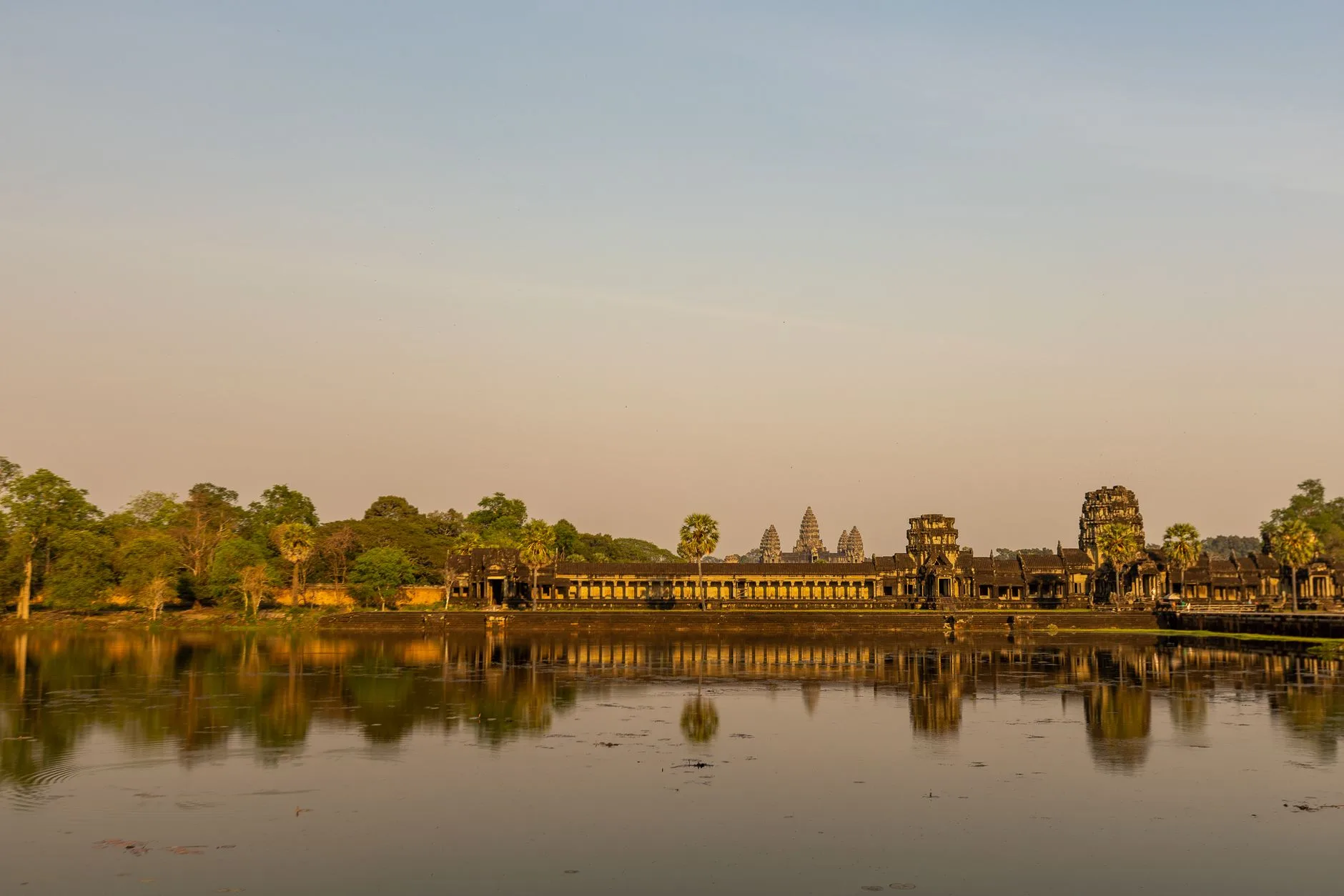
Photo by Serg Alesenko on Pexels
By 5:15am the eastern causeway at Angkor Wat is already lined three deep with tripods, headlamps, and the low murmur of people who paid a tuk-tuk driver extra to get there first. Then the sky over the five towers turns the colour of weak tea, the moat goes still and mirror-black, and for about twenty minutes nobody says much of anything. The silence doesn’t last — by 6am the causeway is a shuffling queue and someone’s drone is buzzing somewhere it shouldn’t be — but that window is worth the alarm clock.
Angkor is the reason most people land in Siem Reap, and it deserves every bit of the reputation. But Cambodia on your own terms — without a fixed group itinerary, moving at your own pace by tuk-tuk, moto, bus and the occasional shared pickup truck — opens up a country that’s far more than one UNESCO site, however extraordinary that site is. This is a guide to doing it independently: the temples, the logistics, and everything the standard three-day Angkor pass doesn’t tell you about.
Angkor: getting the pass and the plan right
The Angkor Archaeological Park requires a ticket purchased at the official Angkor Enterprise ticket centre on Road 60, a few kilometres outside Siem Reap proper — not at the temples themselves, and not from your guesthouse, whatever anyone tells you. Passes come in three tiers: one day, three days (usable within ten days), and seven days (usable within a month). The three-day pass is the sweet spot for most independent travellers — enough time to see the big three (Angkor Wat, Angkor Thom and the Bayon, Ta Prohm) without rushing, plus a day for the outer temples.
Tuk-tuk drivers in Siem Reap work on fairly standard day rates, negotiated the night before — expect to pay more for the “grand circuit” (further temples, longer day) than the “small circuit.” Renting your own scooter is technically restricted for foreigners in some areas and the roads around the park get chaotic near sunset, so most independent travellers hire a driver for the temples and switch to a bicycle or e-bike for the town itself.
| Pass | Cost (approx) | Validity | Best for |
|---|---|---|---|
| 1-day | $37 | Single day | A tight stopover, Angkor Wat + Bayon only |
| 3-day | $62 | 10 days | Most independent travellers — the standard |
| 7-day | $72 | 1 month | Slow travel, photography, repeat sunrise visits |
Start early regardless of your plan. By 9am the heat is already pressing and the main temples are crowded with tour buses; by 10:30 the light is flat and the queues at Ta Prohm’s photogenic fig-tree corner stretch back twenty minutes. A driver who starts at 5am and brings you back to town for lunch during the worst of the heat, then back out for the late afternoon light, is worth the arrangement.
Beyond the big three: Banteay Srei, Beng Mealea, Koh Ker
Angkor Wat, Bayon and Ta Prohm earn their fame, but the temples outside the main circuits are where independent travel pays off — fewer buses, more room to actually look at carved sandstone rather than the back of someone’s head. Banteay Srei, about 25km northeast of Siem Reap, is a small 10th-century temple carved from pink sandstone with some of the finest relief work in the entire park — intricate enough that it’s sometimes called the “citadel of women.” It gets busy by mid-morning tour-bus traffic, so pair it with an early start.
Beng Mealea, roughly 60km east, is a different experience entirely: a massive temple left largely unrestored, its galleries collapsed into jungle, moss-slicked stone requiring you to pick a path over fallen lintels rather than walk a cleared causeway. There’s a wooden walkway for those who want it and a scramble route for those who don’t. Koh Ker, further still at around 120km, was briefly the capital of the Khmer empire in the 10th century and centres on a 7-tier sandstone pyramid, Prasat Thom, that you can climb via a wooden staircase for a view over the forest canopy. Both require a full day with a driver and a separate small entrance fee beyond the Angkor pass — budget $10-15 for Beng Mealea, a bit more for the Koh Ker zone ticket.
Siem Reap town: Psar Chaa and the food beyond the Pub Street glow
Pub Street gets the neon and the $0.50 draft beer signs, but Siem Reap’s actual culinary centre is Psar Chaa, the old market a few blocks away, and the smaller street stalls radiating out from it. Look for nom banh chok — rice noodles under a green fish-based curry, eaten for breakfast — served from metal basins by vendors who’ve been in the same spot for years. Amok, Cambodia’s signature steamed fish curry set in banana leaf with coconut, galangal and kroeung paste, is worth seeking out at a proper Khmer restaurant rather than the tourist-menu version. For specifics on navigating markets like this with confidence, it’s worth reading up on how to eat at local markets in Southeast Asia before you go — the same principles that apply in Bangkok or Hanoi apply here.
Phnom Penh: the capital after the temples
Most independent itineraries run Siem Reap to Phnom Penh by road — a 5-6 hour bus journey (Giant Ibis and Mekong Express are the reliable operators, around $15, with wifi and air-con that actually works) or a faster but pricier boat option along the Tonle Sap during high-water months.
Phnom Penh is a harder city to love quickly than Siem Reap, and that’s part of its value. The riverside promenade along Sisowath Quay is pleasant for an evening walk, but the city’s real weight sits at Tuol Sleng Genocide Museum — a former school turned Khmer Rouge prison — and the Choeung Ek Killing Fields on the city’s outskirts, both of which are sobering, necessary stops rather than easy ones. Budget half a day for each, and don’t rush either.
Balance that with the Central Market (Phsar Thmei), an Art Deco yellow dome from the 1930s selling everything from gold jewellery to fried crickets, and the Russian Market (Phsar Toul Tom Poung), better for textiles and a genuinely good lunch stall scene upstairs. Street food along Street 174 and the riverside at dusk — grilled skewers, sugarcane juice pressed to order, bowls of kuy teav noodle soup — gives a far better sense of the city than any rooftop bar.
The coast: Kampot, Kep, and the islands
South of Phnom Penh, the Cambodian coast runs a different rhythm entirely. Kampot, on the river of the same name, is slow by design — riverside guesthouses, pepper plantations in the hills behind town (Kampot pepper has protected geographical status and is worth a farm visit), and sunset boat trips that cost little and deliver a lot. Thirty minutes further is Kep, a quieter beach town known almost entirely for one thing: crab. The Kep Crab Market sells blue swimmer crab straight off the boats, cooked to order with Kampot green peppercorns at the row of open-air shacks facing the water — it’s one of the most specific, unmissable meals in the country.
From Sihanoukville (itself skippable beyond its role as a ferry hub) boats run to Koh Rong and Koh Rong Samloem, islands that still deliver genuinely quiet beaches if you avoid the party hostels clustered on Koh Rong’s main pier beach — walk or boat-taxi to Long Beach or Sok San on the island’s west side instead. Development here is accelerating fast, so manage expectations: this isn’t an undiscovered paradise anymore, but it’s far less built-up than Thailand’s equivalent islands.
Battambang and the bamboo train
Northwest of Siem Reap, Battambang gets a fraction of the visitors but rewards those who make the detour — a 3-4 hour bus or shared taxi ride through rice country. The town’s French colonial shophouses along the river are worth a wander, but the signature experience is the Battambang bamboo train (norry) — a flat bamboo platform on wheels, powered by a small motor, that runs along a stretch of disused rail track through the countryside at a startling clip, with the driver dismantling and reassembling the platform whenever two trains meet on the single track. It’s touristy now, unapologetically so, but it’s also simply fun, and the surrounding villages making rice paper and fish paste are worth the stop on the way back.
Visas, money, and the practical skeleton
Most nationalities can apply for Cambodia’s e-visa online before arrival — it typically takes a few business days to process and is valid for a single entry of 30 days. Land border crossings from Thailand (Poipet) and Vietnam (Bavet, near Moc Bai) are common for independent travellers continuing a regional route; expect some hassle at Poipet specifically, where unofficial “visa service” touts try to overcharge travellers who haven’t applied online in advance — arriving with an e-visa already approved avoids this entirely.
The riel is the local currency, but US dollars are used everywhere, for everything, down to a $0.50 cup of coffee — ATMs dispense dollars, and riel mostly appears as small change. Budget roughly $25-40 a day for comfortable independent travel covering guesthouses, tuk-tuks, food and temple passes; it can be done cheaper, but Angkor’s entrance fee alone eats a meaningful chunk of a shoestring budget. Dry season (November to March) brings the most manageable heat and least rain, though it’s also the most crowded and the temples can feel dusty by March. The wet season (June to October) is quieter and greener — the moat around Angkor Wat actually looks like a moat — but afternoon downpours are a daily fact of life.
For travellers threading Cambodia into a wider Southeast Asia route, the overland connection onward to Vietnam is straightforward enough that it’s worth planning the two countries together — a route guide for the Vietnam leg is useful groundwork if that’s the plan.
The Bottom Line
- Buy your Angkor pass at the official ticket centre, start before dawn, and don’t try to see everything in one day — the three-day pass exists because the park genuinely needs it.
- The temples outside the main circuit — Banteay Srei, Beng Mealea, Koh Ker — are where independent travel earns its keep: same scale, a fraction of the crowd.
- Phnom Penh rewards patience more than enthusiasm; give Tuol Sleng and Choeung Ek the weight they deserve before heading to the coast.
- Kep’s crab market and Kampot’s slow river pace are worth building real time around, not just a day trip bolted onto Siem Reap.
- Apply for the e-visa before you travel, carry US dollars, and treat the Poipet border crossing with healthy scepticism toward anyone offering to “help.”
Keep reading: Avoiding overtourism in Southeast Asia: where to go