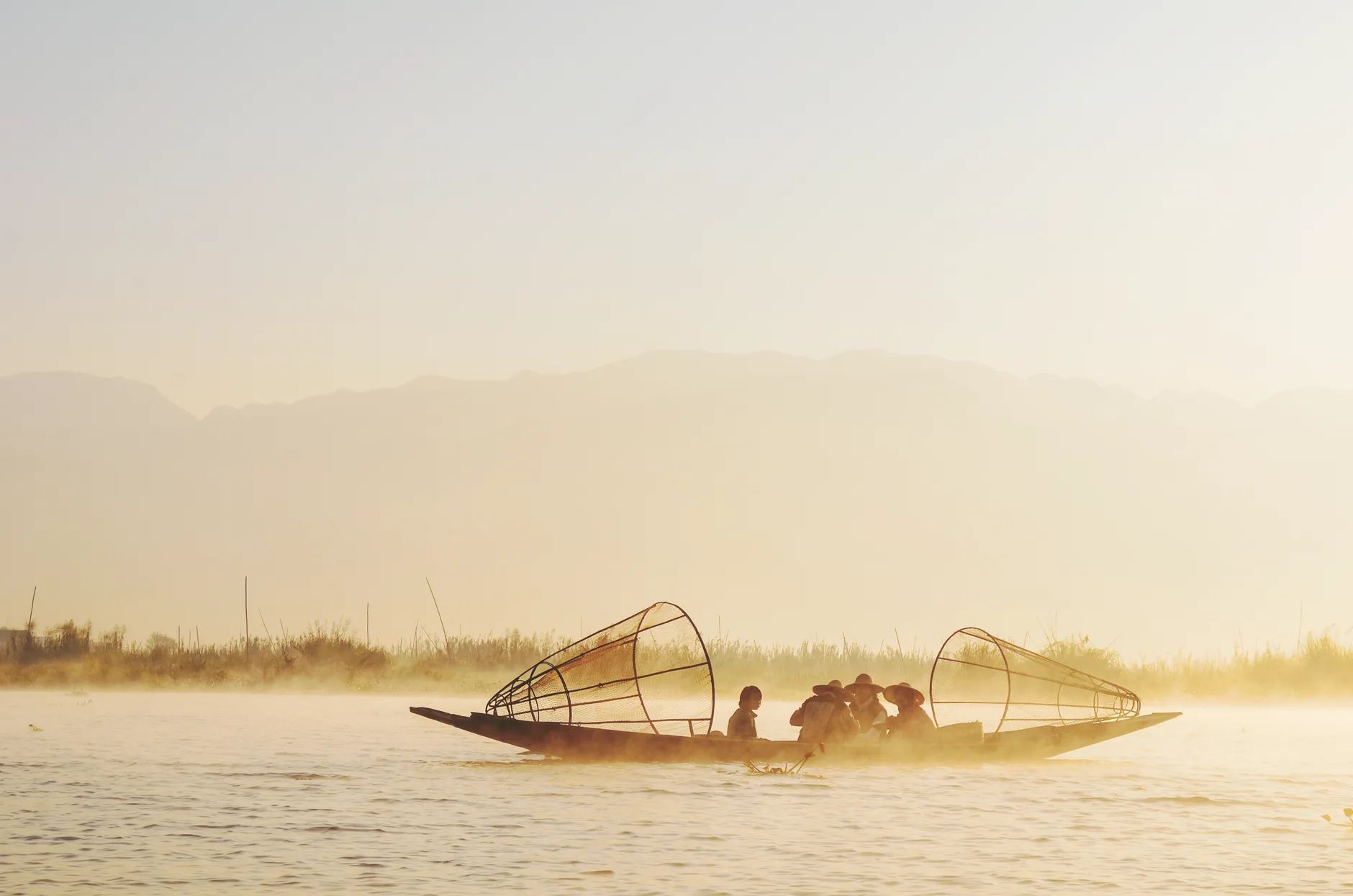
Photo by Amy Chandra on Pexels
The teashop on 19th Street in Yangon’s Chinatown fills up around 7am with men reading the Myanmar Times over cups of sweet, condensed-milk tea, the air thick with charcoal smoke from the grilling skewers next door. A monk in deep maroon robes walks past collecting alms, bare feet on wet pavement, and nobody looks up — this is simply the morning happening, not a performance for anyone’s camera. Above the street, tangled power lines sag between colonial-era buildings with peeling mint-green shutters, paint cracked from a century of monsoons.
This is the Myanmar that independent travel still offers: layered, specific, unresolved. But it’s also a country where the ground has shifted hard since the 2021 military coup, and anyone planning a trip here needs to go in with eyes open about what that actually means — not just for safety, but for where your money ends up and whether going is the right call at all right now.
The honest starting point: is this the right trip, right now
Myanmar has been under military rule since February 2021, and parts of the country are in active armed conflict between the military (the Tatmadaw) and a patchwork of ethnic armed organisations and People’s Defence Forces. This isn’t background noise — it directly shapes where you can and can’t travel, and it should shape whether you go at all.
Before booking anything, check your government’s current travel advisory. The UK’s Foreign, Commonwealth & Development Office maintains detailed country guidance for Myanmar, and the US State Department publishes its own travel advisory — both are updated far more frequently than any blog post, and both currently advise against travel to large parts of the country outside the main tourist circuit. Take that seriously. This isn’t the place to prove a point about independent travel.
The areas that remain reasonably accessible to foreign travellers — Yangon, Mandalay, Bagan, Inle Lake, and a handful of towns in between — are also the areas the government wants tourists to see, which raises a genuine ethical question: a portion of entry fees at major sites, and some hotel ownership, flows toward the military-aligned economy. Independent operators, family-run guesthouses, and community-based tour cooperatives exist and are worth seeking out specifically, but this requires more research than usual, not less.
Visas, entry points, and what’s actually open
Most nationalities need a visa to enter Myanmar. The e-visa system, when functioning, is the simplest route — processing typically takes a few business days and costs around $50, valid for a 28-day single-entry tourist stay. Approval isn’t guaranteed and processing times fluctuate, so apply with buffer time and a backup plan.
Entry is realistically limited to Yangon International Airport and, for some routes, Mandalay International Airport. Land border crossings from Thailand (Mae Sot–Myawaddy, Mae Sai–Tachileik) and from China have opened and closed repeatedly depending on fighting in the border regions and are not reliable options to plan around — check current status close to your departure date rather than trusting anything written months in advance, including this article.
Once inside, the accessible travel corridor runs roughly: Yangon → Bagan → Mandalay → Inle Lake, with Hpa-An and the Mon State caves as a quieter southern add-on. Rakhine State (including the beaches of Ngapali), much of Shan State beyond Inle, Kachin State, and most of the Myanmar-Thailand and Myanmar-China border regions are either restricted, actively dangerous, or both. Travel permits for some areas still exist in theory but are unpredictable in practice.
Getting around: buses, boats, and the sleeper train that tests your patience
Domestic flights connect Yangon, Mandalay, Bagan, and Heho (the airport for Inle Lake) reasonably reliably, and for travellers with limited time, this is the pragmatic choice — a flight that takes an hour replaces a bus journey that can take ten.
For those with more time, overland travel is where Myanmar reveals itself properly. The night buses between Yangon and Mandalay (around 9 hours) or Yangon and Bagan (around 10 hours) are comfortable enough, with reclining seats and a scheduled toilet stop, though air conditioning is set somewhere near Arctic and a layer is worth packing even in April. The Yangon-Mandalay train, by contrast, is slower, rougher, and genuinely worth doing once — wooden-floored carriages rock hard enough to spill your tea, vendors board at every stop selling boiled peanuts and quail eggs through the windows, and the upper-class sleeper cars (worth the small upgrade) have actual beds.
Boat travel on the Irrawaddy River between Mandalay and Bagan is slower still — roughly 11 to 14 hours depending on water levels and season — but it’s one of the more atmospheric ways to arrive at Bagan, watching the temple spires emerge from the river mist at dawn rather than pulling up by road.
| Route | Mode | Duration | Approx. cost (USD) | Notes |
|---|---|---|---|---|
| Yangon → Mandalay | Domestic flight | ~1.5 hrs | $80–130 | Fastest, most reliable |
| Yangon → Mandalay | Night bus | ~9 hrs | $12–20 | Reclining seats, one stop |
| Yangon → Mandalay | Train (upper sleeper) | ~14–16 hrs | $20–40 | Slow, rough, memorable |
| Mandalay → Bagan | Riverboat | ~11–14 hrs | $40–50 | Seasonal, weather-dependent |
| Yangon → Bagan | Night bus | ~10 hrs | $15–22 | Most common overland link |
| Bagan → Inle Lake (Heho) | Domestic flight | ~45 min | $70–100 | Shared small aircraft |
| Bagan → Inle Lake | Shared taxi/bus | ~7–8 hrs | $10–15 | Via Kyaukpadaung |
Bagan: more temples than you can reasonably see, and that’s fine
Bagan’s plain holds over 2,000 surviving temples and stupas across roughly 40 square kilometres, a scale that becomes genuinely disorienting on an e-bike (the standard, legal, and only sensible way to get around — rental runs around $6–8 a day from guesthouses in Nyaung-U). The archaeological zone requires an entry fee, generally around $20–30, paid once on arrival and valid for the duration of your stay.
Skip the temptation to “see everything.” Shwesandaw and the viewpoint platforms around it draw the sunrise crowds, which is reason enough to go elsewhere at dawn — Pyathada Paya’s upper terrace or the quieter temples around Minnanthu village offer the same light with a fraction of the people. Bagan was inscribed as a UNESCO World Heritage Site in 2019, decades after it probably should have been, largely due to earlier restoration work that didn’t meet conservation standards — worth knowing before you’re disappointed that some temples look suspiciously new.
Inle Lake and the Kalaw trek: the slow route in
Rather than flying straight to Heho, consider the two-to-three-day trek from Kalaw to Inle Lake, a route through Shan hill villages, tea plantations, and terraced farmland that remains one of the more rewarding things to do independently in this part of the country — guides are easy to arrange through guesthouses in Kalaw, cost around $15–25 per person per day including homestay accommodation and meals, and the terrain is moderate enough for reasonably fit beginners.
The trek ends at Inle Lake itself, where stilt villages, floating tomato gardens, and the Intha fishermen’s distinctive one-legged rowing technique (a genuine adaptation to the shallow, weed-choked water, not a tourist show) make for a slower, boat-based couple of days. Nga Phe Kyaung monastery and the five-day rotating market, which moves between villages around the lake on a set schedule, are both worth timing your visit around.
Mandalay and Yangon: the bookends
Mandalay feels less immediately charming than Bagan or Inle but rewards a couple of days — U Bein Bridge at Amarapura, the world’s longest teak footbridge, is best walked at golden hour when the monks and commuters crossing it silhouette against the lake; Mandalay Hill offers a long covered stairway up to temple views over the city; and the monastic complex at Sagaing Hill, across the Irrawaddy, holds hundreds of pagodas and working monasteries on wooded hillsides, far quieter than anything in Bagan.
Yangon rewards slower wandering more than ticking off sights. The Shwedagon Pagoda, gilded and genuinely enormous, is worth visiting twice — once at midday for the crowds and gold-leaf spectacle, once after dark when the marble underfoot cools and the complex empties out. Downtown, the grid of colonial streets between Pansodan and Sule Pagoda Road holds crumbling, beautiful buildings worth a walk even without a specific destination in mind, and the Bogyoke Aung San Market is the place for lacquerware, gems, and longyi fabric, though bargaining is expected and prices for foreigners start high.
Money, connectivity, and the unglamorous practicalities
Myanmar remains largely a cash economy for independent travellers, and US dollars are still the backbone of larger payments — hotels, entry fees, and flights are frequently priced in USD. Bring pristine, unfolded, unmarked bills; genuinely minor creases or tiny tears can get notes rejected outright at exchange counters, which catches first-time visitors off guard every time. Myanmar kyat is used for day-to-day spending — street food, local transport, markets — and ATMs in Yangon and Mandalay generally work for international cards, though it’s wise not to rely on this entirely given periodic network issues.
A local SIM (Ooredoo or MPT) is cheap and easy to pick up at the airport, and data coverage is decent in the main tourist corridor, patchy elsewhere. Internet access generally functions but has been subject to restrictions and shutdowns at various points since 2021 — don’t assume constant connectivity, and don’t plan anything that depends on it.
What to eat, and where
Myanmar’s food sits at a genuinely interesting crossroads of Indian, Chinese, and Southeast Asian influence, and it’s underrated even among people who’ve travelled widely in the region. Mohinga — a fish-based rice noodle soup eaten at breakfast — is the closest thing to a national dish, and the best versions are found at street stalls rather than restaurants; in Yangon, the stalls around Thein Phyu Road do a reliable version. Tea leaf salad (laphet thoke), made from fermented tea leaves tossed with fried beans, nuts, and garlic, is sharp, bitter, and genuinely unlike anything else — worth ordering even if it sounds unappealing on paper. Shan noodles, a Inle-region specialty of flat rice noodles in a light tomato-based broth, are worth seeking out specifically around Nyaungshwe. Anyone who’s spent time navigating food markets elsewhere in Southeast Asia will recognise the general logic here — busy stalls with high turnover, boiling broths, and food cooked in front of you are the safest bet.
Who this trip actually suits
Independent travel in Myanmar right now suits travellers who’ve already built some comfort with uncertainty — people who’ve handled budget travel in less straightforward corners of Southeast Asia and aren’t rattled by a cancelled bus, a patchy internet connection, or plans needing to change at short notice. It’s not the place for a first solo trip, and anyone weighing it against other options should know this isn’t the only country in the region offering depth without crowds — it’s simply the one currently asking the most of its visitors in terms of research and flexibility.
The Bottom Line
- Check your government’s travel advisory close to your departure date, not months out — the situation in Myanmar changes, and this article is a snapshot, not a guarantee.
- Stick to the accessible corridor (Yangon, Bagan, Mandalay, Inle Lake, Hpa-An) and don’t attempt border regions or conflict-affected states, regardless of what a fixer or forum post tells you is possible.
- Seek out family-run guesthouses, independent trekking guides in Kalaw, and community-run boat operators at Inle Lake specifically — where your money goes matters more here than in most destinations.
- Build in slack: buses run late, internet drops out, flights get rescheduled. The country rewards travellers who hold their plans loosely.
- Bring crisp, undamaged US dollars, a mix of payment backups, and the patience for a trip that moves at its own pace rather than yours.
Keep reading: Avoiding overtourism in Southeast Asia: where to go