Staying in a traditional Japanese ryokan: a first-timer guide
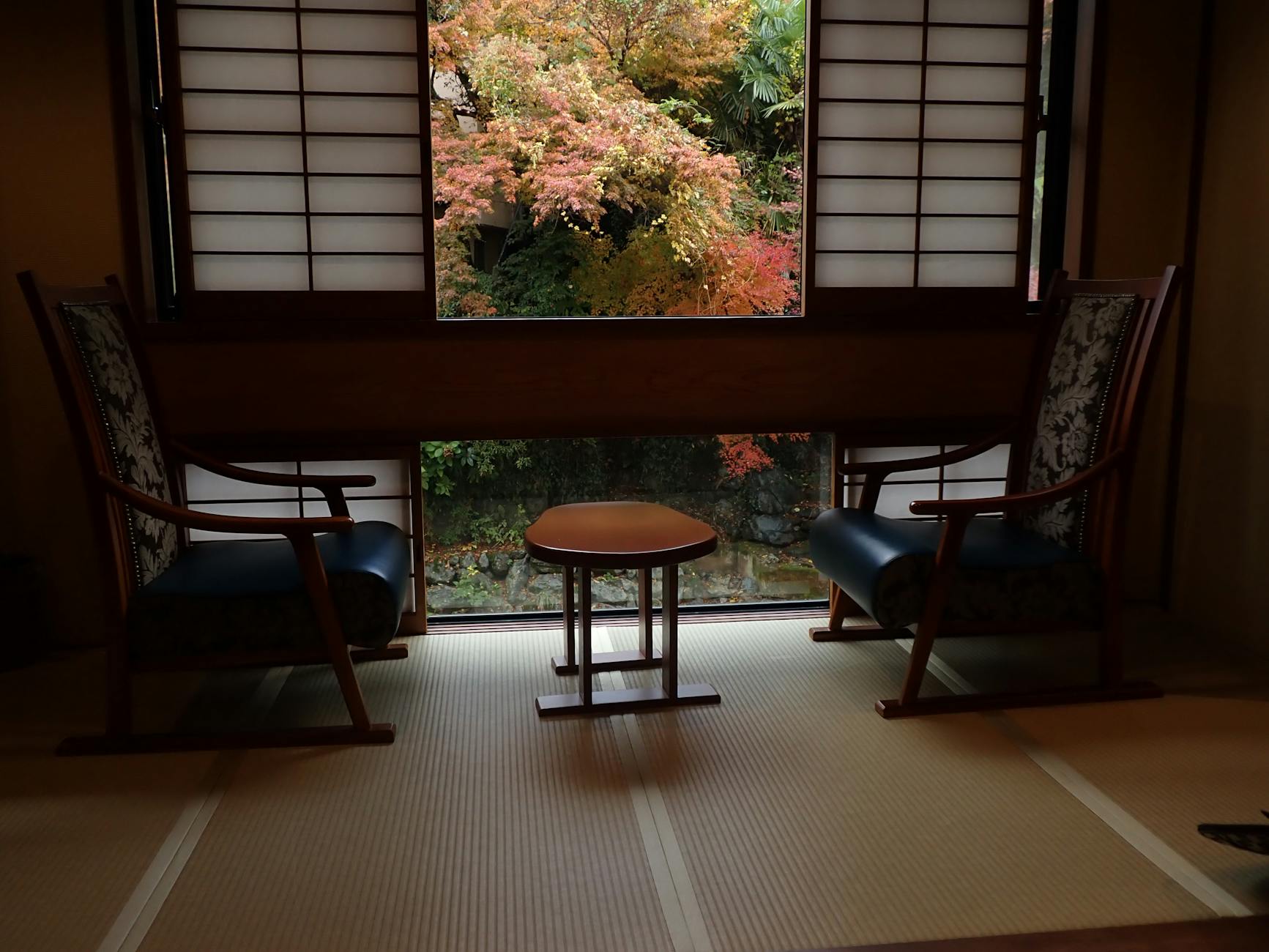
The door to your room is paper-thin — shoji screens that filter afternoon light into something amber and soft. Your futon hasn’t been laid out yet; that happens after dinner. On the low lacquered table there’s a pot of tea and two wagashi sweets shaped like autumn leaves, and somewhere below the window the sound of a wooden bathing bucket hitting stone echoes up from the rotemburo. You take off your shoes at the entrance of the building. Then your slippers. Then, at the tatami threshold, your socks.
The ryokan — Japan’s traditional inn — operates on a completely different logic from a hotel. Understanding that logic before you arrive is half the work.
This guide covers the practicalities in full: where to find a genuinely traditional ryokan, what a stay actually costs, what to wear, how to behave at the onsen, and which towns deliver the kind of experience that makes this one of the most distinctive nights you can spend anywhere in the world.
What actually makes a ryokan a ryokan
The word is everywhere, applied loosely to everything from a century-old wooden inn on a mountain road to a business hotel that put tatami flooring in one wing. For first-timers, the distinction matters.
A traditional ryokan has tatami-mat rooms, futon bedding laid by staff each evening, and — in most cases — yukata (cotton robes) provided for wearing throughout the property. Meals are typically included: kaiseki dinner served in your room or a private dining area, and a Japanese breakfast the following morning. Onsen access, either communal or private, is standard at better establishments. Staff — often referred to as nakai — manage the room throughout your stay.
This is not a serviced apartment you happen to sleep in. The structure of a ryokan stay is deliberate: arrival, bath, dinner, sleep, morning bath, breakfast, departure. That rhythm is the product itself.
The term ryokan is unregulated in Japan, so the simplest filter is to look for properties listed under the Japan Ryokan & Hotel Association, or to search specifically for onsen ryokan in established hot-spring towns. Japan National Tourism Organization’s ryokan guidance is a reliable starting point for understanding classifications.
Where to stay: the towns that deliver
Geography shapes the experience significantly. An onsen town set in mountains or beside a river offers something qualitatively different from an urban ryokan tucked between apartment blocks.
Kinosaki Onsen, Hyogo Prefecture is arguably the most complete introduction: a small town built entirely around seven communal bathhouses, connected by willow-lined streets where guests wander between baths in yukata and wooden geta sandals. Your ryokan entry fee typically includes access to all seven bathhouses. The town is two and a half hours from Osaka by limited express train on the Kinosaki line. Prices for a one-night stay with dinner and breakfast at a mid-tier inn run ¥20,000–¥35,000 per person (roughly £105–£185 / $130–$230).
Kurama Onsen, Kyoto Prefecture sits forty minutes north of Kyoto by Eizan Railway from Demachiyanagi station, in a cedar-forested valley. It’s quieter and more accessible for travellers already based in Kyoto. The single onsen facility here is open-air and set directly against the mountainside.
Hakone, Kanagawa Prefecture is the easiest ryokan destination from Tokyo — around 90 minutes by Romancecar train from Shinjuku on the Odakyu line. It’s popular and more expensive than other regions (expect ¥30,000–¥60,000 per person for a quality stay with meals), but the combination of Fuji views, mountain setting, and excellent ryokan infrastructure makes it a strong choice for first-timers who want logistics kept simple.
Nyuto Onsen, Akita Prefecture requires more effort but rewards it. Seven small inns scattered through a snowy forest in the Tohoku mountains, some accessible only by shuttle bus. The baths are milky white with sulphur, the kitchens draw on northern Japanese mountain cooking, and the isolation is genuine. Access is by Shinkansen to Tazawako station, then a bus or taxi. Snow covers the area from November through April.
Yufuin, Oita Prefecture (Kyushu) has the best concentration of quality ryokan in the western part of the country. It’s a short bus or taxi ride from Beppu, Japan’s most famously intense onsen town, and sits in a quiet valley below Mt Yufu. Yufuin is slightly more commercialised along its main street but pull one turn off Yufuin’s Yumino-Mori road and you’re into rice paddies and steam.
Costs, booking, and what’s included
| Property type | Price per person per night | Meals | Onsen access | English support |
|---|---|---|---|---|
| Budget ryokan / minshuku | ¥8,000–¥15,000 | Sometimes | Often shared | Limited |
| Mid-tier onsen ryokan | ¥18,000–¥35,000 | Dinner + breakfast | Yes | Moderate |
| High-end ryokan (ryotei style) | ¥40,000–¥120,000+ | Full kaiseki included | Private or shared | Usually yes |
Prices are per person, not per room — this surprises many first-timers. Most ryokan quote ippaku nishoku (one night, two meals), meaning dinner and breakfast are built into the rate. This is not optional at traditional properties. Turning down the meals to reduce cost usually isn’t possible; if you want room-only, look for a shukubo (temple lodging) or a minshuku (family-run inn), which are less formal.
Booking directly through the inn’s website — or through Jalan or Ikyu.com (Japanese booking platforms) — often gets better rates than international aggregators. Many traditional ryokan do not list on platforms like Booking.com. The website Ryokan.or.jp lists member properties with English support.
Book two to three months ahead for popular onsen towns, especially during sakura season (late March–mid April), Golden Week (late April–early May), and koyo (autumn foliage) season (mid-October–November). Summer weekends in Hakone sell out well in advance.
The onsen: how it actually works
This is the section most first-timers want but feel awkward asking about.
Japanese communal baths are entered naked. Swimwear is not worn. This is not negotiable at traditional establishments, and attempting to wear a swimsuit in a shared onsen will mark you out immediately. Single-sex bathing areas are the default at virtually all communal facilities; mixed-gender konyoku baths exist but are rare and usually clearly marked.
The sequence: remove your yukata in the changing room, leave it in a basket, carry your small towel into the bathing area. Wash thoroughly at the individual shower stations before entering the bath. This is mandatory, not optional. Sit on the low wooden stool, use the shower head and soap to clean your entire body, rinse completely, then enter the communal pool. The towel does not go into the water; fold it on your head or leave it at the edge.
Temperature at quality onsen runs 40–43°C (104–109°F). Ten to fifteen minutes is enough for most people. Stay hydrated — drink water before and after.
If you have visible tattoos, call ahead. Many traditional ryokan and bathhouses prohibit tattooed guests in shared facilities. Some have private bath options that accommodate this; others don’t. It’s worth asking directly rather than assuming.
Meals: what you’ll be eating and how it works
Kaiseki — the multi-course dinner served at most onsen ryokan — is one of Japan’s great culinary forms. Don’t let the formality put you off. Dishes arrive in sequence: seasonal appetisers, sashimi, a grilled course, simmered vegetables, rice, pickles, and miso soup. Everything is calibrated to the season and the region. In Kinosaki you’ll eat matsuba crab from November through March. In Nyuto Onsen, winter brings gibier (game) and mountain vegetables preserved from summer.
Dinner is typically served between 6pm and 7:30pm; breakfast around 7:30–8:30am. Times are set at check-in. Meals are either brought to your room (room service in the fullest sense) or taken in a private dining room. Communal dining halls are less common in higher-end establishments.
Dietary requirements can often be accommodated with advance notice, but this needs to be communicated at booking, not on arrival. Vegetarian kaiseki (shojin ryori) is a speciality at temple lodgings and some traditional inns, particularly around Kyoto.
Etiquette essentials: what first-timers get wrong
Shoes: Remove them at the entrance genkan and place them in the designated cubby. The inn provides slippers for corridors. Remove slippers again before stepping onto tatami. This feels like a lot of footwear management at first; it becomes automatic.
Yukata: The cotton robe is for use throughout the property and, in onsen towns like Kinosaki, outdoors too. Wrap left side over right — the opposite is reserved for the deceased. The obi sash ties loosely at the front for yukata (unlike a formal kimono).
Timing: Ryokan operate on a tight schedule. Check-in is typically 3–4pm, check-out 10–11am. Dinner is a fixed time, not on demand. Arriving late without calling ahead — especially for dinner — is genuinely disruptive to a small inn’s kitchen.
Phones: Not banned, but keep volumes low and phones away from the communal baths. The pace of a ryokan is deliberate; pulling out a phone in the dining room breaks something.
Tipping: Do not tip. Tipping is not part of Japanese hospitality culture and can cause embarrassment. The service you receive is considered part of the inn’s standard.
As Lonely Planet’s Japan etiquette guide notes, the easiest approach is to watch what other guests do and follow the rhythm the inn sets. Most staff understand that foreign guests are learning as they go and won’t interpret mistakes as disrespect.
Practical logistics for getting there
Japan Rail Pass holders can access most onsen destinations by Shinkansen and limited express without additional cost. Kinosaki, Hakone, and Yufuin are all well-served by rail. Nyuto Onsen requires a taxi or infrequent local bus from Tazawako station (the bus runs roughly every two hours; confirm the schedule before you travel).
The Suica or Pasmo IC card handles local transport and small purchases. Carry cash — many traditional ryokan still prefer or require cash payment, and rural ATMs can be limited to Japan Post or 7-Eleven machines that accept foreign cards.
Mobile data: a pocket Wi-Fi unit rented at the airport or an eSIM from providers like IIJmio or Mobal covers connectivity throughout most onsen regions. Mountains can reduce signal, but in-room Wi-Fi is standard at most ryokan.
Check-in times are firm. If your Shinkansen or connecting train is delayed, call ahead — the nakai system depends on knowing when guests arrive to manage room preparation and meals.
The Bottom Line
-
Choose your town before your inn. The setting — mountain, forest, coast — shapes the experience more than individual room quality. Kinosaki Onsen is the most complete first-time destination; Hakone is the most convenient from Tokyo.
-
Budget for the full package. A mid-tier ryokan with meals at ¥25,000 per person is reasonable value when you account for two high-quality meals and unlimited onsen access. Trying to cut costs on this experience usually means cutting the experience itself.
-
The onsen is not optional — it’s the point. Wash before you enter, go without a swimsuit, keep the towel out of the water. That’s the whole etiquette condensed.
-
Book directly with the inn, and far in advance during peak seasons. Autumn foliage and cherry blossom periods fill quality properties months out. Dietary requirements must be communicated at booking.
-
Let the schedule run you, not the other way around. A ryokan stay is structured: bath, dinner, sleep, bath, breakfast. The rhythm is the rest. The guests who enjoy it most are the ones who stop trying to optimise it.