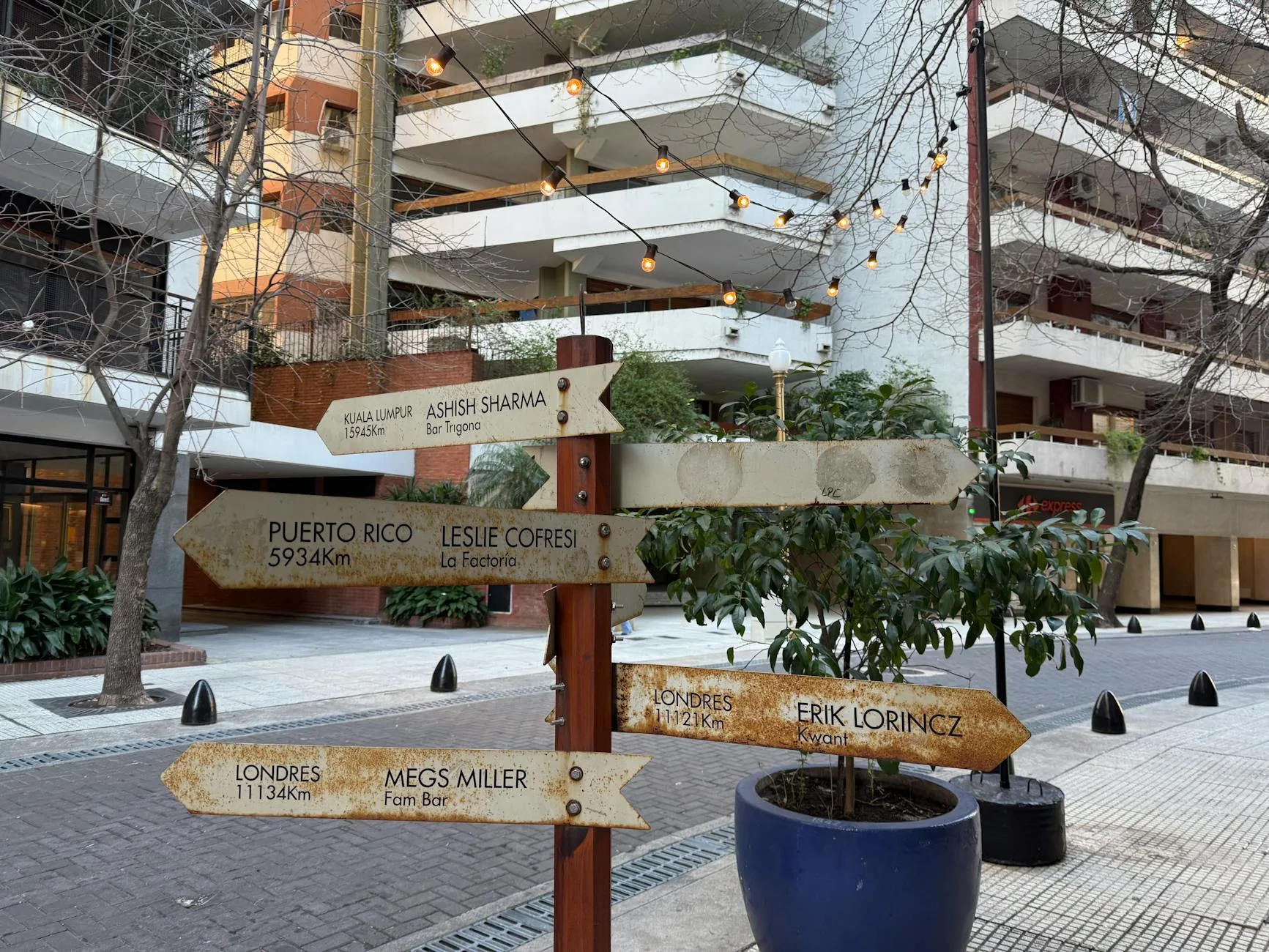
Photo by maria Chaile on Pexels
Street art and culture in Buenos Aires: neighbourhood guide
The wall appears at the end of a narrow passage off Calle Thames, in the heart of Palermo Soho. It’s three storeys tall and depicts a woman mid-dissolution, her face fragmenting into geometric planes of turquoise and burnt orange, her eyes still fixed on you. No plaque, no credit, no context — just paint, brick, and something that demands you stop. A man on a bicycle pedals past without looking up. He has seen it a hundred times.
That is Buenos Aires street art in miniature: monumental in scale, dense with meaning, completely woven into the fabric of daily life. The city’s murals are not a tourist attraction that happens to exist here. They grew out of political upheaval, economic collapse, and a deep tradition of public visual culture. The 2001 financial crisis stripped institutional life bare, and artists responded by taking the streets as their canvas — a tradition that has since produced one of the richest urban art cultures in the world.
This guide moves neighbourhood by neighbourhood through the city’s most rewarding areas for street art and visual culture. Each section gives you what you actually need: where to go, what to look for, how long to spend, and how to get there.
Palermo Soho and Hollywood: where it’s densest
Palermo is the obvious starting point and earns that status. The sub-neighbourhoods of Palermo Soho and Palermo Hollywood contain the highest concentration of significant murals in the city, clustered particularly around Calle Thames, Calle Malabia, and the streets radiating outward from Plaza Serrano (officially Plaza Cortázar).
Start at the corner of Thames and Honduras and walk north toward El Salvador. This eight-block stretch changes weekly — murals are painted over, replaced, layered. That impermanence is part of the culture. The work here ranges from hyper-detailed portraiture to abstract political commentary. Look for the work of Ever, one of Argentina’s most recognised muralists, whose large-scale figures in faded earth tones appear throughout Palermo and beyond.
From Plaza Serrano, the side streets heading toward Jorge Luis Borges and Gurruchaga are worth the wander. The Pasaje del Correo, a small pedestrian alley near the intersection of Costa Rica and Thames, is often covered floor to ceiling in paste-ups and stencil work that shifts seasonally.
Getting there: Subte Line D to Plaza Italia, then a 10-minute walk west. Or Line D to Scalabrini Ortiz. The neighbourhood is very walkable. Budget 2–3 hours minimum to wander properly.
Villa Crespo: the working neighbourhood with serious walls
One block west of Palermo, Villa Crespo operates at a different register. Less boutique, more functional — textile workshops, small factories, neighbourhood cafés that have been there for forty years. The street art here reflects that texture. Murals tend larger, rawer, more explicitly political.
The stretch of Avenida Corrientes between Scalabrini Ortiz and Avenida Medrano is where Buenos Aires’ late-night cultural life concentrates, and the building facades along it are treated as ongoing exhibitions. Further north, around Calle Loyola and Avenida Warnes — the city’s auto-parts district — vast industrial walls carry enormous murals that you’d miss entirely if you weren’t on foot.
The Mercado de Villa Crespo, on Aguirre 1200, is worth a stop: a converted factory space housing food stalls, design studios, and small galleries, with several murals on its exterior walls painted during the building’s renovation. Inside, lunch runs around 2,500–4,000 ARS for a main and a drink (prices shift with inflation — budget roughly USD 5–8 at current parallel rates).
Getting there: Subte Line A to Avenida La Plata, then walk north on Scalabrini Ortiz. Or Line B to Malabia.
San Telmo: history, politics, and Sunday chaos
San Telmo is the city’s oldest neighbourhood, and its relationship with visual culture is older and more complicated than Palermo’s. The cobblestoned streets around Defensa, Balcarce, and Bolívar are thick with colonial architecture, and the murals here tend to engage directly with that history — depicting the desaparecidos, indigenous rights, Peronist iconography.
The Feria de San Telmo, held every Sunday along Defensa between the Plaza de Mayo and Parque Lezama, fills the street with antique dealers, street performers, and craft vendors from around 10am to 5pm. It draws large crowds — Sunday afternoon can feel genuinely shoulder-to-shoulder. The murals on the surrounding buildings are best photographed on a weekday when the crowds thin and the light on the painted facades is cleaner.
El Zanjon de Granados (Defensa 755) is not a street art venue, but it’s the kind of place that gives San Telmo its depth: a restored 19th-century tunnel system beneath a private house, open for guided tours Wednesday through Sunday (entry around USD 12 in 2026). The tours are conducted in Spanish and English and take 45–60 minutes.
Don’t miss Pasaje Lanín, about three blocks south of Parque Lezama in the Barracas neighbourhood — technically a short walk from San Telmo proper. The entire street, including house façades, pavements, and even the trees’ painted bases, was decorated by artist Marino Santa María starting in the 1990s with intricate, mosaic-style coloured tiles and ceramic work. It’s unlike anything else in the city and remains largely residential — ring the doorbell at number 33 and the homeowners sometimes let visitors into the interior courtyard, which continues the tiling inside.
Getting there: Subte Line C to San Juan or Independencia. Pasaje Lanín is in Barracas — take Line C to San Juan and walk east on Caseros about 8 blocks.
La Boca: beyond the postcard
La Boca has a street art culture that exists in complicated relationship with its tourist fame. The Caminito pedestrian street — with its brightly painted corrugated-iron houses — is photographed millions of times a year and is genuinely worth seeing, but it’s the blocks surrounding it that carry more interesting work.
The murals around Avenida Almirante Brown and the streets leading toward the Riachuelo waterfront tend to be larger, darker, and less curated: political street art mixed with commissioned work for local businesses, paste-ups layered over paste-ups. The Fundación PROA (Av. Pedro de Mendoza 1929), a contemporary art foundation with a strong international programme, sits right on the waterfront with excellent permanent and rotating exhibitions. Entry is around USD 4; closed Mondays.
La Boca operates differently from Palermo in one practical sense: it’s best visited during daylight hours and the main pedestrian corridor. The surrounding streets, especially after dark or if you wander far from the main drag, require more care — it’s a neighbourhood with significant socioeconomic inequality and pockets that tourists have little reason to venture into. That’s not a reason to avoid it, but it’s worth knowing.
Getting there: No Subte line serves La Boca directly. Take Bus 29 from the city centre (runs along Defensa from San Telmo) or Bus 64 from Palermo. The ride is 20–35 minutes depending on traffic.
Coghlan and Colegiales: the quieter north
Less covered in most guides, the northern neighbourhoods of Coghlan and Colegiales reward a slow afternoon. Coghlan in particular has the feel of a small provincial town transplanted into the capital — detached houses with gardens, a quiet plaza, and almost no tourist infrastructure. The street art here is newer and more dispersed, but the Pasaje Beláustegui and the side streets around Calle Congreso in Colegiales carry a clutch of excellent murals by artists associated with the collective Run Don’t Walk, known for intricate, large-format work that merges naturalist imagery with surrealist detail.
For a sense of how the art scene intersects with music and nightlife culture, the bars and venues around Calle Céspedes in Colegiales — places like El Bar de la Chola — double as informal galleries, with rotating art on interior walls and regular acoustic performances on weekends.
Getting there: Subte Line D to Palermo, then Bus 39 or 57 north into Colegiales. Coghlan is best reached by the Tren Mitre from Retiro station — it runs every 15–20 minutes and costs under USD 0.50.
Practical logistics: getting around, costs, and timing
| Neighbourhood | Best time to visit | Getting there | Time needed | Entry costs |
|---|---|---|---|---|
| Palermo Soho/Hollywood | Morning (better light, fewer crowds) | Subte D to Plaza Italia | 2–3 hours | Free (street) |
| Villa Crespo | Weekday afternoon | Subte B to Malabia | 1.5–2 hours | Free (street) |
| San Telmo | Weekday (avoid Sunday if crowds bother you) | Subte C to San Juan | 2–3 hours | Free (street); El Zanjon ~USD 12 |
| La Boca | Late morning, daylight only | Bus 29 or 64 | 2 hours | Free; PROA ~USD 4 |
| Colegiales/Coghlan | Weekend afternoon | Subte D + bus, or Tren Mitre | 1.5–2 hours | Free (street) |
Currency note (2026): Argentina’s inflation means printed prices date quickly. The most reliable approach is to carry US dollars and exchange at casas de cambio (exchange houses) — legal since the currency reforms of 2024 — which give significantly better rates than ATMs or hotel desks. Always confirm current rates before you travel; BBC Travel’s Argentina coverage provides useful context on navigating the city’s economic fluctuations.
Guided street art tours: Several operators run two to three-hour walking tours of Palermo and San Telmo for around USD 15–25 per person. Graffitimundo is the most established — founded by a group of foreign residents with long relationships with the city’s artists, their guides speak English and Spanish and include access to a few studios and private spaces not visible from the street. Worth booking in advance, especially in high season (March–May and September–November).
Safety: Buenos Aires is a large Latin American city with the ordinary range of petty crime risks. The neighbourhoods covered here are all navigable without particular concern during the day. Keep phone use minimal in less-populated streets, don’t leave cameras unattended, and follow general city-sense. The tourist police number is 0800-999-5000.
If your Buenos Aires trip is part of a broader South American journey, the best multi-day hikes in Patagonia for beginners covers the southern reaches of Argentina in practical detail — a natural extension of a Buenos Aires base.
Best season: March to May (autumn) gives mild temperatures, lower tourist numbers, and the best light for photography. October and November are also excellent. January and February are hot and humid; July is cold and many venues reduce their hours.
Where culture lives beyond the walls
Street art is the most visible layer of Buenos Aires’ cultural life, but it points to deeper layers worth following.
The Centro Cultural Recoleta (Junín 1930), housed in a former Franciscan convent, runs free and low-cost exhibitions, performance spaces, and film screenings year-round. The building alone is worth the visit; the courtyard hosts outdoor events most weekend afternoons. Entry to the main gallery spaces is free.
The MALBA (Museo de Arte Latinoamericano de Buenos Aires, Figueroa Alcorta 3415) is the city’s strongest collection for understanding where Buenos Aires’ visual culture sits within the wider Latin American tradition — Antonio Berni’s large-scale social realist work, Frida Kahlo, and a strong contemporary photography programme. Entry around USD 8; closed Tuesdays.
For food alongside all of this: in San Telmo, El Federal (Carlos Calvo 599) has been operating since 1864 and serves straightforward Argentine bar food — tortilla española, picada, cold Quilmes — in an interior that hasn’t changed much in decades. The empanadas de carne are made in-house. In Villa Crespo, Las Cabras (Fitz Roy 1795) is a reliable neighbourhood parrilla with good prices and no tourist theatre. The entraña (skirt steak) is worth ordering.
Buenos Aires’ restaurant and nightlife scene runs late by any global standard: dinner before 9pm is unusual, and the city’s cultural programming — talks, performances, gallery openings — often begins at 8pm and runs past midnight. Plan your street art walks for the morning or early afternoon and save evenings for the city’s interior life.
If the appetite for culturally specific neighbourhood immersion extends to other Latin American cities, the learning Spanish in Antigua, Guatemala: a language school guide covers a very different Central American register — but Spanish preparation of any kind pays dividends in Buenos Aires, where English is less widely spoken outside the tourism industry than you might expect.
The Bottom Line
-
Palermo Soho is the densest starting point, but Villa Crespo and Pasaje Lanín in Barracas offer more texture with significantly fewer other visitors. Build a route that connects more than one neighbourhood per day — they’re close and the Subte makes it easy.
-
Go on foot. The street art in Buenos Aires is on alleyways, building sides, shuttered persianas, and interior courtyard walls. Rideshares and buses will get you to a neighbourhood, but the work is found by walking slowly and looking sideways.
-
The cultural calendar runs parallel to the street. Check the Centro Cultural Recoleta and MALBA’s monthly programming before you arrive — exhibitions rotate frequently and there’s almost always something scheduled that costs nothing or very little.
-
Currency logistics matter more here than in most cities. Legal exchange houses (not black market, which has effectively been absorbed into the formal system post-2024 reforms) give far better rates than ATMs. Carry USD in clean, undamaged bills — Argentine casas de cambio can be finicky about condition.
-
The art changes. Walls are painted over, murals disappear, new ones appear. A building you read about may carry entirely different work by the time you arrive. That is part of the point. Bring a good eye rather than a checklist.
Keep reading: How to spend a month in Colombia on a budget