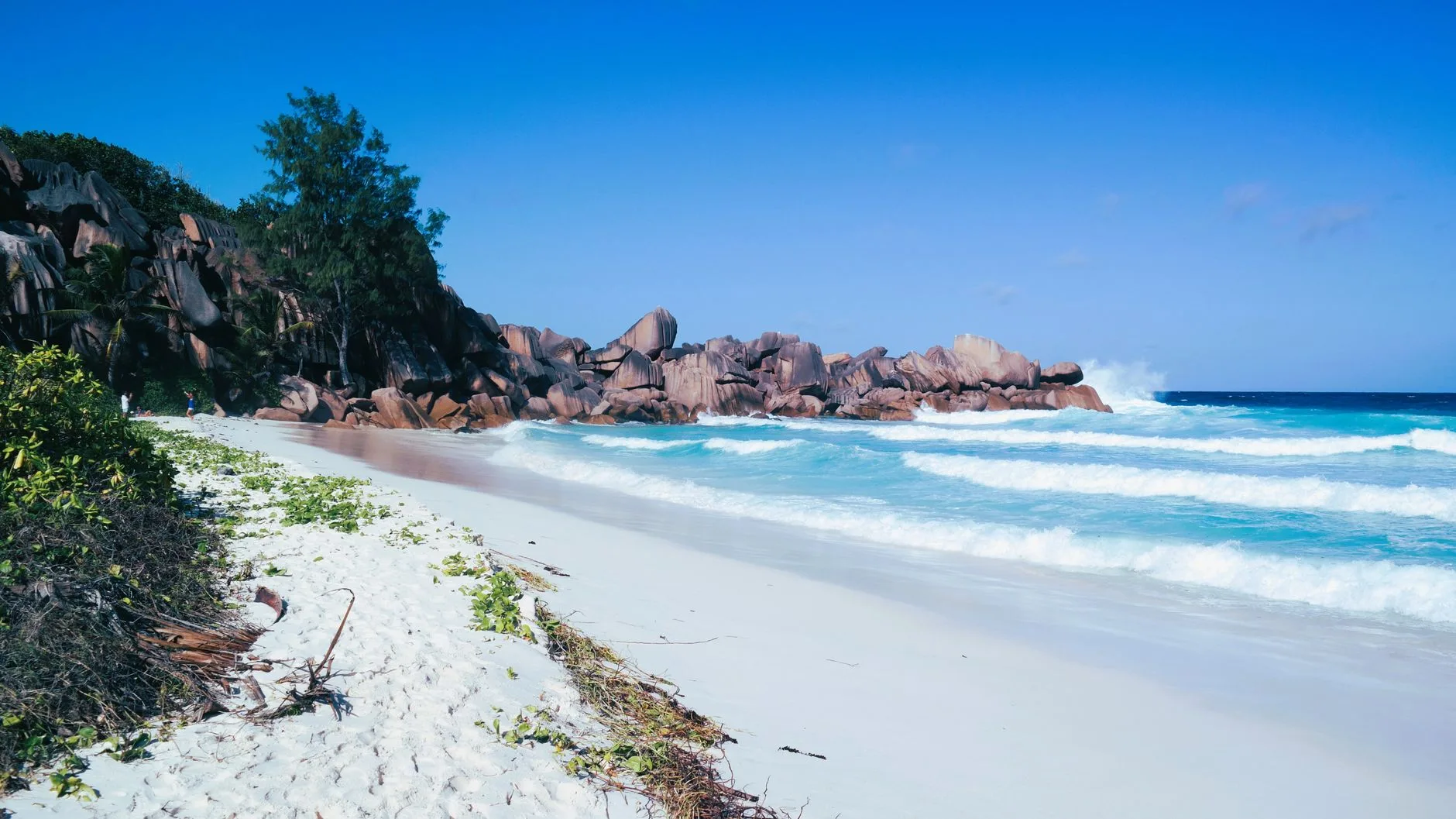
Photo by Riccardo Cocconcelli on Pexels
The granite boulders at Anse Source d’Argent are the colour of rusted copper at low tide. They lean over the sand in shapes that look engineered — arches, overhang, smooth cathedral walls — and the water between them shifts from turquoise to near-white depending on how deep it is and where the sun is sitting. It’s the kind of place that makes you stop mid-sentence.
The Seychelles is an archipelago of 115 islands scattered across the Indian Ocean northeast of Madagascar, and it has been attracting a particular kind of visitor for decades: those willing to spend real money to sit somewhere genuinely beautiful. That reputation is earned. But the islands are also more varied than the resort brochures suggest, and knowing which beach suits your actual trip — one island or three, snorkelling or swimming, easy access or a bit of a walk — makes a significant difference to whether you leave satisfied or slightly underwhelmed.
This guide covers ten of the best beaches across the main islands: Mahé, Praslin, and La Digue. Each entry names the beach specifically, tells you how to reach it, what the water is like, how crowded it gets, and what surrounds it. Prices are in Seychellois rupees (SCR) and euros, which are widely accepted. Entry to Seychelles requires a Travel Authorisation (free, obtained online before departure) and proof of onward travel and accommodation; there are no visa fees for most nationalities.
What to know before you go
Getting there: The only international airport is Seychelles International Airport on Mahé (SEZ). Direct flights run from Dubai (Emirates), Doha (Qatar Airways), Paris (Air Seychelles, Air France), and Nairobi, among others. From the UK, expect roughly 10–11 hours with a connection.
Getting between islands: Inter-island ferries run from the Inter Island Quay in Victoria, Mahé. Cat Cocos operates the Mahé–Praslin route (approximately 1 hour, around €35–40 each way). La Digue is reached by ferry from Praslin (15 minutes, around €15 each way). Helicopters exist but cost significantly more. Inner island Air Seychelles flights connect Mahé to Praslin in 15 minutes for around €100–150.
Best season: May to September brings southeast trade winds — cooler, slightly choppy on the east coasts, but good visibility for snorkelling. October to April is warmer and calmer, with the west and south coasts gentler. December to February can bring rain. There is no truly bad time, but your choice of beach may shift depending on season.
Costs: The Seychelles is expensive by any measure. Budget on €150–250 per person per day for mid-range accommodation, meals, and transport. Guesthouses (known locally as cases) on La Digue can bring this down. Self-catering helps considerably.
Sustainability note: The Seychelles has committed to protecting over 30% of its marine territory. Reef-safe sunscreen (mineral-based, no oxybenzone) is strongly encouraged and increasingly required by resorts. If you’re thinking about how to reduce your travel footprint more broadly, there’s useful framing in how to travel more sustainably without giving it up.
1. Anse Source d’Argent, La Digue
The most photographed beach in the Seychelles, and the fame is legitimate. Anse Source d’Argent sits on the southwest coast of La Digue, accessible through the L’Union Estate — you pay around SCR 300 (roughly €20) to enter the estate, which also contains a copra plantation and giant tortoise pen.
The beach itself is a series of coves divided by those famous granite boulders, each pocket of sand slightly different in character. Arrive before 9am or after 3pm to avoid the midday crunch. The water is shallow and calm, particularly during the southeast trade wind season when the west coast of La Digue is sheltered. Good for swimming; the snorkelling is patchy, with better options nearby.
La Digue has no cars beyond a few utility vehicles. You hire a bicycle (SCR 150–200 per day) from one of several rental sheds near the ferry jetty and cycle south along the sealed road past Le Repère and Anse Réunion. The ride takes about 15 minutes. This is a working island — most residents farm, fish, or run guesthouses — and cycling through the interior past vanilla plantations and cinnamon trees is worth doing slowly.
2. Grand Anse, La Digue
On the opposite side of La Digue from Anse Source d’Argent, Grand Anse faces southeast and is exposed to the open ocean. The result is a longer, wilder beach with stronger surf — beautiful to walk but often unsafe to swim, particularly between May and September when the swell builds.
Come here for the scale and the solitude. The sand stretches for nearly a kilometre with almost no development behind it, backed by casuarina trees and a lagoon that fills and empties with the tide. You will likely share it with very few people. The cycle from the ferry is around 25 minutes, mostly flat.
Grand Anse is best visited in the calmer northwest monsoon season (October to April). Even then, check the surf before entering. Local knowledge matters here — ask at your guesthouse the morning you plan to go.
3. Anse Lazio, Praslin
Anse Lazio sits at the northwestern tip of Praslin and is consistently rated among the finest beaches in the Indian Ocean by people who have seen a lot of them. The water is a deep, clear blue-green, the sand is pale and coarse, and two granite outcrops frame the bay. It is beautiful in an uncomplicated, immediately obvious way.
Getting there from Grand Anse (Praslin’s main town) takes around 30 minutes by taxi or bus. The public bus from Grand Anse to Anse Lazio runs several times a day and costs around SCR 10–15. Shared taxis are around SCR 150–200. The road is sealed but winds steeply in places.
Facilities include a small restaurant, Bonbon Plume, which serves grilled fish and octopus curry at tables under the trees. Portions are generous; expect to pay around €25–35 for a main. The snorkelling off the southern rocks is worthwhile — parrotfish, surgeonfish, and the occasional hawksbill turtle patrol the shallow reef. Bring your own equipment from Praslin town; rentals at the beach itself are limited.
Anse Lazio is busy between 11am and 2pm, particularly during peak season (December–January, July–August). Arrive early and you’ll have the water largely to yourself.
4. Anse Georgette, Praslin
North of Anse Lazio, and technically within the grounds of the Constance Lemuria Resort, Anse Georgette is accessible to non-guests — but you need to arrange it in advance. Call the resort, give your name and the date you plan to visit, and they’ll add you to a list. There is no fee; this is a legal requirement under Seychellois law that all beaches remain publicly accessible.
The beach is quieter than Anse Lazio precisely because the logistics deter casual visitors. The water is clear, the snorkelling is good, and the sand is finer. You walk through the resort grounds to reach it — about 10 minutes on a well-maintained path. Bring food and water; you cannot use resort facilities as a non-guest.
5. Anse Volbert (Côte d’Or), Praslin
This is the long, curved beach on Praslin’s northeastern coast — the one backed by guesthouses, small restaurants, and dive shops. It lacks the drama of Anse Lazio but compensates with practicality: calm, swimmable water year-round (sheltered from both monsoons), good snorkelling off the northern end, and easy access by bus or bicycle.
Anse Volbert is where to base yourself if you want to be near the water with easy access to boats heading to Curieuse Island or the St. Pierre snorkelling site (a single granite pinnacle 20 minutes offshore, absolutely worth doing). Several dive operators — including Octopus Dive Centre and Blue Sea Divers — run daily trips from the beach.
Accommodation here ranges from family-run guesthouses at €80–120 per night to mid-range hotels at €200+. Eating is easier and cheaper than elsewhere on Praslin; the small Tante Mimi restaurant a short walk from the beach does a good grilled jobfish with breadfruit chips.
6. Petite Anse, Mahé
The Four Seasons resort sits above Petite Anse on Mahé’s southwest coast, and for a long time this was effectively a private beach. Non-guests can access it, again by Seychellois law, either by walking the coastal path from Anse Louis or by arranging access through the hotel. It is not the most convenient beach to reach, which is exactly why it’s worth the effort.
The water is calm, deep blue, and warm. The beach is backed by forest, and the granite boulders that frame it are smaller and more numerous than at Source d’Argent. There are no facilities for non-guests, so bring everything you need. The coastal walk from Anse Louis takes 20–30 minutes and is well-marked.
7. Beau Vallon, Mahé
Beau Vallon is the most developed beach on Mahé — a long, north-facing bay about 10km from Victoria by bus (SCR 10–15 from the central bus station) with watersports operators, restaurants, beach bars, and hotel frontage. It is the social beach of the Seychelles, and it delivers what it promises: reliable swimming, easy access, plenty to eat, and enough people around to feel lively rather than isolated.
The Sunday evening grilled fish market at Beau Vallon — where vendors set up charcoal grills along the beachfront after sundown — is worth seeking out. You eat outside at plastic tables while hawksbill turtles occasionally surface in the bay behind you. A plate of grilled red snapper or octopus with rice costs around SCR 200–300 (€13–20).
Snorkelling is possible off the northern rocky headland. Dive Seychelles and Beau Vallon Watersports both operate from here; a two-tank dive costs around €90–110 including equipment.
8. Anse Intendance, Mahé
On Mahé’s southern coast, Anse Intendance is long, wide, and powerful — a surf beach where the Indian Ocean arrives with real force between May and October. Swimming during this period is dangerous; the riptides are strong and there are no lifeguards. Come for the walk, the landscape, and the drama.
Outside of the trade wind season (November to April), the water calms enough to swim, and the beach empties significantly compared to busier spots further north. The Banyan Tree Resort occupies the southern end; public access is from the car park at the northern end of the beach, reached via a short path through the trees.
Getting here from Victoria takes around 45 minutes by bus with a change in Quatre Bornes; the last stretch requires either a taxi or a longish walk. Budget around SCR 300–400 for a taxi from the capital.
9. Anse Major, Mahé
Anse Major is only reachable on foot — there is no road access. The trail begins at the end of the sealed road at Bel Ombre, on Mahé’s northwest coast, and takes 40–50 minutes each way along a coastal path that crosses exposed rock sections and rewards you with views back toward the granite cliffs above the sea.
The beach itself is small, quiet, and very clear. There is a good coral reef to the right of the beach (facing the water) with consistent snorkelling — bring your own mask and fins. No facilities at all; carry food and water. The trail is rocky in places but not technically demanding. Wear proper shoes.
This kind of beach — earned rather than simply arrived at — shares something with the trails described in best multi-day hikes in Patagonia for beginners: the effort is part of what makes the place feel like yours.
10. Anse Cocos, La Digue
The furthest accessible beach on La Digue, Anse Cocos sits beyond Grand Anse and Anse Caiman, reached by a 30–40 minute walk along a path through palm forest from the bicycle park at the edge of Grand Anse. The path is mostly flat but can be muddy after rain.
The beach is wide, backed by palms, and usually empty. There is a tidal pool at the southern end that makes for safe, calm swimming when the open sea is rough. No facilities, no vendors, no noise beyond the wind and the surf. Bring water; the walk back under a midday sun is dehydrating.
Best visited in the calmer months (October to April) when the water is swimmable. In the trade wind season, go for the walk and the solitude, not the swimming.
Beach comparison table
| Beach | Island | Access | Best season | Swimming | Snorkelling | Crowds |
|---|---|---|---|---|---|---|
| Anse Source d’Argent | La Digue | Bicycle, 15 min | May–Sept (sheltered) | Good (calm) | Patchy | High |
| Grand Anse | La Digue | Bicycle, 25 min | Oct–Apr | Risky in SE wind | Poor | Low |
| Anse Lazio | Praslin | Bus or taxi | Year-round | Excellent | Very good | Medium–High |
| Anse Georgette | Praslin | Walk through resort | Year-round | Excellent | Good | Low |
| Anse Volbert | Praslin | Bus or bicycle | Year-round | Excellent | Good (north end) | Medium |
| Petite Anse | Mahé | Coastal walk, 20–30 min | Oct–Apr | Good | Moderate | Low |
| Beau Vallon | Mahé | Bus from Victoria | Year-round | Good | Moderate (N headland) | High |
| Anse Intendance | Mahé | Taxi + walk | Oct–Apr | Good in calm season | Poor | Low–Medium |
| Anse Major | Mahé | 40–50 min hike | Year-round | Good | Very good | Very Low |
| Anse Cocos | La Digue | 30–40 min walk | Oct–Apr | Good (tidal pool) | Moderate | Very Low |
Practical logistics: moving between islands
If you are visiting all three main islands, the most efficient loop from Mahé is: Mahé → Praslin by Cat Cocos ferry (1 hour) → La Digue by ferry from Praslin (15 minutes). Return the same way or fly back from Praslin to Mahé. Allow at least two nights per island; three on Praslin or La Digue is better.
Book ferry tickets through the Cat Cocos website or at the Inter Island Quay in Victoria at least a day in advance during peak season. The ferry can sell out. The crossing between Mahé and Praslin is usually smooth but can be rough between June and August; take seasickness precautions if you’re susceptible.
For reliable official information on entry requirements and travel advisories, the Seychelles Tourism Authority maintains updated guidance on Travel Authorisations and conservation fees.
The Bottom Line
- La Digue punches above its weight. For a small island with no cars, it contains two of the ten best beaches in the archipelago and the most memorable cycling of any Seychelles island. Base yourself here for at least two nights, more if you can.
- Anse Lazio is the standard by which everything else is measured. It is busy by Seychellois standards but justifiably so. Go early, hire a boat to St. Pierre while you’re on Praslin, and eat at Bonbon Plume.
- The best beaches require some effort. Anse Major, Anse Cocos, Anse Georgette — none of these are hard to reach, but all require more than stepping off a minibus. That effort is why they remain genuinely quiet.
- Season matters more than most guides admit. The southeast trade wind season (May–September) makes the east coasts of all three islands rougher and the west coasts calmer. Plan your beach choices around the wind direction, not just the calendar month.
- The Seychelles is not cheap, and the cost is not going down. Budget honestly: €150–250 per person per day is realistic for mid-range travel, and this is before activities. The guesthouses on La Digue represent the best value accommodation in the archipelago, and self-catering in a rented case for a week can reduce costs significantly.
Keep reading: Free diving in the Maldives: a beginner’s guide