Top 10 street food cities in Asia
It’s 7am on Jalan Gurdwara in Georgetown, Penang, and the char kway teow vendor has already been at his wok for three hours. The smoke is thick, the oil is loud, and there’s a queue of people who clearly did not come here on accident. Nobody is taking a photo. They’re just eating — quickly, standing up, with full concentration.
That’s the thing about serious street food cities. The eating happens at pace, with purpose, in places that were not designed to be photographed. The best ones have infrastructure: covered markets that have operated for decades, hawker centres with assigned stalls, night markets with a rotation so reliable you can plan a week around them. They also have history — cuisines shaped by migration, trade, geography, and poverty that became, over generations, some of the most technically demanding cooking on earth.
This list covers ten Asian cities where street food is not a sideshow. Each entry includes specific places, specific dishes, and honest guidance on when to go, how to get around, and what to expect. If you want a broader sense of how to navigate this kind of eating without getting sick or confused, the guide to eating at local markets in Southeast Asia is worth reading before you go.
1. Penang, Malaysia
The case: Georgetown is one of the most concentrated street food environments on the continent. The city’s role as a 19th-century trading port created a cuisine that blends Hokkien Chinese, Malay, Indian Tamil, and Nyonya (Peranakan) traditions — often within a single bowl.
What to eat: Char kway teow (flat rice noodles, cockles, bean sprouts, dark soy, charred in pork lard) is the headline dish — find it at Lorong Selamat or the stalls behind Chowrasta Market. Assam laksa, a sour fish broth over thick rice noodles, is served at the Air Itam hawker centre near Kek Lok Si temple. Nasi kandar — rice with rotating curries ladled on top — is a Tamil Muslim institution; Line Clear on Penang Road operates 24 hours and has done so for over 70 years.
Logistics: Fly into Penang International Airport (15 minutes from Georgetown by taxi, around RM25). Most stalls are concentrated in Georgetown’s Unesco-protected core, walkable from most guesthouses. The best eating hours are 7–10am for breakfast and 6–10pm for dinner. Avoid major Chinese New Year closures if hawker-hopping is your primary goal.
2. Bangkok, Thailand
The case: Bangkok’s street food scene is enormous in scale and range — from the Muslim-majority neighbourhood of Bang Rak to the old Chinatown district of Yaowarat to the covered markets of Chatuchak. The city was briefly threatened by a municipal crackdown on pavement vendors in 2017, but the food culture absorbed the pressure and continues.
What to eat: On Yaowarat Road (Chinatown), the speciality is seafood — grilled river prawns, oyster omelettes, and boat noodles. Pad thai at Thip Samai on Mahachai Road is a genuine institution, operating since 1966 and worth the queue. In the Ari neighbourhood, look for boat noodle shops open from breakfast onwards. Khao man gai (poached chicken over rice with ginger broth) is a breakfast staple citywide; the cluster near Victory Monument is particularly strong.
Logistics: Bangkok is best navigated by BTS Skytrain and MRT for longer distances, then by foot or motorbike taxi for the last few hundred metres. Yaowarat is most alive after dark — arrive around 7pm. Street food prices run ฿40–100 per dish at most stalls. Learning basic Thai before visiting Thailand makes ordering meaningfully easier, especially outside tourist areas.
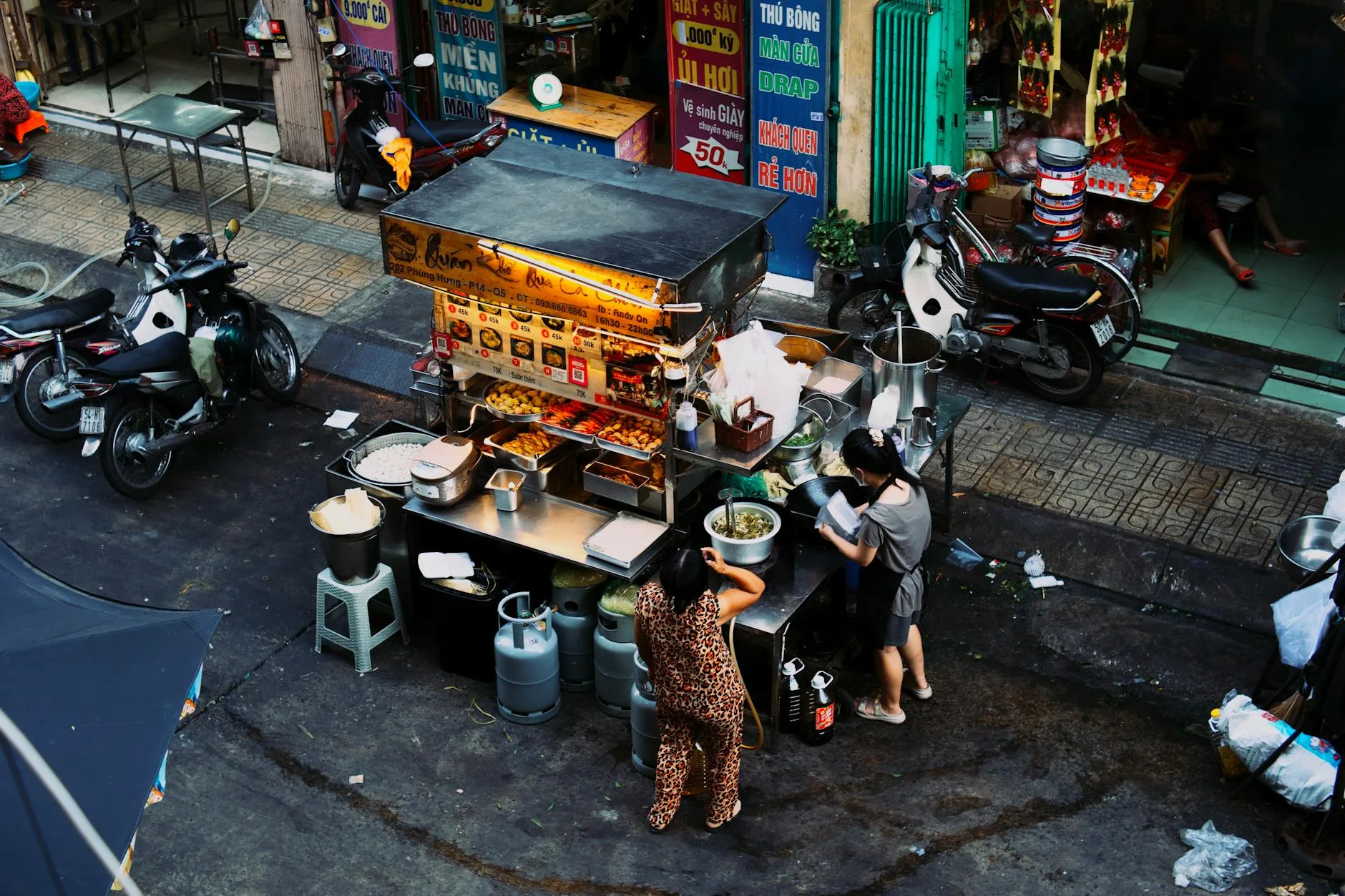
3. Ho Chi Minh City, Vietnam
The case: HCMC (Saigon) is fast, loud, and layered. The street food reflects the south of Vietnam — lighter than Hanoi, more herb-forward, with French colonial residue visible in the bánh mì and the coffee.
What to eat: Bánh mì Huynh Hoa on Lê Thị Riêng Street is widely considered the city’s best — a long roll packed with five types of pork, pâté, pickled daikon, cucumber, and fresh chilli. Bún bò Huế (spicy beef noodle soup from Central Vietnam) is found across the city but is particularly good in District 3. Com tấm (broken rice with grilled pork chop, shredded pork skin, and a fried egg) is the quintessential Saigon breakfast — every district has a good one by 7am. The Ben Thanh night market is tourist-oriented but useful for orientation; better eating is found in the alleys of Districts 1, 3, and 4.
Logistics: Grab (ride-hailing) is the standard way to navigate. A trip across the city runs ₫30,000–60,000. The central districts are walkable at night. July to November is wet season — bring waterproof sandals.
4. Taipei, Taiwan
The case: Taiwan’s night markets are not just food venues — they are civic infrastructure, places where families go in the evening the way others go to parks. Shilin, Raohe, and Ningxia are the three most important in Taipei, each with distinct character.
What to eat: At Ningxia Night Market (Datong District), the focus is traditional Taiwanese: oyster vermicelli, pork liver soup, and taro balls. Raohe Street Night Market, near Songshan, is slightly less crowded than Shilin and easier to navigate; the pepper pork bun (baked in a cylindrical clay oven) at the entrance is one of the more singular eating experiences in the city. Beef noodle soup — dense braised broth, hand-pulled noodles, tendon — is found in restaurants rather than stalls, but is central to Taipei’s food identity; Lin Dong Fang on Bade Road is the standard reference point.
Logistics: Taipei’s MRT is clean, cheap, and extensive — NT$20–65 per journey. Night markets run from around 6pm to midnight, with Fridays and Saturdays being the fullest nights. The city is compact enough that two or three neighbourhoods can be covered on foot in an evening.
5. Osaka, Japan
The case: Osaka has a phrase attached to it — kuidaore, roughly “eat until you drop” — that the city takes as a point of civic pride. The Dotonbori canal area and the covered arcades of Shinsaibashi and Kuromon Market form the centre of gravity, but the food extends into working-class neighbourhoods like Tsuruhashi and Shinsekai.
What to eat: Takoyaki (octopus balls in batter, topped with bonito flakes, mayonnaise, and okonomiyaki sauce) is street food in the most literal sense — made in front of you on a cast-iron mould. Wanaka in Dotonbori is the most-photographed vendor but any neighbourhood stall will do. Okonomiyaki (savoury pancake with cabbage, egg, and various proteins) is better eaten sitting down; Mizuno on Dotonbori has been operating since 1945. Kushikatsu — deep-fried skewers of meat, vegetable, and seafood — originated in the Shinsekai district; Daruma is the oldest chain, with multiple Shinsekai locations.
Logistics: Japan Rail and the Osaka Metro cover the city thoroughly. A day pass on the metro costs ¥800. Kuromon Market (near Nippombashi station) is best visited between 9am and noon — it’s a working wholesale market that also sells directly to the public. Most street stalls are cash-preferred, though IC cards are increasingly accepted.
6. Chengdu, China
The case: Chengdu is the capital of Sichuan cuisine, and Sichuan cuisine is built on a flavour principle — mala, the combination of numbing Sichuan peppercorn and chilli heat — that produces cooking unlike anything else in China. The street food scene operates through a network of snack lanes (xiaochi jie) and morning markets that most visitors never find.
What to eat: Dan dan noodles (thin noodles with chilli oil, preserved vegetables, minced pork, and peanuts) are found throughout the city; the best versions are in the alley behind Wenshu Monastery. Mapo tofu is technically a restaurant dish, but versions are sold at street stalls around Chunxi Road. Longchao Shou — a chain of old-style teahouse-restaurants with counters selling traditional Sichuan snacks — serves zhong dumplings (pork dumplings in a sweet-soy sauce) and red oil wontons that cost under ¥20 per serving. The Kuanzhai Alley complex in Qingyang District is tourist-friendly but serves real food alongside the souvenir shops.
Logistics: Chengdu’s metro is expanding rapidly; most eating districts are reachable on Lines 1, 2, or 4. Mandarin is essential here — English is minimal outside hotels. Navigating language barriers in rural China offers practical strategies that apply in Chengdu’s older neighbourhoods too. Best visited October to December, when the haze clears.
7. Hanoi, Vietnam
The case: Hanoi’s street food culture is older, more austere, and more neighbourhood-specific than Saigon’s. Each dish has its street, sometimes its block. The Old Quarter is the obvious starting point, but the city rewards those who push further into Ba Dinh and Tay Ho districts.
What to eat: Pho bo (beef noodle soup) is the defining Hanoi dish — the version here is cleaner and more restrained than in the south, the broth long-cooked with charred ginger and star anise. Pho Bat Dan on Bat Dan Street opens at 6am and runs out by 10am. Bun cha (grilled pork patties and belly in a sweet fish sauce broth, served with cold rice vermicelli) is a lunchtime institution; Bun Cha Huong Lien on Le Van Huu Street is famous as the place Anthony Bourdain and Barack Obama ate in 2016, but the dish is good at dozens of addresses. Banh cuon (steamed rice rolls with minced pork and wood ear mushrooms) is best eaten before 9am.
Logistics: The Old Quarter is dense and walkable; distances between landmarks are short enough that a day on foot covers considerable ground. Motorbike taxis and Grab are cheap. November to March is dry and cool — the best season for street eating.
8. Mumbai, India
The case: Mumbai’s street food is tied to geography in an unusually literal way. The dishes of Chowpatty Beach, Dharavi, Crawford Market, and Mohammed Ali Road are each distinct, and moving between them is part of the experience. The city’s working-class vada pav culture — a spiced potato fritter in a bread roll, sometimes called India’s hamburger — runs on every street corner.
What to eat: Vada pav is ₹15–30 at most stalls and is most authentically eaten outside the Dadar train station, where the rush-hour crowds move through the vendors like water. Pav bhaji (spiced mashed vegetable curry with buttered bread rolls) is evening food, best at the stalls along Juhu Beach or at Sardar on Tardeo Road. Mohammed Ali Road, in the Muslim-majority Dongri neighbourhood, is the destination for iftaar street eating during Ramadan — seekh kebabs, nihari, malai khaja — but operates year-round. Bhelpuri and sev puri (puffed rice and crispy noodle snacks with tamarind chutney) are the canonical Chowpatty Beach foods.
Logistics: The local train network is the spine of Mumbai — crowded, functional, cheap (₹10–50 for most journeys). Avoid peak rush hour (8–10am, 6–8pm) if carrying bags. Many street stalls are vegetarian by default; meat and fish stalls are concentrated in specific neighbourhoods. Monsoon season (June–September) shuts down some pavement operations.
9. Taipei’s rival: Tainan, Taiwan
The case: Tainan is Taiwan’s oldest city and arguably its most food-serious. Unlike Taipei, which imports food culture from across the island and beyond, Tainan has a hyper-local cuisine built up over 400 years of settlement. It is smaller, quieter, and significantly less visited — which means the eating is less performative.
What to eat: Coffin bread (guancai ban) — a deep-fried bread loaf hollowed out and filled with a thick seafood or chicken chowder — is the city’s signature oddity, available near Chihkan Tower in the West Central District. Milkfish belly (hushan, grilled or braised) is a Tainan speciality; the stalls around Hua Yuan Night Market on Zhonghua Road are a good starting point. Dan zai mian (Slack Season Noodles — thin noodles in shrimp broth with pork and shrimp, served in a small bowl) originated in Tainan; Degree Noodles near Chihkan Tower has operated since 1895. The city’s breakfast culture runs deep — head to the Anping district for oyster congee by 8am.
Logistics: Tainan is 90 minutes from Taipei by HSR (High Speed Rail), around NT$1,080 one way. The city centre is compact and bikeable; YouBike rental stations are throughout the old town. This is one of the best arguments for building Taiwan time into a regional trip if food is a priority.
10. Penang’s neighbour: George Town vs. Kuala Lumpur
The case: KL belongs on this list as a counterpoint to Georgetown — it is a bigger, more chaotic, and more ethnically diverse food city, where Malay, Chinese, Indian, and Mamak (Indian-Muslim) cuisines compete at street level in a way that reflects the city’s modern demographic complexity.
What to eat: Jalan Alor in Bukit Bintang is the tourist food street, and it is genuinely good despite its reputation — char kway teow, grilled chicken wings, and chilli pan mee alongside cold Tiger beers. More interesting is Brickfields (Little India), where banana leaf rice and roti canai with fish curry operate from dawn. The Malay food at Bazar Baru Chow Kit — a sprawling wet and dry market in the working-class Chow Kit neighbourhood — is among the most authentic in the city: nasi lemak wrapped in banana leaf, sup tulang (bone marrow soup), ikan bakar (charcoal-grilled fish with sambal). Mamak stalls (open 24 hours, selling roti canai, teh tarik, and mee goreng) are the city’s connective tissue — there is one within walking distance of almost every address.
Logistics: The LRT and MRT systems cover most eating neighbourhoods. A single journey costs RM1.20–4.00. Grab is cheap and reliable. KL operates in intense heat year-round (30–35°C); the covered hawker centres and Mamak stalls are air-conditioned or at least shaded.
City comparison table
| City | Best for | Budget per meal | Best season | Ease of navigation |
|---|---|---|---|---|
| Penang | Depth and variety | RM5–15 | Nov–Feb | Easy (walkable core) |
| Bangkok | Scale and nightlife | ฿40–100 | Nov–Feb | Moderate (BTS + foot) |
| Ho Chi Minh City | Speed and flavour | ₫30,000–80,000 | Dec–Apr | Easy (Grab + foot) |
| Taipei | Night markets + safety | NT$50–150 | Oct–Dec | Very easy (MRT) |
| Osaka | Precision and tradition | ¥300–800 | Mar–May, Oct–Nov | Very easy (metro) |
| Chengdu | Spice and depth | ¥10–30 | Oct–Dec | Moderate (Mandarin needed) |
| Hanoi | Breakfast culture | ₫30,000–70,000 | Nov–Mar | Easy (walkable Old Quarter) |
| Mumbai | Density and diversity | ₹15–100 | Oct–Feb | Moderate (local train) |
| Tainan | Authenticity, low crowds | NT$40–120 | Oct–Dec | Easy (bikeable) |
| Kuala Lumpur | 24-hour Mamak culture | RM5–15 | Year-round | Easy (MRT + Grab) |
The practical side of street food travel
Two things determine how well a street food trip goes: timing and tolerance. Most serious stalls open early (6–8am for breakfast dishes) and sell out — this is not a marketing tactic, it is what happens when someone makes 80 bowls of broth from scratch at 4am. Arrive late and the food is gone or stale. The best strategy in any of these cities is to eat breakfast at a market, rest, eat again in the evening, and leave the midday hours for transit and non-food activities.
On hygiene: cooked food sold from a busy stall with high turnover is generally safer than cold food sitting out, or quiet stalls with low traffic. A full queue is a better health signal than a gleaming surface. That said, stomach adjustment takes a few days in any new food environment — if you are combining several cities on one trip, read the practical section of this guide to eating at local markets in Southeast Asia before you land.
According to CNN Travel’s assessment of Asia’s food cities, the common thread among the continent’s top food destinations is not exoticism but infrastructure — the existence of decades-old markets, inherited recipes, and communities that treat cooking as a serious trade. That holds true across every city on this list.
UNESCO’s Intangible Cultural Heritage framework recognises some of these food traditions formally, though most of the best street food in Asia operates well outside any official recognition programme — it exists because it is good, cheap, and necessary.
The Bottom Line
-
Penang and Tainan are the two cities where food culture is most concentrated and most historically grounded — if you can only choose two, choose them. Both are compact enough to eat your way around seriously in three to four days.
-
Bangkok and Ho Chi Minh City offer scale and variety but require more navigation. The best food is not where it is easiest to find — commit to a neighbourhood rather than a highlight reel.
-
Osaka and Taipei have the most accessible infrastructure for travellers who are less comfortable with language barriers. Both cities are easy to navigate solo and have strong English signage in food areas.
-
Chengdu and Hanoi reward early risers and people who are willing to walk away from the obvious centre. The best stalls in both cities operate on their own schedules and are not waiting to be discovered — they are busy with the people who already know about them.
-
Budget is not the constraint it once was — the most expensive meals on this list (Osaka, Taipei) still come in well under the cost of a mid-range restaurant in Western Europe. The currency of good street food travel is time and willingness, not money.
Keep reading: How to eat at local markets in Southeast Asia