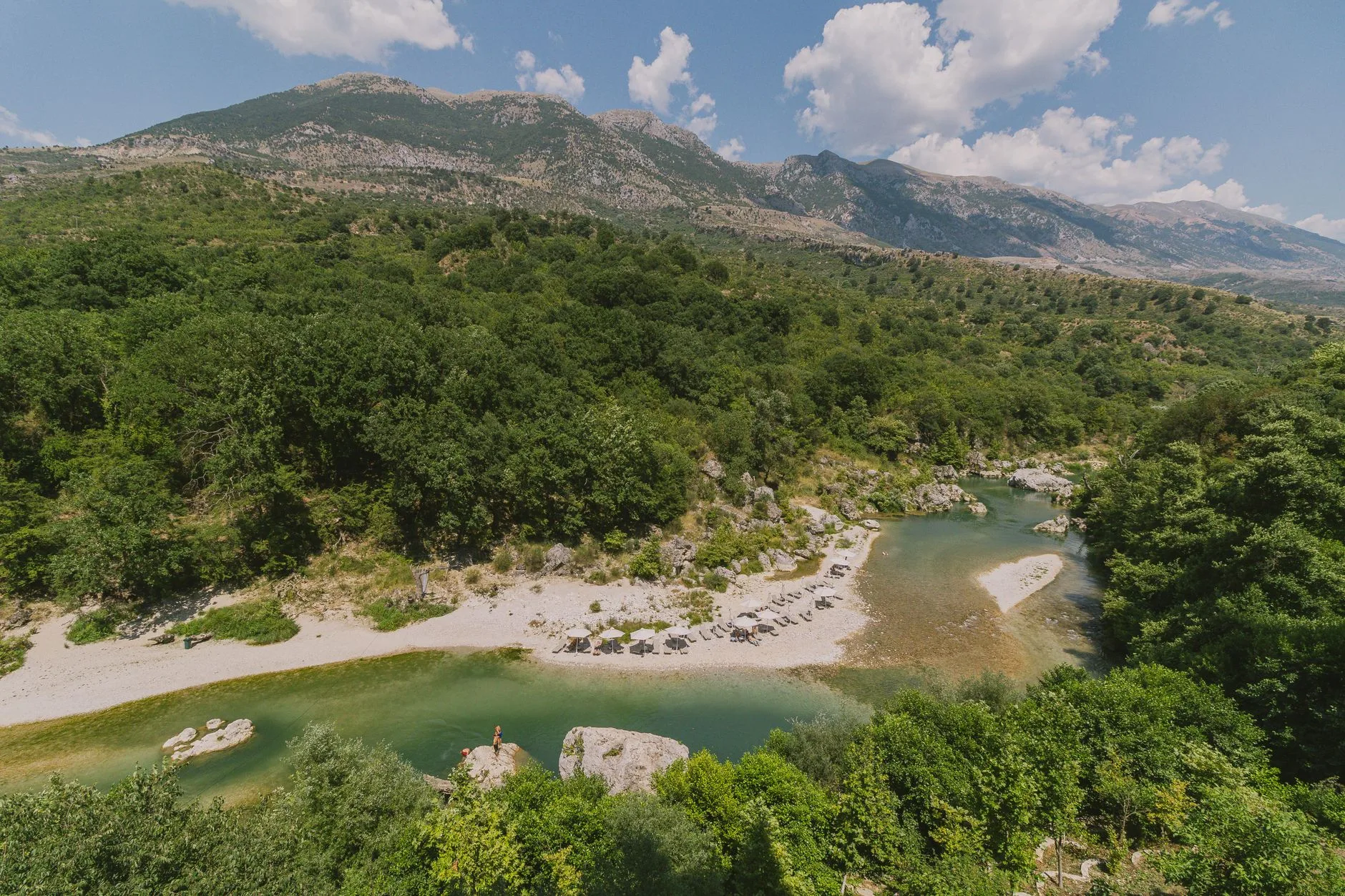
The furgon leaves Tirana’s informal bus yard near the Zogu i Zi roundabout when it fills up, not before, and not according to any schedule posted anywhere. A man in his sixties negotiates the price of a sack of walnuts with the driver while the engine idles. Someone’s grandmother is handed up through the sliding door and settles into the front seat like she’s done it a thousand times, because she has. Two hours later you’re climbing the switchbacks toward Theth, the Accursed Mountains closing in on both sides, and the Adriatic coast you left that morning feels like a different country entirely.
That’s the condition of travel in Albania right now: unresolved, improvised, occasionally maddening, and more rewarding for it. The country has spent the last decade shedding its reputation as Europe’s forgotten corner, but the infrastructure hasn’t quite caught up to the attention — which, depending on your temperament, is either the whole appeal or a genuine inconvenience. This guide treats it as both.
Getting In and Getting Around
Tirana International Airport (Nënë Tereza) is the main entry point, with direct flights from most major European hubs on carriers like Wizz Air and easyJet, plus Albania’s own national carrier running routes to London, Rome, and beyond. If you’re coming overland, the land borders with Montenegro (via Ulcinj to Shkodër), Kosovo (via Prizren to Kukës), Greece (via Kapshticë near Korçë), and North Macedonia (via Struga to Pogradec) are all straightforward, with minibuses crossing most of them daily.
Once inside the country, the furgon is the backbone of Albanian transport — a shared minibus that runs fixed routes but flexible timetables. There’s no national booking app, no unified timetable online; you turn up at the departure point (often a petrol station or a roundabout rather than a formal terminal), ask around, and wait. It’s cheap — a few euros for most intercity routes — and it works, but it rewards patience over precision. For the coastal and mountain routes, a rental car gives you far more control, and Albania’s roads, while improved dramatically on the main arteries, still turn to gravel and switchback drama the moment you leave them.
| Route | Best transport | Time | Cost (approx) |
|---|---|---|---|
| Tirana to Shkodër | Furgon or bus | 1.5–2 hrs | €3–5 |
| Tirana to Berat | Furgon | 2–2.5 hrs | €4–6 |
| Tirana to Gjirokastër | Bus | 4–5 hrs | €8–10 |
| Shkodër to Theth | 4×4 furgon (seasonal) | 3 hrs | €8–10 |
| Sarandë to Himara (coastal road) | Bus or rental car | 1.5 hrs | €3–5 (bus) |
| Korçë to Pogradec | Furgon | 1 hr | €2–3 |
The Coast That Isn’t the Côte d’Azur — Yet
The Albanian Riviera runs from Vlorë down to Sarandë along the Ionian Sea, and it’s the clearest sign of the country’s tourism trajectory: beach clubs now sit where goats grazed a decade ago, and prices in Dhërmi and Himara climb every July. Go anyway, but go with eyes open about what you’re walking into in peak season — July and August bring Italian and Kosovar crowds in real numbers, and the narrow coastal road (the SH8) becomes a slow crawl of rental cars and tour buses.
The better move, if your schedule allows it, is shoulder season — late May or September — when the water’s still warm, the beach bars are open, and the road isn’t a parking lot. Gjipe Beach, reached by a short hike down from the clifftop road between Dhërmi and Ilias, has no infrastructure beyond a single seasonal bar and a campsite, and that’s precisely its appeal. Further south, Ksamil’s turquoise coves get compared to the Caribbean so often it’s become a cliché, but arrive before 10am and you’ll understand why, before the day-trip boats from Sarandë arrive.
For travellers who’ve walked other European coastlines, the Riviera trail between Dhërmi and Vuno offers a rougher, steeper cousin to routes like those covered in our guide to the best coastal walks in Europe — expect loose stone, serious heat in summer, and views over the Ionian that make the scramble worth it.
Gjirokastër and Berat: The Twin Museum Cities
Both Gjirokastër and Berat carry UNESCO World Heritage status, and both reward slow wandering over checklist tourism. Gjirokastër, in the south, is a steep hillside town of stone-roofed Ottoman houses climbing toward a hilltop castle that doubles as a Cold War relic — inside, a captured American reconnaissance plane from the 1950s sits in the courtyard, a leftover from Albania’s decades of paranoid isolation under Enver Hoxha. The bazaar below sells qifqi, small rice balls flavoured with mint, a dish specific enough to this town that you won’t easily find it elsewhere.
Berat, the “town of a thousand windows,” stacks its white Ottoman houses in tiers on either side of the Osum River, Christian quarter on one hillside, Muslim quarter on the other, castle crowning both. Climb to Kalaja e Beratit in the early morning before the heat sets in and the tour groups arrive; several working Orthodox churches inside the castle walls still hold services, and the Onufri Museum houses 16th-century icons that rarely get the attention they deserve. Entry to the castle runs around €2–4, and most of the churches inside charge a small separate fee.
Theth and the Accursed Mountains
The Albanian Alps — properly the Bjeshkët e Nemuna, or “Accursed Mountains” — sit in the far north, and Theth is the village most travellers use as a base. The drive in from Shkodër is an event in itself: unpaved for long stretches, carved along cliff edges, passable by furgon only from roughly May to October. The village itself has no bank, patchy electricity in parts, and a scattering of guesthouses run by families who’ll feed you more than you can eat for around €20–25 a night including dinner and breakfast.
The signature route is the day hike from Theth to Valbona over the Valbona Pass, roughly 17–18 kilometres and 6–8 hours depending on fitness, crossing at around 1,800 metres with views stretching across limestone peaks that feel genuinely remote in a way increasingly rare in Europe. A ferry on Lake Komani, connecting back toward Shkodër, is one of the more striking journeys on the continent — three hours gliding between sheer canyon walls on a boat that doubles as the only transport link for several isolated riverside villages. Hikers who’ve done long-distance European routes covered in our best long-distance walking trails in Europe guide will recognise the appeal immediately, though Theth-Valbona is shorter and rougher around the edges, with far less waymarking.
Tirana: More Than a Layover
Most itineraries treat Tirana as a one-night necessity before heading to the coast or the mountains, which undersells it. The Blloku district, once a gated zone reserved for Communist Party officials and off-limits to ordinary Albanians until 1991, is now the city’s densest cluster of cafés and bars — a genuinely strange historical irony that locals will happily explain over an espresso. The Pyramid of Tirana, a brutalist former museum turned derelict landmark turned renovated tech-education hub, sits a short walk from Skanderbeg Square, where the National History Museum’s Socialist Realist mosaic still dominates the façade.
For food, Pazari i Ri (the New Bazaar) is the place for byrek — the flaky, spinach-or-cheese-filled pastry that functions as Albania’s national breakfast — alongside stalls selling sheep’s cheese, dried figs, and raki poured without much ceremony at 9am if that’s your inclination. Tiranë’s café culture, dense and unhurried, has drawn comparisons to the slower-paced cities featured in our rundown of the best cities in Europe for slow travel, though Tirana’s chaotic traffic and ongoing construction keep it from feeling fully polished — which is, again, part of its current charm.
Money, SIM Cards, and the Practical Friction
Albania uses the lek, and while euros are accepted in many tourist-facing businesses on the coast, you’ll get a worse exchange rate than using an ATM and paying in lek directly. Card payments are increasingly common in Tirana and the Riviera resorts but far less reliable inland — carry cash, especially for guesthouses, furgons, and rural restaurants. A local SIM card (Vodafone or One Telecom) costs around €10–15 for a generous data package and is easy to pick up at the airport or any city kiosk.
English is widely spoken among younger Albanians and in tourist areas, considerably less so in mountain villages, where Italian sometimes fills the gap thanks to decades of Italian television beamed across the Adriatic during the Hoxha years — an odd historical footnote that still shapes everyday conversation.
When to Go
July and August bring heat, crowds, and the highest prices on the coast — manageable if you’re there for beach time and nightlife, less so if you want Gjirokastër or Berat without a tour bus parked outside the castle gate. Shoulder months (April–May and September–October) hit the best balance of warm weather, open mountain roads, and thinner crowds. Winter closes much of the north — Theth’s guesthouses mostly shutter from November to April — but Tirana and the south stay mild and workable year-round, Mediterranean climate holding even into December.
The Bottom Line
- Albania rewards flexibility more than planning. Furgon schedules, mountain road conditions, and guesthouse availability all shift with the season and sometimes the weather that morning — build slack into your itinerary rather than a tight schedule.
- The coast and the mountains are genuinely different countries in feel. Don’t try to do both in under ten days unless you’re comfortable moving fast.
- Cash, patience, and a willingness to ask strangers for directions will get you further here than any app. Google Maps’ walking routes in rural areas are unreliable at best.
- The “hidden gem” window is closing, particularly on the Riviera. The mountains and the museum towns still move at their own pace — go to those first if authenticity matters more to you than convenience.
- If budget is the deciding factor, Albania remains one of the cheapest countries in Europe to travel well, especially inland — guesthouse stays, bus fares, and market food rarely strain a modest daily budget.
Keep reading: Budget travel in Albania: Europe’s last hidden gem