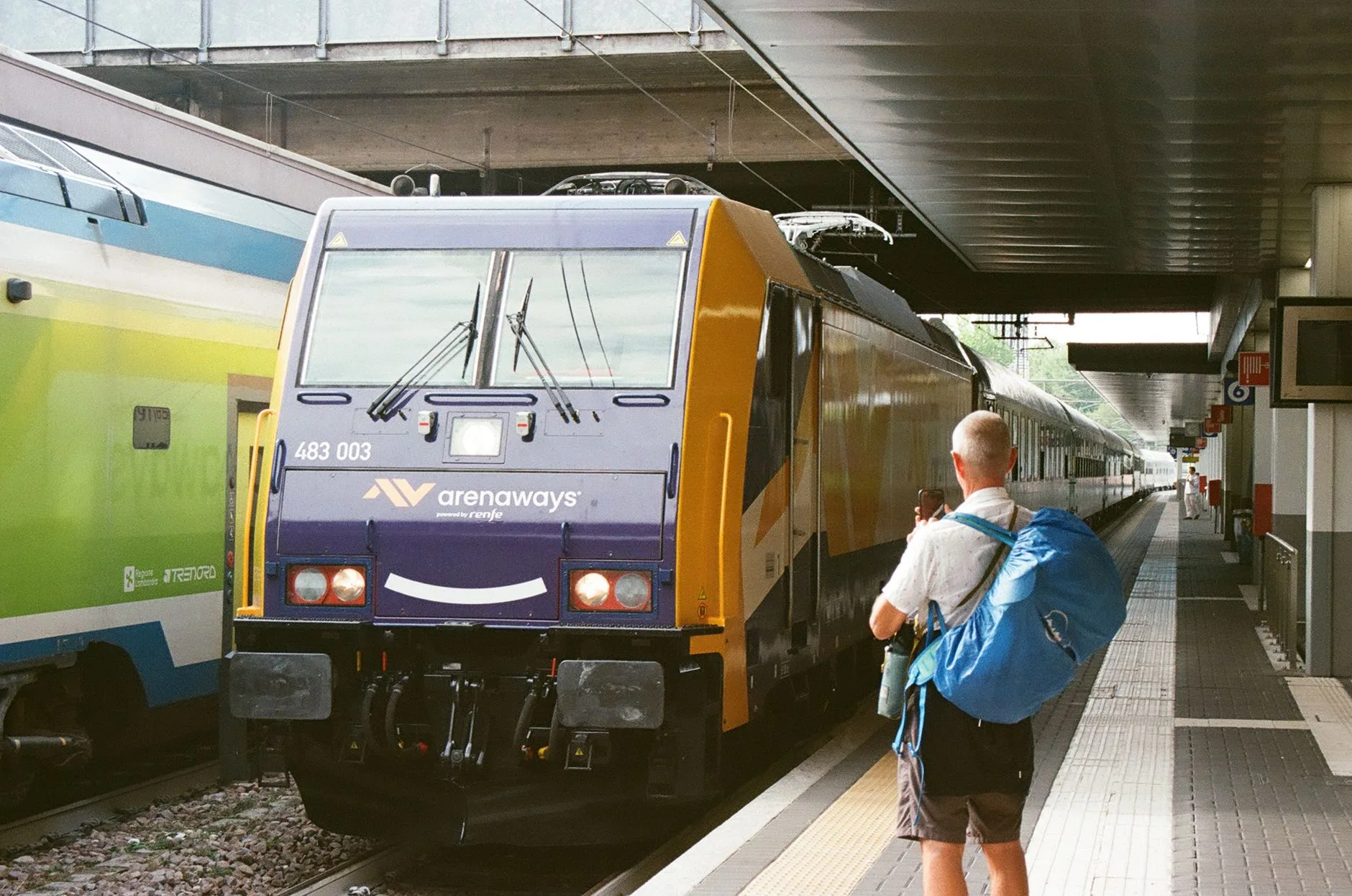
Photo by Maartje Eyskens on Pexels
The platform at Zürich Hauptbahnhof fills up fast around half past eight in the morning — commuters in wool coats, two Australians trying to work out which end of the train the dining car is on, a conductor checking her watch against the departure board with the mild impatience of someone who has done this ten thousand times. The train to Milan via the Gotthard Base Tunnel pulls in silent and precisely on time, and for the next three and a half hours you’ll watch Switzerland fold itself into tunnels and valleys before the architecture, the language, and the smell of the air changes somewhere around Chiasso. No security queue. No gate. Just a ticket check and a seat.
This is the appeal of train travel in Europe, and it’s also the thing first-time Interrail users underestimate: the trains themselves are the easy part. The planning — routes, reservations, which legs need booking weeks ahead and which you can wing — is where people either fall in love with the system or spend their first three days frustrated in a station ticket office. This guide covers both.
What an Interrail (or Eurail) pass actually buys you
Interrail passes are for European residents; Eurail passes are for everyone else. Functionally identical — same train network, same rules, different websites. Both work on the same principle: you pay upfront for a set number of travel days within a validity window (commonly 15 days, 1 month, 2 months, or 3 months), then you tap into an app or carry a paper pass that you activate on days you actually ride.
What people get wrong immediately: the pass is not a ticket. On regional and most intercity trains across Germany, Poland, the Baltics, and much of Eastern Europe, you simply board — the pass is your ticket. But on high-speed and overnight services — French TGVs, Spanish AVEs, Italian Frecce, most Eurostar and Thalys/Eurostar-branded routes, and sleeper trains — you need a seat reservation on top of the pass, and those cost extra (typically €3–€35 depending on route and class) and sell out, especially in July and August.
This catches people constantly. You can own a perfectly valid Global Pass and still find yourself standing in Paris Gare de Lyon unable to get on the next three TGVs to Lyon because every seat with a reservation slot is sold. Book high-speed reservations as early as the system allows — usually 2–3 months ahead for French and Italian routes.
Building a route that actually makes sense
The mistake almost everyone makes on a first trip is trying to cover too much ground. A 15-day pass used to zigzag between eight countries means you’ll spend more hours on trains than in any one place, and you’ll remember stations better than cities. A slower loop through fewer countries with two or three nights per stop gives you something closer to the texture of each place rather than a photo from the platform.
A workable three-week route through central Europe: Amsterdam → Berlin → Kraków → Vienna → Ljubljana → Venice → Zürich, averaging three nights per stop with a couple of travel days built in as rest, not rush. Each leg is between 3 and 8 hours, almost none require a reservation except the Vienna–Venice stretch via the Austrian rail network, which benefits from booking the EuroCity service.
For a slower, more deliberate pace, consider pairing train travel with time off the rails entirely — the Danube cycle path between Passau and Vienna, for instance, is a popular add-on for travellers who want a few days of something other than train windows, and it connects neatly to the same stations you’d already be passing through.
The overnight trains worth taking (and the ones to skip)
Europe’s night train network has had a genuine revival since 2020, driven partly by Austrian operator ÖBB’s Nightjet network, which now runs comfortable sleeper services between Vienna, Zürich, Venice, Berlin, Paris, and Rome. A couchette (shared six-berth compartment) costs relatively little above the reservation fee; a private sleeper cabin costs considerably more but includes breakfast and, on the better routes, a surprisingly good shower.
The Vienna–Venice Nightjet is worth doing once for the experience alone: you fall asleep somewhere in the Austrian Alps and wake up gliding across the causeway into Venezia Santa Lucia with the lagoon on both sides. The Paris–Berlin route is more useful than romantic — it saves you a hotel night and arrives at a sane hour. Skip the budget seated overnight trains unless the price difference is significant; a seven-hour journey sitting upright rarely leaves you fit for a full day of sightseeing afterward.
What to actually pack for weeks of train travel
Anyone who’s done a long rail trip will tell you the same thing: the suitcase that seemed reasonable in your bedroom becomes a genuine liability on your fourth set of station stairs with no lift. Overhead luggage racks on most European trains are modest, and not every platform has a ramp or working escalator — Naples Centrale and several stations in the Balkans still require carrying bags up and down stairs.
A 40–50 litre backpack or a soft duffel with wheels beats a rigid hard-shell case almost every time. Pack layers — northern Europe in April can be five degrees colder than Vienna the same week — and bring a portable charger, because overnight trains and some older regional services don’t reliably have working power outlets.
Where the system breaks down — and how to plan around it
Honesty matters more here than anywhere else in this guide. Interrail is excellent but not seamless. Strikes are common in France and Italy, sometimes announced with only a few days’ notice; check national rail operator sites (SNCF, Trenitalia) directly rather than relying on the app, which can lag behind real-time disruptions. Border regions in the Balkans — crossing from Serbia into Bosnia, or Montenegro into Albania — often mean slow, infrequent trains or none at all, requiring a bus instead, which the pass doesn’t cover. If your route includes southeastern Europe, build in flexible days and expect buses to fill gaps the rail network simply doesn’t reach, something travellers researching budget travel in the Balkans run into constantly.
Ticket inspectors on regional trains in Germany and Czechia are thorough and show little patience for an uninstalled app or a pass that hasn’t been activated correctly — activate each travel day before boarding, not after the conductor arrives. Fines for travelling without a validated pass are not symbolic; they run into the hundreds of euros.
Comparing pass types and typical costs
| Pass type | Validity window | Travel days included | Good for |
|---|---|---|---|
| 4 Travel Days in 1 Month | 1 month | 4 days | A short city-hopping trip, e.g. Lisbon–Madrid–Barcelona |
| 7 Travel Days in 1 Month | 1 month | 7 days | A two-week trip mixing travel and settled stays |
| 10 Travel Days in 2 Months | 2 months | 10 days | Slow travel across 4–6 countries over several weeks |
| Global Pass – Continuous | 15 days to 3 months | Unlimited within window | Fast-paced, high-mileage trips; best value if riding most days |
| One Country Pass | Set window per country | 3–8 days | Focused trips — e.g. just Italy or just Spain |
Prices shift seasonally and by age bracket (youth, adult, senior), so check current rates on the Eurail or Interrail official site before budgeting, rather than relying on older blog figures.
Food, timing, and the small rituals that make it work
Train travel rewards a bit of planning around meals. Dining cars still exist on some long-distance and overnight services but are inconsistent — Nightjet trains sell a reasonable breakfast box, French TGVs have a buffet car that’s fine in a pinch, but Eastern European regional trains often have nothing at all. Stock up before boarding: a bakery sandwich from a station concourse, a block of cheese and bread picked up at a market the day before. If your route passes through a city with a market worth lingering in, build the stop around it — several of Europe’s best food markets, from Budapest’s Nagycsarnok to Barcelona’s Boqueria, are a short walk from the main station and worth an hour before your next train.
Arrive at the platform 15–20 minutes before departure, not because European trains are unreliable (they’re generally punctual) but because platforms change without much warning and you don’t want to be the person sprinting with a backpack as the doors beep closed.
The Bottom Line
A rail pass rewards patience more than ambition — fewer countries, more nights per stop, and genuine slack in the schedule will serve you better than a itinerary crammed with cities. Reserve high-speed and overnight seats the moment booking windows open, especially for France, Italy, and the Nightjet network, because the pass alone won’t guarantee you a seat. Carry a soft bag, not a hard case, and expect stairs. Build slack into Balkan or border-heavy routes, where buses quietly fill gaps the railway doesn’t reach. And treat the slower legs — a regional train through the Austrian countryside, an unplanned two hours in a station café — as part of the trip rather than dead time between the places you actually came to see.
Keep reading: Cycling the Danube as a slower way to see central Europe