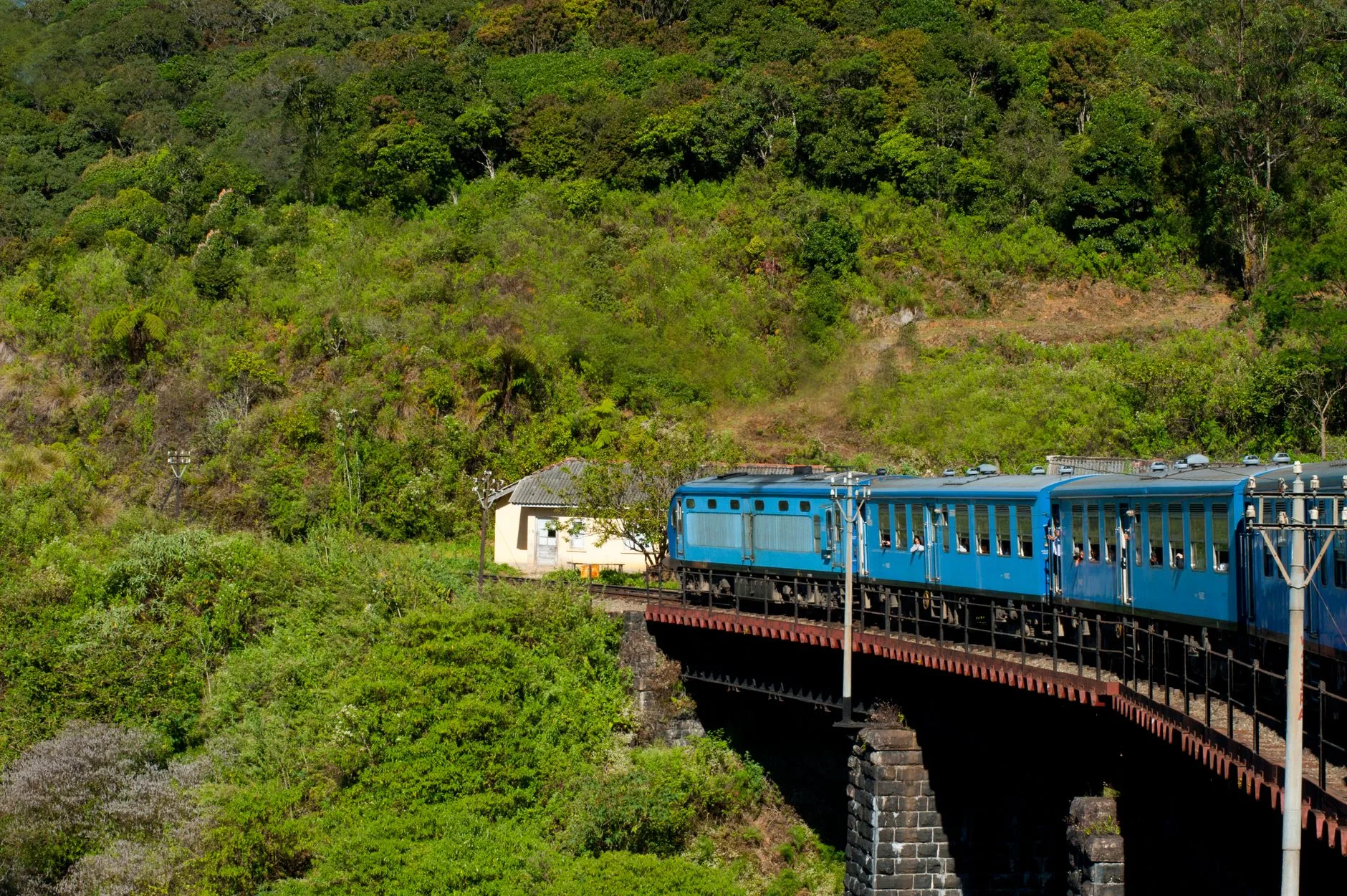
Photo by Atlantic Ambience on Pexels
The platform at Nanu Oya is cold enough at 6am that the tea pickers waiting for the Badulla-bound train wrap shawls over their shoulders, and the mist sitting in the valley below hasn’t decided yet whether it will burn off or settle in for the day. A vendor works the length of the platform with a basket of vadai wrapped in newspaper. Somewhere down the line, a horn sounds twice — not urgent, just announcing itself — and the blue-and-yellow carriages of the 9:45 to Ella come around the bend through tea bushes planted so close to the track you could touch them from an open door.
This is the version of Sri Lanka most people come for when they ask about the trains, and it delivers. But the rail network does far more than the hill country loop that fills everyone’s Instagram feed, and knowing which line does what — and which seat to actually book — makes the difference between a trip that runs smoothly and one spent standing in a corridor for four hours with your pack between your knees.
Why the train, and why it isn’t always the fast option
Sri Lanka Railways is slow, often delayed, occasionally cancelled without much warning, and still the single best way to see the country’s interior. Roads between Kandy and Ella exist and buses are faster, but they miss the tunnels, the switchbacks, and the stretch of track that loops back over itself near Demodara. The train isn’t a shortcut. It’s the point.
Budget accordingly: a journey that Google Maps says takes three hours by road might take five by rail, and delays of 30–60 minutes are routine rather than exceptional. If you’re connecting to a flight or a tightly booked tour, build in slack.
The hill country line: Colombo to Kandy to Ella
This is the spine of Sri Lankan rail travel and the one route worth planning your whole trip around. The full journey from Colombo Fort to Badulla (Ella sits about two-thirds of the way along) climbs from sea level to over 1,800 metres, passing through Peradeniya, Hatton, Nanu Oya (the stop for Nuwara Eliya), Haputale, Ella, and the Demodara loop, where the track spirals under itself through a tunnel to manage the gradient.
Most travellers do it in two legs rather than one long haul: Colombo or Kandy to Nanu Oya or Ella, with a break in Kandy to see the Temple of the Sacred Tooth Relic, part of Kandy’s UNESCO-listed Sacred City, before continuing up into the hills.
Named trains worth knowing:
– Podi Menike and Udarata Menike run Colombo Fort–Badulla daily, stopping at all the scenic points.
– Kandy Intercity services connect Colombo and Kandy faster, with fewer stops, good for the first leg if you want to save the slow scenery for the Kandy–Ella stretch.
Reserve a seat if you possibly can, especially for the Kandy–Ella or Nanu Oya–Ella segment, which has become genuinely difficult to board unreserved in peak season (December–March, and again in July–August). Second-class reserved seats and the first-class observation saloon (rear carriage, panoramic windows) sell out days to weeks ahead online. Third class is unreserved, cheap, and means standing by the open doors if you board at a popular station — which, honestly, some travellers prefer for the photos, delays and discomfort notwithstanding.
Booking logistics: what actually works
Sri Lanka Railways runs an online booking portal that opens reservations 30 days in advance, and it is, to put it kindly, inconsistent — expect timeouts, failed payments, and occasional total unavailability. A more reliable route for international travellers is booking through a local travel agent or guesthouse a few days ahead, or using the counter at the departure station the moment reservations open if you’re already in the country.
The Man in Seat 61 remains the most detailed independent resource for understanding Sri Lankan train classes, timetables, and the quirks of the booking system — worth a read before you commit to a date.
Practical notes that save frustration:
– Buy a platform ticket (a few rupees) if you’re seeing someone off or need station access without a journey ticket.
– Carry small denomination rupees; change at ticket windows is often in short supply.
– Confirm the platform number close to departure — it’s announced in Sinhala, Tamil, and English, but not always far enough ahead to sprint across the overpass comfortably.
The coastal line: Colombo Fort to Galle and Matara
Less photographed than the hill line but arguably more useful day to day, this route runs south along the coast through Mount Lavinia, Bentota, Hikkaduwa, and Galle, continuing to Matara. For long stretches the track runs close enough to the shoreline that you get open ocean on one side and coconut-palm villages on the other, with the added entertainment of vendors selling achcharu (spiced fruit pickle) and king coconuts through the windows at stops.
This line is a commuter route first and a scenic one second. Morning and evening trains out of Colombo are genuinely crowded — third class can mean standing room only — so aim for mid-morning or early afternoon departures if comfort matters more than the view from a packed doorway. Second-class reserved seats exist on some services and are worth booking for the full Colombo–Galle run (around 2.5 hours).
If you’re building out a longer Sri Lanka itinerary and comparing this stretch of coast against other island options in the region, it’s worth a look at the broader landscape of island travel in Asia before deciding how much time to allocate here versus inland.
The northern line: Colombo to Jaffna
The Yal Devi service to Jaffna reopened fully some years after the civil war ended and now runs daily from Colombo Fort through Anuradhapura and Vavuniya, taking roughly six to seven hours. It’s a different experience from the hill or coastal lines: flatter, hotter, less visually dramatic, and far less touristed. Air-conditioned second-class carriages exist and are worth the modest upgrade on this route specifically, since the northern plains heat builds fast once the sun is properly up.
Jaffna itself rewards the trip — the Nallur Kandaswamy Kovil, the Jaffna Fort built originally by the Portuguese, and a food culture built around crab curry and odiyal kool that’s distinct from anything in the south. Few travellers extend this far north on a short trip, which is exactly the appeal if you’re trying to move past the well-worn Colombo–Kandy–Galle triangle — a theme worth thinking about generally when avoiding overtourism in Southeast Asia and its neighbouring regions.
Practicalities worth knowing before you board
Toilets on long-distance trains are basic squat or Western-style cubicles, not always stocked with paper — carry your own. Food comes from platform vendors and onboard trolleys rather than a dining car: expect rotti, vadai, and short eats rather than a proper meal, so eat before a long leg or carry something. Mobile signal holds up well along most of the network, useful for tracking delays via apps, though the hill sections do drop out in tunnels and deep valleys.
Luggage racks are overhead and open, fine for a backpack, awkward for a large wheeled suitcase — if you’re travelling with one, the train network is less forgiving than buses or private transport.
| Route | Journey time | Best for | Booking difficulty |
|---|---|---|---|
| Colombo–Kandy | 2.5–3 hrs | First taste of hill scenery, Temple of the Tooth | Moderate — book ahead in peak season |
| Kandy–Ella | 6–7 hrs | The classic scenic run, Nine Arch Bridge, tea country | High — reserve weeks ahead for 2nd class/observation |
| Colombo–Galle–Matara | 2.5–3.5 hrs | Coastal scenery, easy day trips | Low to moderate — crowded at peak commute times |
| Colombo–Jaffna (Yal Devi) | 6–7 hrs | Northern Sri Lanka, Jaffna’s distinct culture | Moderate — AC 2nd class worth booking |
The Bottom Line
The hill country line between Kandy and Ella is worth planning a trip around, but it’s also the hardest leg to book spontaneously — reserve it as early as the system allows, or accept you might be standing. The coastal run to Galle works well as a half-day addition without much planning, while the Jaffna line rewards travellers willing to go further than the standard southern loop. Build slack into your schedule everywhere; delays aren’t the exception on Sri Lankan rail, they’re close to the rule. And if train logistics feel like only one piece of the puzzle, it’s worth pairing this with a wider look at budget travel in Sri Lanka to cover accommodation, costs, and how the rail network fits into a longer independent route around the island.
Keep reading: Budget travel in Sri Lanka: a guide for independent travellers