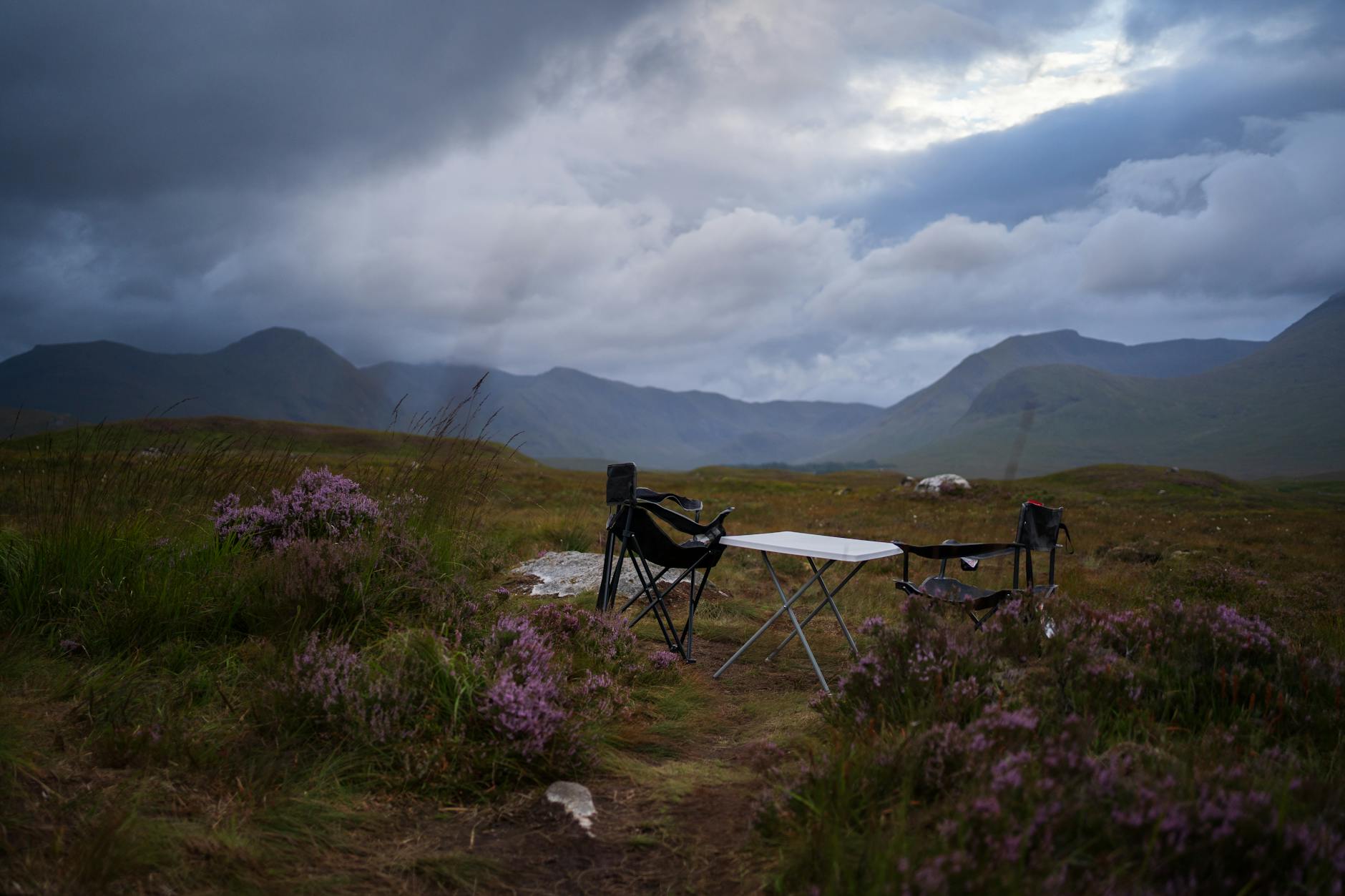
Wild camping in Scotland: what you need to know
The midges arrive before the light does. On the eastern shore of Loch Ossian, somewhere in the Corrour wilderness, it’s just past five in the morning and the sky is going from black to a bruised violet over Rannoch Moor. The tent is damp with condensation, beaded along the inside of the flysheet. The nearest road is eight kilometres away. There is no signal, no café, no one checking a booking confirmation. This is what Scotland’s land access laws make possible, and it is genuinely unusual in the world.
Scotland is one of the few countries where wild camping is not just tolerated but written into law. The Land Reform (Scotland) Act 2003 grants a right of responsible access to most unenclosed land, including the right to camp overnight. That legal foundation changes how you plan and move through the country — but it won’t tell you which glens flood in October, where the midges are at their worst, or how to reach a remote loch shore without a car. That’s what follows.
The law in practice, not in theory
The 2003 Act is usually summarised as “you can camp anywhere in Scotland.” The fuller version, set out in the Scottish Outdoor Access Code, is more specific and considerably more useful.
You have the right to camp on most land as long as you do it responsibly: stay no more than two or three nights in any one spot, pitch out of sight of roads and houses where possible, leave absolutely no trace, and move on without needing to be asked. Human waste should be buried well away from water sources, and all rubbish — including food scraps — packed out.
What the Act doesn’t cover: enclosed fields with crops or livestock, golf courses and sports grounds, land within the curtilage of a house or garden, and anywhere already managed as a formal campsite. In practice, that still leaves the overwhelming majority of Scotland open — deer forest, open moorland, loch shores, forestry land, and mountainside all qualify.
Open fires are legal in principle but carry real conditions attached. They must be small, kept well clear of peat and overhanging vegetation, and fully extinguished — cold to the touch, not just dark. During dry spells, particularly on the west coast in spring and early summer, temporary fire bans are increasingly common, and the Scottish Wildfire Forum issues alerts when risk is high. Carry a gas stove as your primary cooking method regardless of the season; treat a fire as a bonus, not a plan.
One specific exception worth knowing: the eastern shore of Loch Lomond, within a designated camping management zone, requires a permit between March and September — more on that below. Elsewhere, the right of access holds.
Where to go: four regions, four different trips
Scotland’s wild camping terrain splits roughly into four zones, each with its own character, access difficulty, and trade-offs.
The Northwest Highlands — Torridon, Assynt, and the coast around Cape Wrath — offer the most dramatic camping in Britain. A high camp on the Torridon ridge, with Beinn Eighe’s quartzite scree catching the last light, looks out across the Minch on a clear evening. Further north, the Assynt peninsula is scattered with small lochans beneath Stac Pollaidh and Suilven, and the walk-in to Sandwood Bay — a pink-sand beach backed by dunes, three miles from the nearest road at Blairmore — is one of the best overnight beach camps in the country. The cost of all this is weather: this is some of the wettest, windiest terrain in Europe, and midges near standing water in summer are relentless. Come in May or September, not July or August.
Loch Lomond and the Trossachs National Park is the nearest wild country to Glasgow and Edinburgh, and the pressure shows. East Loch Lomond, from Balmaha north along the West Highland Way, sits inside a camping management zone between 1 March and 30 September, requiring a permit booked in advance through the National Park’s website — currently around £4 to £8 per night depending on pitch. Rangers do patrol and do check. The western shore and the hills above Loch Katrine, by contrast, carry no such restriction and see a fraction of the traffic.
The Cairngorms offer genuine high-plateau camping without the multi-day approach that the Northwest often demands. The Lairig Ghru corridor, Glen Feshie, and the Garbh Choire below Braeriach all see regular wild camps, and the long June light — barely dark by midnight this far north — turns a plateau pitch into something close to otherworldly. Treat the warning seriously, though: above 900 metres this is sub-arctic terrain even in August, and winter conditions can arrive with little notice.
Galloway Forest Park, in the southwest, is the easiest introduction. Gentle terrain, far fewer midges than the west coast, and dark skies good enough to have earned Dark Sky Park status make it a sensible first wild camp before committing to Knoydart or the Cairngorm plateau.
| Region | Access without a car | Midges | Best season | Permit needed |
|---|---|---|---|---|
| Northwest Highlands (Torridon, Assynt) | Difficult — infrequent buses, long walk-ins | High (June–Aug) | May, September | No |
| Loch Lomond & Trossachs (east shore) | Easy — regular bus from Glasgow | Moderate–high | April–May, September | Yes, March–Sept |
| The Cairngorms | Moderate — train to Aviemore, then bus/taxi | Moderate | June, September | No |
| Galloway Forest Park | Moderate — train to Ayr/Girvan, then bus | Low | April–October | No |
When to go
Scotland’s weather doesn’t follow a predictable script, but the pattern below holds broadly true across a normal year.
| Season | Conditions | Midges | Daylight | Verdict |
|---|---|---|---|---|
| January–March | Cold, wet, snow likely above 500m | None | Short | Experienced winter campers only |
| April–May | Variable, occasional late snow | Low | Lengthening fast | Often the best window of the year |
| June–July | Warmest, busiest, almost no darkness in the north | High | Very long | Good with preparation |
| August | Warm, crowded, midge peak mid-month | Very high | Long but shortening | Bring a head net, no exceptions |
| September | Cooling, quieter, autumn colour on the birches | Low–moderate | Good | The most reliable all-round month |
| October–November | Storms, short days, river crossings can turn dangerous fast | None | Short | Demanding but beautiful |
Culicoides impunctatus — the Highland midge — deserves its own line. It’s a biting fly that exists in densities capable of ending an evening outdoors entirely, particularly near still water, in the west, at dawn and dusk, from June through August. Smidge (the Scottish-made repellent, not a DEET product) works reasonably well; a £5 head net is not optional if you’re near Loch Maree or in Knoydart in late summer. The one mercy: midges hate wind, rain, and direct sun — which means the clearest, brightest days are often also the calmest, and therefore the worst. Plan around this rather than against it.
Getting there without a car
The persistent assumption is that wild camping in Scotland requires a car. It doesn’t — but it does require timetable literacy.
The West Highland Line, run by ScotRail, is the backbone for the Northwest and Rannoch Moor. From Glasgow Queen Street, trains run roughly four times a day to Fort William (around 3 hours 45 minutes) and on to Mallaig (just over 5 hours), with the line splitting at Crianlarich. Corrour and Rannoch stations — both request stops, both with no public road access at all — sit directly on this route, making the Corrour wilderness genuinely reachable without a vehicle. Off-peak advance fares from Glasgow typically run £25–£35 one way; book through ScotRail well ahead for the cheapest tickets. The overnight Caledonian Sleeper from London Euston to Fort William is a slower but useful option if you’re starting further south.
Scottish Citylink coaches cover the road network the railway misses. Service 915/916 runs Glasgow to Fort William and on to Skye, useful for Torridon via a connection at Inverness; the Inverness–Ullapool route (around 1 hour 20 minutes, roughly £15) is the way into Assynt. Routes to the far northwest — Durness, Cape Wrath’s gateway — thin out considerably and often run on seasonal timetables operated by smaller local companies; check Traveline Scotland before relying on them, since services can run as little as once a day or not at all outside summer.
For Loch Lomond, West Coast Motors and Citylink both run frequent services from Glasgow’s Buchanan bus station to Balmaha, around an hour each way — genuinely the easiest wild camp to reach on public transport in the country.
Knoydart, the peninsula with no road connection to the rest of Britain, is reached by a