Best dive sites in Indonesia: top 10
The boat leaves the dock at Labuan Bajo before sunrise. By the time the sky turns pink over the Flores Sea, you’re already an hour out, sitting on the bow with a cup of black coffee and a briefing sheet you’re reading by headtorch. The dive guide — a young man from Bima who has been underwater here since he was a teenager — is drawing currents on a whiteboard with a blue marker. The water, he explains, moves fast here. You need to know which way to fall in.
Indonesia is not a single dive destination. It is dozens of them: 17,000 islands straddling the Coral Triangle, the most biodiverse marine ecosystem on the planet, stretching from the humid northwest tip of Sumatra to the remote reefs of West Papua. The range of diving is extraordinary — from drift dives in cold upwellings to shallow macro photography in warm volcanic bays, from famous current-swept channels to barely-visited reefs where the boatman has to drop you by GPS because there are no landmarks on the surface.
What follows is a practical breakdown of ten of the strongest dive destinations in this country — what makes each one worth the journey, what you will actually encounter, and how to get yourself there without spending more than necessary or less than required.
How we chose these sites
These ten sites were selected for a combination of biodiversity, dive experience quality, and logistical accessibility — not pure remoteness or difficulty. Some are well-known. A few are not. None require technical certification unless stated, though current experience is an advantage at several of them. If you are planning a broader Indonesia trip, it is worth reading about avoiding overtourism in Southeast Asia — some of these regions are under genuine environmental pressure, and the choices you make about operators and timing matter.
The top 10 dive sites in Indonesia
1. Raja Ampat, West Papua
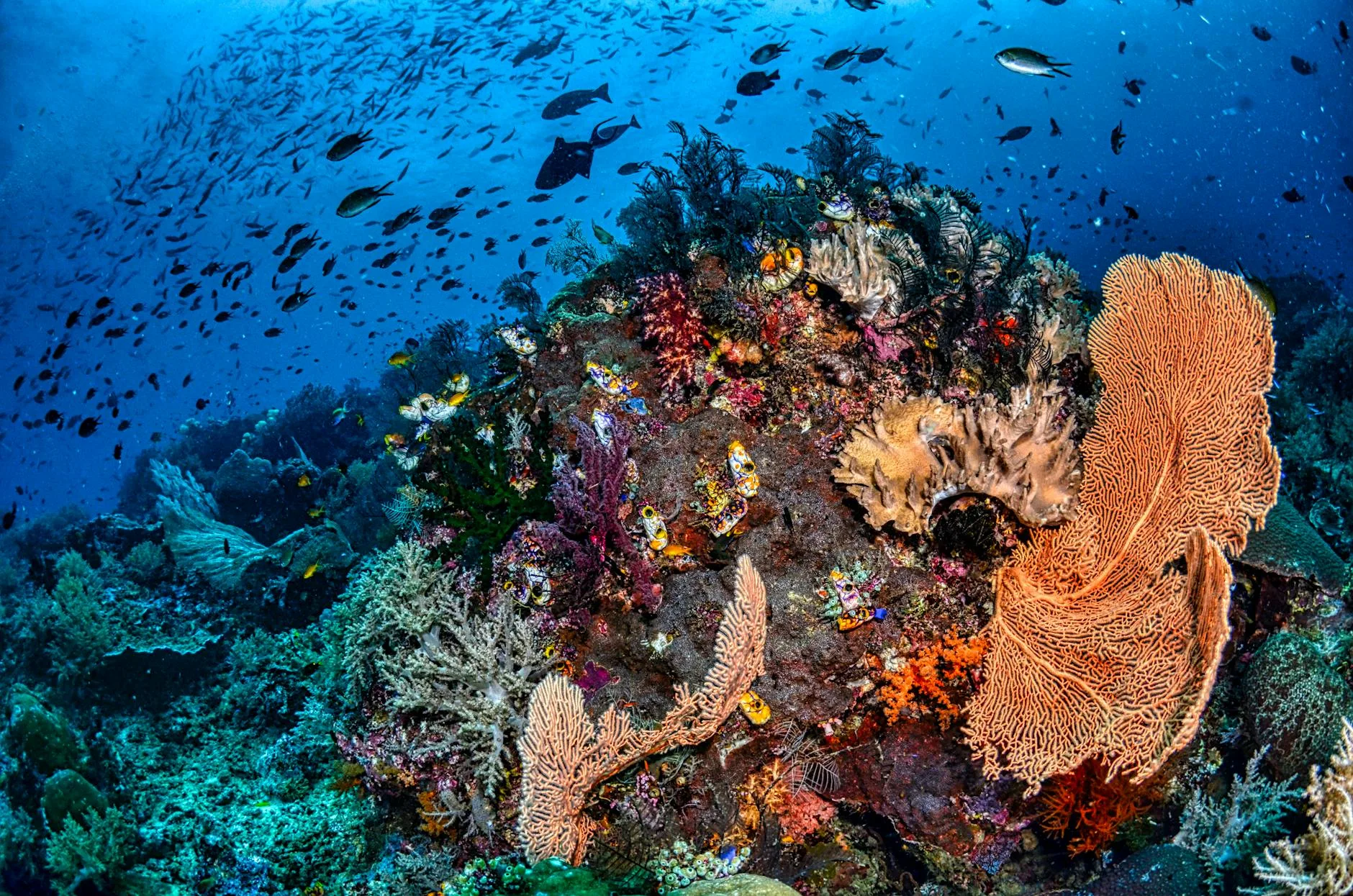
Raja Ampat sits at the northwestern tip of the Bird’s Head Peninsula, and the numbers around it are frequently cited, seldom exaggerated: over 1,500 fish species and 600 coral species have been recorded here, making it one of the most species-rich marine environments measured anywhere on Earth. The dive sites spread across four main island groups — Waigeo, Batanta, Salawati, and Misool — with the most reliable access from the town of Waisai on Waigeo.
The Dampier Strait, between Waigeo and Gam Island, holds sites like Cape Kri (a drift dive with extraordinary fish density), Blue Magic (known for wobbegong sharks and barracuda), and Sardine Reef, where schools of fish move in columns so thick they dim the light. Misool, in the south, requires a liveaboard or a stay at one of the small eco-resorts and offers some of the least-visited reefs in the region — mushroom coral formations, mantas, and reef sharks in water that often turns glassy blue-green in the late morning.
Logistics: Fly from Jakarta or Makassar to Sorong (SOQ), then take the public ferry (around 2 hours, roughly IDR 200,000 / ~USD 12) or speedboat (45 minutes, IDR 600,000–800,000) to Waisai. Most dive resorts are on Gam or Mansuar islands, a further 30–60 minutes by boat. Liveaboards depart from Sorong. Raja Ampat charges a conservation entry fee of USD 100 (valid for one year). Best season: October to April. Visibility is generally best November to January.
2. Komodo National Park, East Nusa Tenggara
The diving around Komodo island and its surrounding islets — Rinca, Padar, Kanawa, Batu Bolong — is defined by water temperature and current. Cold upwellings from the deeper Banda Sea push nutrient-rich water through the channels, and the result is coral that feeds rather than just exists: enormous sea fans, thick table corals, and the kind of fish life — reef sharks, mantas, tuna, Napoleon wrasse — that goes with serious water movement.
Batu Bolong is the signature site, a seamount rising steeply from the channel floor that attracts dense aggregations of fish and is manageable even in moderate current if you time your entry. Castle Rock and Crystal Rock, in the north near Gili Lawa, are more current-exposed and reward intermediate to experienced divers. Cannibal Rock, near Rinca, is a famous macro site — a rubble slope covered in nudibranchs, frogfish, and juvenile everything — in contrast to the big-water drama elsewhere in the park.
Logistics: Fly to Labuan Bajo (LBJ) on Flores, which has direct connections from Bali (45 minutes, from around IDR 500,000). Dive operators are concentrated along the main waterfront street. A two-tank day trip costs roughly USD 80–120 including park fees. Liveaboards ranging from 3 to 8 nights depart from Labuan Bajo and are the most efficient way to cover the full park. Best season: April to November. July–August brings the strongest currents and the most reliable manta sightings.
3. Tulamben, Bali
Tulamben is a small fishing village on Bali’s northeast coast, roughly three hours from Kuta by road, and it exists almost entirely because of one wreck: the USAT Liberty, an American cargo ship torpedoed in 1942 and beached here, which slid into the sea during a volcanic eruption in 1963 and now lies at 5–29 metres on a black sand slope. It is one of the most dived wrecks in Asia, and justifiably so — the ship is heavily encrusted with coral after six decades underwater, and the fish life using it as habitat includes bumphead parrotfish, giant trevally, hawksbill turtles, and an astonishing density of smaller reef species.
The site is accessible from shore, which means you can dive it at times when boat-based operators are not running — very early morning, when the bumphead parrotfish feed in large schools along the bow, or at dusk. Beyond the Liberty, Tulamben’s Drop-Off is a wall dive beginning just metres from the beach, and the area around the river mouth (Coral Garden) offers solid macro.
Logistics: Hire a car or take a shared shuttle from Kuta or Ubud to Tulamben (around USD 20–35). Most divers stay in simple guesthouses in the village itself — rooms from USD 20–40 per night with dive packages. A two-tank boat dive (or shore dive) costs USD 35–60 depending on guide inclusion and equipment rental. The Liberty is diveable year-round; October to March brings calmer seas on this coast.
4. Nusa Penida, Bali
Twenty kilometres southeast of mainland Bali by fast boat, Nusa Penida has developed rapidly as a dive destination over the past decade, largely on the strength of two things: Mola mola (ocean sunfish) and manta rays. The sunfish congregate around the island from July to October, drawn by cold water upwellings from the south, and are encountered on sites like Crystal Bay — a point on the northwest tip of the island where the bottom drops away steeply and temperatures can drop to 18°C below the thermocline. It is cold, sometimes disorienting dive — you go down looking for a fish the size of a small car.
Manta Point, on the southwest coast, is more reliably approachable: a cleaning station on a shallow reef where reef mantas circle in open water above you. The current here is manageable and the site suits intermediate divers comfortably.
Logistics: Fast boats run from Sanur harbour (45 minutes, around IDR 200,000–350,000 each way). Dive operators are based around Toyapakeh in the north and Sampalan on the east coast. Most day-trip divers come from Bali, but staying overnight on the island gives you earlier access to sites before the day-trip boats arrive. Best season: July to October for Mola mola; November to June for calmer water and better visibility on the manta sites.
5. Banda Sea, Maluku
The Banda Sea is one of those places that requires committing to: there is no dipping in. The islands of Banda Neira, Gunung Api, and the outer Banda chain sit in the centre of the Maluku archipelago, accessible from Ambon, and the marine environment here — volcano-fed water, ancient reef systems, near-zero tourist infrastructure — is unlike anywhere else in Indonesia. Diving is done almost exclusively from liveaboards or from Banda Neira itself, and the sites include walls dropping to 500 metres, schools of hammerhead sharks at Manuk Island (an active volcanic island in the outer chain), and reef systems that have seen minimal disturbance.
This is serious diving — remote, logistically complex, and not a place where things go wrong cheaply. But for divers who want a genuine sense of Indonesia’s scale and wildness, the Banda Sea delivers in a way that more accessible destinations cannot.
Logistics: Fly from Jakarta or Makassar to Ambon (AMQ), then take an express boat to Banda Neira (4–6 hours, around IDR 300,000). Liveaboards departing from Ambon or Sorong typically include Banda as part of longer eastern Indonesia itineraries. Best season: October to April. This is a specialist destination — research operators carefully before booking.
6. Alor Archipelago, East Nusa Tenggara
Alor sits at the eastern end of the Lesser Sunda chain, past Flores and past the crowds, and it has a particular character: volcanic, current-swept, biologically unusual. The reefs here are fed by cold upwellings and are some of the least bleached in Indonesia — partly due to the water temperature, partly due to the near-absence of visitor pressure. Dive sites like Kal’s Dream, Pura Wall, and the Pantar Strait are known among experienced divers but rarely appear on mainstream itineraries.
The macro diving at Alor is exceptional — pygmy seahorses, blue-ringed octopus, hairy frogfish — but the current dives are the signature experience. Whale sharks are encountered semi-regularly in the strait.
Logistics: Fly from Bali to Kupang (KOE), then connect to Alor’s Mali Airport. Alternatively, some liveaboards from Komodo or Flores include Alor on extended eastern Indonesia routes. Land-based dive operations are small and mostly guesthouse-based. Budget USD 80–120 per day for accommodation and two-tank diving. Best season: April to November.
7. Lembeh Strait, North Sulawesi
Lembeh is a narrow strait between the mainland of North Sulawesi and Lembeh Island, and it looks like nothing much from the surface: a stretch of dark water between port facilities, fishing boats, and black volcanic sand beaches. Below, it is considered one of the finest muck diving environments anywhere in the world.
Muck diving is, in essence, the opposite of reef diving: you move slowly across featureless sandy or silty bottom, looking for the camouflaged, the peculiar, and the miniature. In Lembeh, this means mimic octopus, flamboyant cuttlefish, hairy frogfish, Rhinopias scorpionfish, blue-ringed octopus, various species of mantis shrimp, and dozens of nudibranch species per dive. Many of these animals are nocturnal or crepuscular, and Lembeh’s night dives are extraordinary.
Logistics: Fly to Manado (MDC), then drive or take a shuttle to Bitung (around 1.5 hours). Most dive resorts are on the Lembeh Island side of the strait. Resort packages including accommodation and three dives per day run from around USD 150–250. The strait is diveable year-round; visibility is often low (5–8 metres), which is expected and irrelevant to the experience. Best for photographers and naturalists.
8. Bunaken Marine Park, North Sulawesi
An hour’s boat ride north of Manado, Bunaken National Marine Park was one of Indonesia’s first gazetted marine protected areas and it shows — the wall diving here is exceptional. The park’s five main islands (Bunaken, Manado Tua, Siladen, Nain, and Montehage) are ringed by walls that begin at the surface and drop, in places, to 200 metres or more. These walls are covered in hard and soft coral — gorgonian fans, sea whips, sponges — and the fish aggregations at depth are consistent.
The diving is generally easier than Komodo or Alor: moderate currents, warm water (28–30°C), and good visibility most of the year. It suits all experience levels. The combination of Bunaken for reef diving and Lembeh for muck is a compelling two-stop North Sulawesi itinerary.
Logistics: Fly to Manado. Day trips to Bunaken leave from the Boulevard waterfront area. Better to stay on Bunaken island itself (accommodation from USD 40–80 per night with dives) for access to sites before day-trippers arrive. Park entry fee around IDR 150,000 per day. Best season: May to November.
9. Derawan Archipelago, East Kalimantan
Borneo’s East Kalimantan coast is not obviously a dive destination, but the Derawan islands — Derawan, Sangalaki, Kakaban, and Maratua — are consistently excellent. Sangalaki is one of the most reliable manta ray sites in Indonesia, with resident reef mantas circling a cleaning station year-round. Kakaban hosts a landlocked marine lake, cut off from the sea for thousands of years, where stingless jellyfish have evolved — you can swim through them; they won’t sting.
Maratua atoll, the outermost island, has walls and channels with good shark activity and some of the clearest water in the region.
Logistics: Fly from Makassar or Balikpapan to Berau, then take a speedboat to Derawan island (about 2 hours, IDR 300,000–500,000). Accommodation is available on Derawan and Maratua; most divers use these as bases. This is a destination worth combining with a wider Borneo overland trip. Best season: March to November.
10. Gili Islands, Lombok
The Gili Islands — Gili Trawangan, Gili Air, and Gili Meno — are well-known and visited, but the diving here deserves inclusion for a specific reason: it is genuinely good, reliably accessible, and well-suited to newer divers or those combining a dive trip with non-diving travel. The underwater sculpture installations near Gili Meno (a series of concrete figures being colonised by coral) are distinctive, and sea turtles are so consistently present on the local reefs — Meno Wall, Shark Point, Halik — that most divers encounter multiple individuals per dive.
Dive training is widely available at competitive prices across all three islands. Trawangan has the most operators; Air is quieter and generally better for intermediate divers who want less foot traffic on the sites. If overtourism is a concern — and on Trawangan in peak season, it is — the nearby Gili Nanggu group off the southwest Lombok coast gets a fraction of the visitors and has comparable diving.
Logistics: Fast boats from Bali (Padang Bai or Serangan harbour) to the Gilis take 1.5–2 hours and cost IDR 300,000–500,000. The Gilis have no motorised vehicles; you move by foot, bicycle, or cidomo (horse cart). A PADI Open Water course runs approximately USD 350–400. Best season: May to November for clearest water; diveable year-round.
Comparison table: Indonesia’s top dive sites
| Site | Best for | Experience level | Best season | Approx. daily dive cost | Getting there |
|---|---|---|---|---|---|
| Raja Ampat | Biodiversity, reefs | All levels | Oct–Apr | USD 80–130 | Fly to Sorong, ferry to Waisai |
| Komodo | Currents, pelagics | Intermediate+ | Apr–Nov | USD 80–120 | Fly to Labuan Bajo |
| Tulamben | Wreck, shore diving | All levels | Year-round | USD 35–60 | Road from Kuta/Ubud |
| Nusa Penida | Mola mola, mantas | Intermediate | Jul–Oct (sunfish) | USD 60–100 | Boat from Sanur, Bali |
| Banda Sea | Remote reefs, hammerheads | Advanced | Oct–Apr | USD 200+ (liveaboard) | Fly to Ambon, boat |
| Alor | Muck, currents | Intermediate–Advanced | Apr–Nov | USD 80–120 | Fly via Kupang |
| Lembeh Strait | Muck, macro, photography | All levels | Year-round | USD 150–250 (package) | Fly to Manado, drive |
| Bunaken | Walls, reef fish | All levels | May–Nov | USD 40–80 | Fly to Manado, boat |
| Derawan | Mantas, marine lake | All levels | Mar–Nov | USD 60–100 | Fly to Berau, speedboat |
| Gili Islands | Training, turtles, access | Beginner–Intermediate | May–Nov | USD 50–80 | Boat from Bali |
Planning your Indonesia dive trip
Indonesia’s distances are the first thing to understand. The country spans roughly the same width as the continental United States. Raja Ampat and Bali are 3,000 kilometres apart. A single trip cannot cover all ten of these sites; choose a region and go deep into it.
Garuda Indonesia, Lion Air, and Citilink operate the domestic network. Jakarta (CGK) and Bali (DPS) are the main hub airports. For remote destinations like Banda or Alor, expect connections via Makassar (UPG) or Ambon (AMQ). Book domestic flights as early as possible — small routes to places like Berau or Waisai sell out and prices spike.
If you are planning your first major Indonesia trip and want to understand the cultural context of the islands you will be moving through — particularly in Bali, Lombok, and Flores — reading about how to do a homestay in rural Indonesia before you go gives you a more grounded frame for what you will encounter on land between dives.
For conservation context, NOAA’s Coral Triangle overview is useful background reading on why this region matters and what threatens it. Dive responsibly — no touching coral, no feeding fish, choose operators who brief on buoyancy and environmental conduct.
For divers combining this trip with non-diving exploration of Bali’s cultural interior — festivals, ceremonies, village life — the piece on attending a local festival in Bali as an outsider is worth reading before you arrive. Bali’s ceremonial calendar is dense and, with a little preparation, accessible to visitors in a way that is genuinely enriching rather than extractive.
The Bottom Line
- Don’t try to cover everything. Choose one region per trip — Raja Ampat, or the North Sulawesi combo of Bunaken and Lembeh, or an eastern Flores/Komodo itinerary — and give each place the time it deserves. Rushing between islands adds exhaustion and carbon, and reduces the quality of diving.
- Liveaboards make sense for remote sites. For Raja Ampat’s outer reefs, the Banda Sea, or a full Komodo coverage, a liveaboard is not a luxury — it is the most practical and often the most affordable way to access the best sites. Prices range from USD 150 to USD 400+ per person per day depending on vessel standard.
- Timing matters significantly. Mola mola require July–October at Nusa Penida. Mantas at Komodo peak in dry season (April–November). Banda Sea visibility drops in wet season. Plan around what you specifically want to see, not just “the dry season.”
- Operator choice has genuine conservation weight. The Coral Triangle is under real pressure from climate bleaching, illegal fishing, and irresponsible dive tourism. Choose operators who are members of PADI’s Green Star programme or who contribute to local reef monitoring. Ask directly — good operators welcome the question.
- Indonesian dive infrastructure is uneven. In Tulamben, Lembeh, and the Gilis, equipment rental and rescue response are reliable. In Alor or the outer Banda islands, assume you are responsible for your own safety at a higher level. Bring serviced equipment, dive with a buddy, and know your limits in current.
Keep reading: How to do a homestay in rural Indonesia