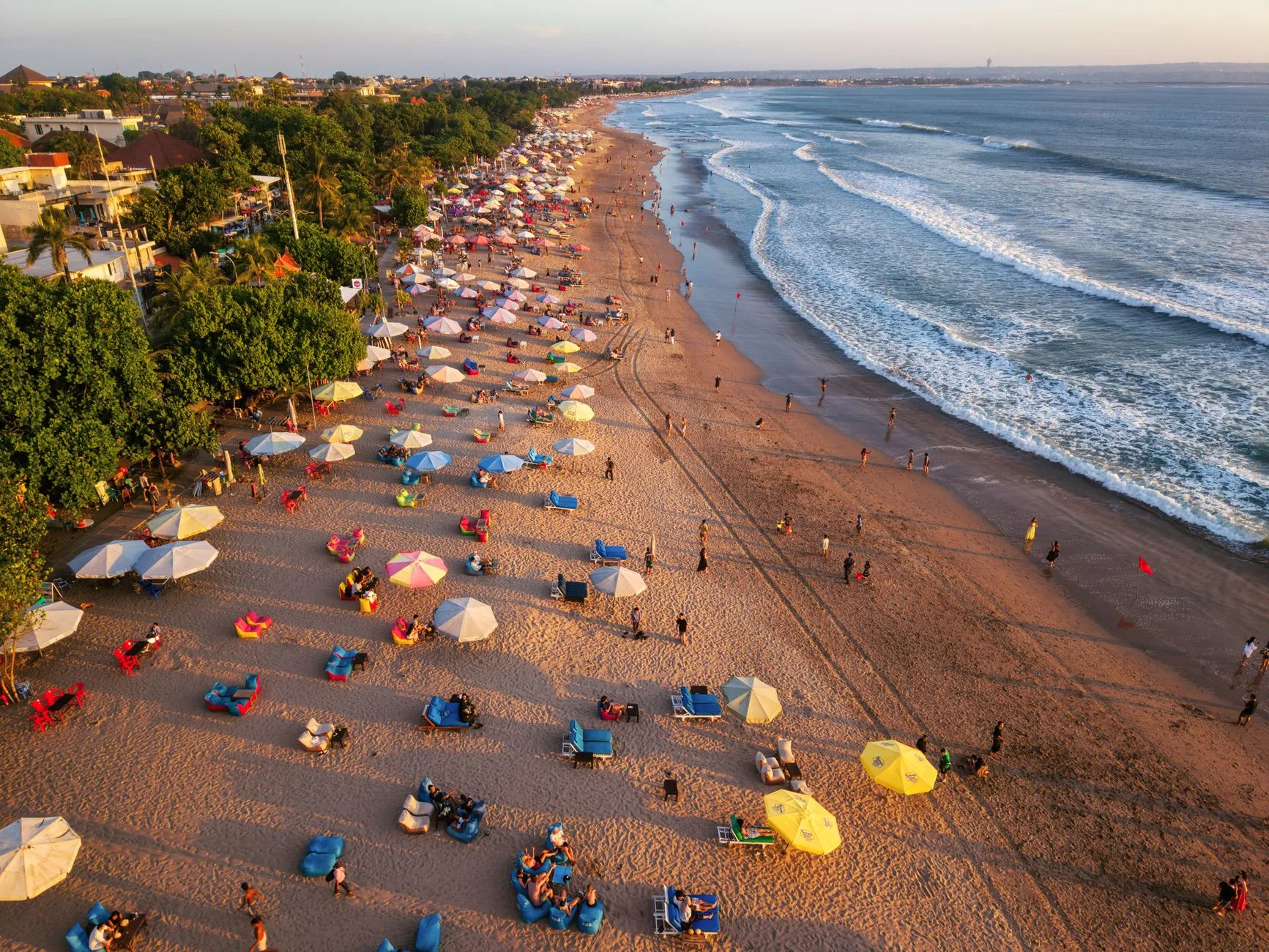
The 4am bus out of Yogyakarta’s Giwangan terminal smells like clove cigarettes and instant coffee, and the driver’s cassette deck is playing dangdut at a volume that makes conversation pointless. You’re headed for Mount Bromo, four hours east through sugarcane fields turning silver in the dark, and the woman beside you has already fallen asleep against the window with a bag of market-bought rambutan in her lap. This is not the Bali you’ve seen on a screen. There’s no infinity pool, no beach club, no queue for a photo. There’s just a long, cheap, slightly uncomfortable ride toward something worth seeing, which is more or less the entire premise of travelling through Java and Lombok on a budget.
Bali gets the attention, and fairly so — but it also gets the crowds, the inflated prices, and an infrastructure built almost entirely around tourism. Java and Lombok are different animals: bigger, rougher around the edges, cheaper, and far less rehearsed. Java is Indonesia’s political and cultural spine, home to ninth-century temples, active volcanoes, and cities that run on their own unhurried logic. Lombok, Bali’s quieter neighbour across the Lombok Strait, offers beaches with a fraction of the development and a volcano trek that ranks among Southeast Asia’s best. Together they make a loop that can be done for genuinely little money, provided you’re willing to take the slow bus sometimes.
Getting there and getting around: the real logistics
Most budget routes start in Yogyakarta (locals say “Jogja”), reachable by budget flights from Jakarta, Bali, or Kuala Lumpur for as little as $20–40 one way if booked a few weeks out. From Jogja, Indonesia’s train network — run by PT KAI — is the most comfortable overland option: the economy-class Progo or Bengawan trains run between Jogja and Jakarta for under $10, while the pricier Argo Lawu offers reclining seats and air conditioning for closer to $20.
Buses are cheaper still and cover routes the trains don’t. Long-haul overnight buses (bus malam) connect Jogja to Surabaya, Surabaya to Probolinggo (the jumping-off point for Bromo), and onward toward Banyuwangi for the ferry to Bali. From Banyuwangi, a short ferry crossing (about 45 minutes, a dollar or two) gets you to Gilimanuk in Bali, and from Bali’s Padangbai or Serangan harbours, public ferries or faster boats cross to Lombok — public ferries run about 4–5 hours and cost a few dollars; fast boats cut that to 90 minutes–2 hours for considerably more.
Domestic flights fill the gaps when time is tight — Surabaya to Lombok, for instance, runs regularly on budget carriers. None of this is glamorous. Delays happen, buses break down, ferries occasionally cancel in rough weather. Build slack into your itinerary rather than booking a flight the next morning.
Yogyakarta: temples, batik alleys, and the best cheap eating in Java
Jogja functions as the obvious base for several days. The city itself is low-rise, bicycle-heavy, and built around the Kraton (Sultan’s Palace) and the warren of alleys at Taman Sari, the old royal bathing complex where you can still get lost in tunnels that once connected the palace to the mosque. Jalan Malioboro is the main tourist strip — worth a walk for the night market atmosphere, less so for the shopping, which trends toward mass-produced batik.
For food, skip the Malioboro restaurants aimed at visitors and head to Gudeg Yu Djum near the Kraton for the city’s signature dish: gudeg, young jackfruit stewed for hours in palm sugar and coconut milk until it’s dark, sweet, and faintly meaty, served with rice, chicken, egg, and a fiery sambal krecek on the side. A full plate runs $2–3. For something sharper, the night-time angkringan carts that appear along Jalan Wijilan after dark sell nasi kucing — small portions of rice with a scrap of fish or tempeh, wrapped in banana leaf — for about 20 cents each, alongside grilled skewers and sweet tea. It’s the cheapest proper meal you’ll eat anywhere in Indonesia, and one of the most atmospheric: plastic stools on the pavement, a kerosene lamp, strangers sharing a bench.
Just outside the city, two UNESCO World Heritage sites justify the entry fees that budget travellers often grumble about. Borobudur, the world’s largest Buddhist temple, is best visited at opening time (6am) before the heat and tour groups arrive — entry for foreign visitors runs around $25, steep by local standards but it funds site maintenance. Prambanan, a cluster of soaring Hindu temples about 40 minutes from the city centre, costs slightly less and is arguably more photogenic at sunset, when the black volcanic stone spires catch the last light.
Mount Bromo: the volcano everyone photographs and almost no one describes accurately
Bromo gets presented online as a single perfect sunrise shot, which undersells how strange and cold the whole experience is. You’ll typically base yourself in Cemoro Lawang village, reached by bus and shared jeep from Probolinggo (roughly 2–3 hours, a few dollars for the bus, more for the jeep convoy up to the viewpoint). Jeeps leave around 3am for Penanjakan viewpoint, where you’ll stand in temperatures close to freezing — genuinely cold, bring a jacket you’d laugh at packing for “tropical” Indonesia — waiting for the sun to rise over a sea of volcanic sand and three cones: Bromo itself still smoking, Batok’s symmetrical ridges, and Semeru, Java’s highest peak, occasionally puffing ash in the background.
Afterward, the jeep drops you at the edge of the Sea of Sand, and you can walk or hire a horse (bargain hard, a few dollars) to the base of Bromo’s crater, then climb roughly 250 concrete steps to peer into the sulphurous, rumbling interior. It’s loud, it smells like rotten eggs, and it’s worth every uncomfortable 3am minute. Budget travellers often share jeeps in groups of six to split the cost, which can bring the per-person rate down to $10–15 for the full sunrise-and-crater package.
Ijen: the blue fire crater most visitors skip
Further east, near Banyuwangi, Kawah Ijen offers something stranger than Bromo and draws far fewer visitors, largely because reaching it requires another pre-dawn start and a genuinely strenuous hike. The trek begins around midnight from the Paltuding post, climbing roughly 3km of steep, rocky trail in the dark to reach the crater rim by 2–3am. The reward — visible only in full darkness — is “blue fire,” sulphuric gas combusting as it escapes vents in the crater wall, burning electric blue against the black rock.
Miners work the crater through the night, carrying baskets of raw sulphur up the same trail you’re descending, each load weighing 70–90kg. It’s a sobering thing to witness alongside a sunrise hike framed as adventure tourism — a reminder that this landscape is also somebody’s workplace. Entry costs around $15–20 for foreign visitors, masks are essential (sulphur fumes sting badly near the crater), and guides, while not strictly mandatory, are worth hiring for the descent into the crater itself, which is not maintained to any particular safety standard.
Crossing to Lombok: Rinjani, the Gili Islands’ quieter cousin, and the south coast
Lombok sits close enough to Bali that many visitors treat it as a day trip, which misses the point entirely. The island’s defining feature is Mount Rinjani, Indonesia’s second-highest volcano, and the multi-day trek to its summit and crater lake, Segara Anak, is among the most physically demanding — and rewarding — treks in Southeast Asia. Most trekking agencies in Senaru or Sembalun run two- or three-day packages (around $150–250, including guides, porters, food, and camping gear, which is mandatory under national park rules), the price reflecting genuine logistics rather than tourist markup.
For something gentler, the south coast around Kuta Lombok (not to be confused with Bali’s Kuta) has become the island’s main budget hub: guesthouses from $10–15 a night, warungs serving plantar-grilled fish and plecing kangkung (water spinach in a chilli-shrimp paste dressing), and beaches — Tanjung Aan, Mawun, Selong Belanak — that still have more coconut palms than beach clubs, though that’s shifting fast as development accelerates along the coast road. Surfing here is excellent and notably less crowded than Bali’s breaks, particularly at Desert Point and Gerupuk.
The Gili Islands (Gili Trawangan, Gili Meno, Gili Air) sit off Lombok’s northwest coast and have their own trajectory — Trawangan now firmly on the party circuit, Meno still sleepy, Air somewhere in between. No motorised vehicles on any of the three, which keeps a particular hush over them even as prices creep upward. Snorkelling off all three islands is genuinely good and cheap (gear rental a couple of dollars), though for serious diving, Indonesia’s best sites lie elsewhere in the archipelago.
| Route/Destination | Transport | Approx. Cost | Time | Best For |
|---|---|---|---|---|
| Jakarta/Bali to Yogyakarta | Budget flight | $20–40 | 1–1.5 hrs | Fast entry point |
| Yogyakarta to Probolinggo (Bromo) | Overnight bus | $8–15 | 8–10 hrs | Budget volcano access |
| Probolinggo to Banyuwangi (Ijen) | Bus/train | $5–10 | 3–4 hrs | Combining both volcanoes |
| Banyuwangi to Bali (Gilimanuk) | Ferry | $1–2 | 45 min | Onward to Lombok |
| Bali (Padangbai) to Lombok | Public ferry | $5–10 | 4–5 hrs | Slow, scenic, cheap |
| Bali to Lombok | Fast boat | $25–40 | 1.5–2 hrs | Saving time |
| Senaru/Sembalun to Rinjani summit | Guided trek | $150–250 | 2–3 days | Serious trekking |
Costs, seasons, and what the budget actually looks like
A realistic daily budget across Java and Lombok, staying in guesthouses and eating mostly at warungs, runs $20–35 a day including transport — noticeably less than equivalent travel in Bali’s tourist zones, where accommodation and food prices have risen sharply in recent years. The dry season, April to October, is the sensible window for volcano trekking, since Bromo and Ijen’s viewpoints are frequently fogged in or dangerous during the wet months. July and August bring the biggest crowds and the highest jeep and guesthouse prices at Bromo specifically; shoulder months like May, June, or September offer a reasonable trade-off between weather and cost.
Street food is both the cheapest and most reliable way to eat well — a point worth taking seriously, since digestive trouble is the single biggest trip-derailer for budget travellers in Indonesia. Sticking to stalls with high turnover, where food is cooked fresh in front of you rather than sitting under a heat lamp, cuts the risk considerably — a principle that holds across markets throughout Southeast Asia, not just here.
The crowds you’ll still find, and how to avoid adding to them
None of this is untouched territory. Bromo’s main viewpoint gets genuinely crowded in peak season, jeeps lined up bumper to bumper for the sunrise. The Gilis have their own well-documented overdevelopment issues. The honest approach is less about avoiding people entirely and more about timing and alternatives — arriving at Bromo’s secondary viewpoints like King Kong Hill instead of the main Penanjakan crush, or choosing Gili Air over Trawangan, or trekking Rinjani via the less-travelled Torean route. The broader question of how to spread tourism pressure more evenly across the region is one worth thinking through before you book anything, and it’s covered in more depth in guidance on avoiding overtourism across Southeast Asia.
The Bottom Line
- Budget $25–40/day for Java, slightly more for Lombok once you factor in the Rinjani trek or boat transfers, and expect the cheapest, best food to come from warungs and angkringan carts, not restaurants with English menus.
- Build in slack: buses break down, ferries get cancelled in rough seas, and volcano viewpoints get fogged out. A rigid itinerary will wear you down faster than any physical discomfort.
- Bromo and Ijen reward the sleep deprivation; both start before 3am and both are genuinely cold, which surprises most visitors to “tropical” Indonesia.
- If Rinjani’s multi-day trek feels like too much, Lombok’s south coast around Kuta offers a lower-effort, still-rewarding alternative with excellent surf and far fewer crowds than Bali’s equivalent beaches.
- This region isn’t a secret, and treating it as one misses the point — it’s simply less built for tourism than Bali, which means slower buses, fewer English menus, and a trip that asks a little more of you in exchange for a lot more texture.
Keep reading: 10 alternatives to Bali for island travel in Asia