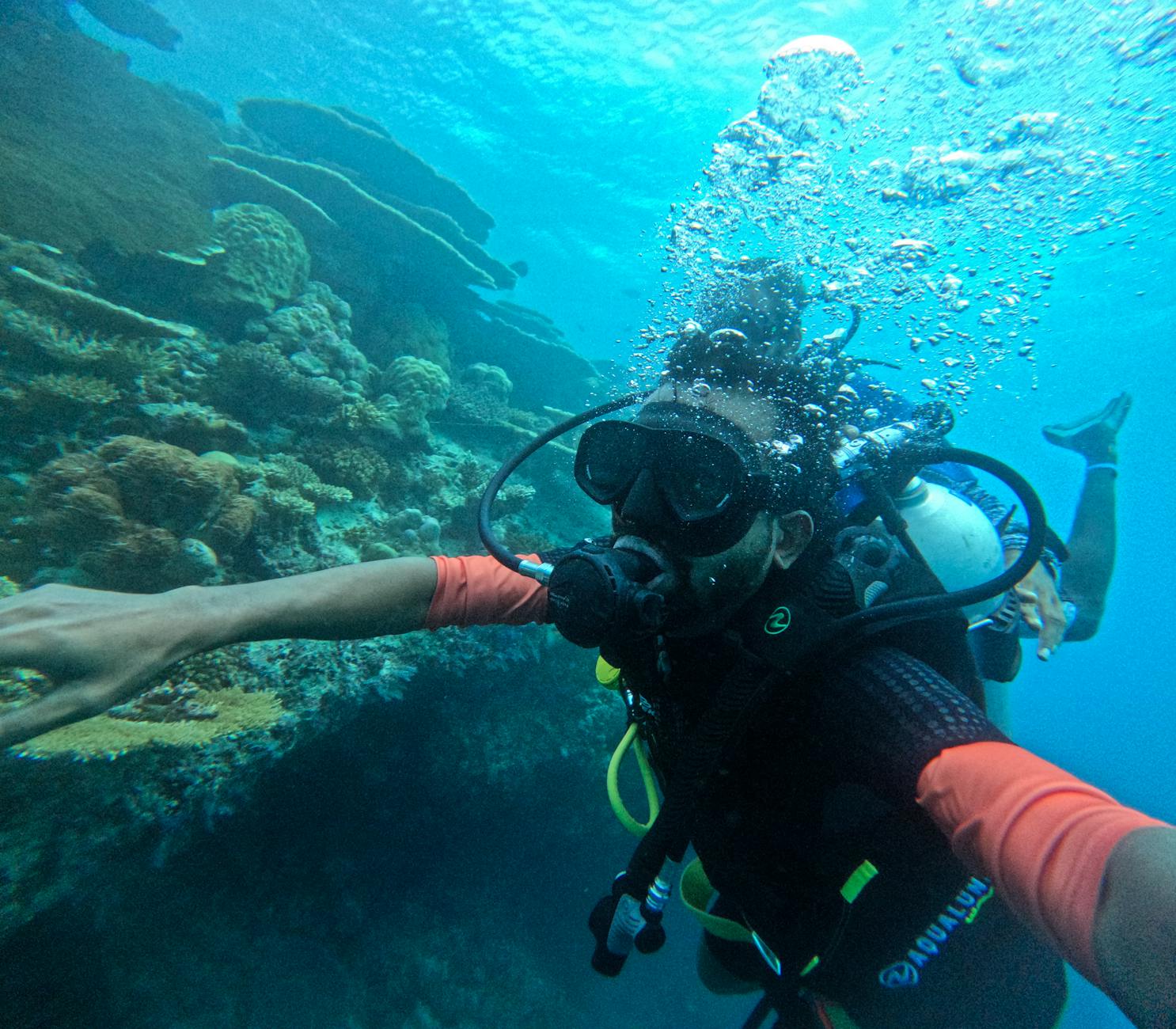
Photo by Md Rafatul Islam on Pexels
Free diving in the Maldives: a beginner’s guide
The dhoni bobs in a flat blue nothing, forty minutes south of Malé. There’s no reef visible from the surface — just a thermocline shimmer three metres down and, below that, the suggestion of something enormous moving slowly in from the west. Your instructor tells you to equalise early and often. You tip forward, feet up, and descend into water so clear it feels like falling through air.
That moment is available to beginners. You don’t need a decade of spearfishing or a competition record. What you need is honest preparation, the right atoll, a structured course, and realistic expectations about what your lungs will do on day one versus day three. This guide gives you all of that.
What “beginner” actually means here
First: freediving is breath-hold diving, not scuba. No tank, no regulator — you descend on a single inhale and surface before your body demands air. A complete novice might manage 5–8 metres comfortably on the first day. By the end of a two-day beginner course, 10–15 metres is realistic for most people. The Maldives’ famous sites — the whale shark aggregations at South Ari Atoll, the manta cleaning stations at Baa Atoll’s Hanifaru Bay — sit in 10–25 metres of water. You can see a great deal from shallower depths if you’re comfortable in the water at all.
Don’t arrive expecting to hover at 20 metres on day one. Do arrive expecting to be genuinely surprised by how accessible this is.
Where to base yourself: atolls and islands
South Malé Atoll (Maafushi Island) is the practical starting point for budget-minded beginners. Maafushi is a 45-minute speedboat transfer from Velana International Airport (around $25–30 per person on a shared transfer). The island has guesthouses from $60–90 per night, cafes, and three or four dive centres that offer freediving instruction alongside their scuba operations. The house reefs off the western end of Maafushi drop cleanly to 15–20 metres — good for early training dives without a boat journey.
South Ari Atoll is where you go once you have some depth under you. Specifically, the channel between Dhigurah and Maamigili islands is the most reliable whale shark corridor in the Maldives — National Geographic has documented aggregations here throughout the year, with peak numbers from July to November. Reaching South Ari requires a domestic flight from Malé to Maamigili Airport (30 minutes, $120–160 return on Maldivian Airlines) or a speedboat transfer of roughly 2.5 hours ($60–80 each way on shared charters from Malé).
Baa Atoll is the UNESCO Biosphere Reserve and home to Hanifaru Bay, a seasonal plankton trap that draws manta rays in staggering numbers. Entry to Hanifaru is regulated — only certified snorkellers and divers with a guide can enter during peak season (June–October), and the bay is shallow enough (4–8 metres maximum) that a complete beginner with solid snorkel technique can have the defining experience of the trip without any formal freediving qualification. A seaplane from Malé to Dharavandhoo Airport takes 25 minutes and costs $340–400 return.
Getting your certification before you go (or on arrival)
A PADI Freediver or SSI Freediving Level 1 course takes two days and certifies you to 20 metres with a buddy. In the Maldives, this costs $250–350 and is offered at several centres on Maafushi and at resort dive schools on Rangali Island and Ellaidhoo in North Ari Atoll.
A smarter option for many travellers: complete the theory and pool session at home before you fly. Freediving instruction bodies like AIDA publish a list of affiliated schools globally, and finishing the confined-water session at your local pool means you arrive in the Maldives needing only the open-water dives — often half the course cost and all of the fun.
If you arrive without any certification, most Maafushi centres offer a “Discover Freediving” day ($80–120) that teaches breath control, equalisation, and safe ascent technique in a single supervised session. This is not a certification but it is genuinely useful as a first step.
The logistics table: costs, transfers, and timing
| Element | Detail | Approximate Cost (2026) |
|---|---|---|
| Velana Airport → Maafushi | Shared speedboat, ~45 min | $25–30 per person |
| Maafushi guesthouse | Per night, including breakfast | $60–120 |
| PADI/SSI Freediver course | 2 days, open water cert | $250–350 |
| Discover Freediving session | 1 day, no cert | $80–120 |
| Malé → Maamigili (South Ari) | Domestic flight, return | $120–160 |
| Malé → Dharavandhoo (Baa) | Seaplane, return | $340–400 |
| Guided whale shark snorkel/freedive | 3–4 hrs, South Ari | $60–90 |
| Peak season (whale sharks) | South Ari, Jul–Nov | — |
| Peak season (mantas, Hanifaru) | Baa Atoll, Jun–Oct | — |
| Shoulder season (flat seas) | Jan–Apr, northeast monsoon | Best visibility |
What to actually practise before you arrive
Equalisation is the thing that defeats most beginners before depth does. The Frenzel technique — pressurising your ears using tongue movement rather than blowing against a pinched nose — is much harder to learn underwater than in a dry room. There are good tutorials online; spend a week practising before you board the plane.
Breath-hold tables (CO2 and O2 tables) are secondary: useful, but your instructor will cover them on the course. What they can’t easily fix once you’re in the water is an equalisation problem that’s been ignored.
Also: get comfortable floating face-down. Spend time in a hotel pool if you can. The most common beginner error in the Maldives is surface anxiety — tension in the shoulders and neck that bleeds oxygen and wrecks dive time before the descent even begins.
Honest notes on difficulty and safety
Freediving has real risks. Shallow water blackout — a loss of consciousness caused by hypoxia during ascent — is responsible for most freediving fatalities, and it can happen at 5 metres as easily as 30. The rule is absolute: never freedive alone. Every reputable centre on Maafushi and in South Ari will pair you with a buddy and teach you rescue procedures on day one of any