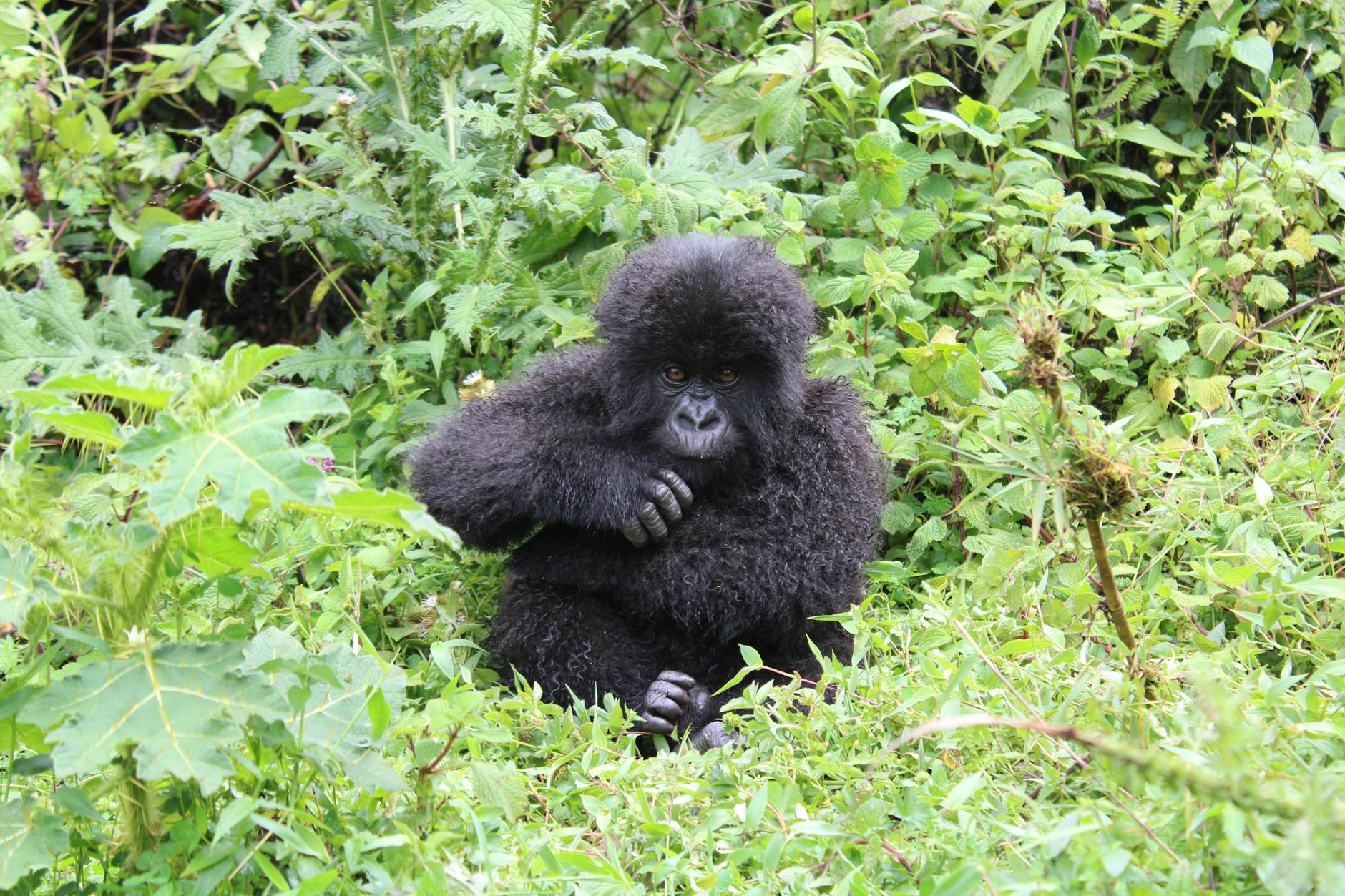
A silverback gorilla’s attention is a specific weight. When the guide signals you to stop—15 meters away, behind ferns—and the gorilla looks at you, you’re briefly witnessed by an intelligence that registers difference. This moment is nearly identical in Uganda and Rwanda. Everything else about the experience is not.
Cost difference: Uganda permits cost $700, Rwanda permits cost $1,500. That’s $800 per person. Trek difficulty, landscape type, probability of seeing gorillas, solitude level, and infrastructure quality differ significantly between the two. Choosing isn’t about which gorillas are “better.” It’s about what kind of trek you want around that moment.
The Financial Reality
Rwanda (Volcanoes National Park): Permit costs $1,500 USD per person per trek. This is the baseline—one permit, one trek, one group. Park entry is included. A 3-day trip (one full trek day) costs $1,500 in permit alone. Add accommodation ($50–150/night), guides, transport.
Uganda (Bwindi Impenetrable National Park): Permit costs $700 USD per person per trek. Infrastructure is lower, visitor management is less refined, but the permit is half the price. A 3-day trip with full accommodation can be done for $700 + $100–200 in lodging + $50 in transport.
What drives the price difference:
– Rwanda caps visitor numbers at 80 permits per day across the park. Uganda caps fewer.
– Rwanda invests heavily in park infrastructure: roads, visitor centers, ranger training.
– Rwanda’s permits fund conservation directly and visibly; Uganda’s system is less transparent.
– Rwanda’s tourism infrastructure is developed (hotels, restaurants, guides); Uganda’s is basic.
– Demand for Rwanda exceeds supply. Uganda has more capacity.
The practical implication: If you have $3,000 for gorilla trekking, Rwanda gives you one trek. Uganda gives you two treks (multiple gorilla families) in different regions, with better accommodation, and reserves left over.
The Trek Itself: Difficulty, Duration, and Actual Conditions
Rwanda (Volcanoes National Park):
– Trek duration: 45 minutes to 4 hours (average 2–3 hours)
– Terrain: High altitude (1,900–2,500m), volcanic slopes, mossy forest, relatively gentle
– Navigation: Roads lead to the park; guides follow pre-planned routes; radio tracking confirms gorilla locations daily
– Group dynamics: 8 people maximum per permit (often 4–6); multiple groups in the park simultaneously
– Habituation: Gorillas are fully habituated to human presence; they continue normal behavior around viewers
– Success rate: 94–99% of trekkers see gorillas
– Recovery: Trek ends by 1–2pm; afternoon for rest and exploration
Uganda (Bwindi Impenetrable):
– Trek duration: 2–6 hours (average 4–5 hours, sometimes a full day)
– Terrain: Dense undergrowth, steep slopes, slippery after rain, 1,400–2,600m elevation, harder on the body
– Navigation: Limited roads; guides navigate by territory knowledge and radio contact; gorilla location isn’t always pinpointed
– Group dynamics: 8 people maximum, but often 1–2 groups per large section of the park; you may be alone for hours
– Habituation: Gorillas tolerate human presence but don’t ignore it; they move, react, change behavior around observers
– Success rate: 80–95% of trekkers see gorillas (lower because terrain makes finding them harder, not because gorillas avoid humans)
– Recovery: You’re tired; many people spend the afternoon resting at the lodge
Honest comparison:
Rwanda’s trek is managed, efficient, and reliably delivers the moment. You see gorillas, you have energy left for the afternoon, you return feeling you accomplished something.
Uganda’s trek is harder. Your knees absorb punishment. You might trek 4 hours and not see the family assigned to you. If you do see them, the encounter feels less “managed”—the gorillas are genuinely wild in their reactions, and you’re genuinely in their space, not they in yours. If you haven’t been active recently, it’s worth taking time to build back your base fitness before attempting the harder terrain.
Landscape, Isolation, and How It Feels to Move Through the Forest
Rwanda (Volcanoes National Park):
The approach is orderly. A driver takes you from your hotel in Musanze town (30 mins) to the park gate. There’s a visitor center, a pre-trek briefing room, ranger uniforms, and an organized dispersal of groups. You hike upward on established trails; the forest is lush but not overwhelming. You pass through bamboo sections and see other trekkers. The boundary between “town” and “park” is clear.
The landscape is beautiful in a postcard way. Moss covers trees. The terrain is steep but navigable. Elevation gain is real but not debilitating. The air is cool. You’ll be breathing hard, but you’ll also be managing the environment, not being consumed by it.
Uganda (Bwindi Impenetrable):
The approach is slower. You drive to a gate community (not a visitor center), show your permit to a ranger, and meet your guide. There’s no briefing room, no systematic grouping. You’re simply handed to a guide and pointed into the forest.
The forest is genuinely impenetrable in places. The canopy blocks light. Vegetation is dense—branches grab at your backpack, roots are invisible under leaf litter, the ground is uneven and slippery when wet. Smells are stronger here. The understory is layered and disorienting.
You’re not the center of attention. You may see other tourists, but you’ll go stretches where you only see your guide and porters. The forest is indifferent to your presence. You’re moving through a real wilderness where gorillas are native and tourism is an addition, not the primary purpose.
The practical difference:
Rwanda’s landscape is manageable and beautiful. Uganda’s landscape is harder, more sensorial, less “scenic” in a Western sense, but more immersive.
How Much Time You Need
Rwanda:
– Kigali airport to Volcanoes: 2.5 hours by car
– Trek day: full day (6am–1pm typically)
– Minimum trip: 3 days (one day arrival/settling, one trek day, one return day)
– Maximum value: 3–4 days (second trek is possible but expensive)
Uganda:
– Kampala airport to Bwindi: 8–10 hours by road (rough road, slow driving)
– Trek day: full day, exhausting
– Minimum trip: 3 days (but compressed due to travel time)
– Better trip: 4–5 days (1 acclimatization/travel, 2 trek days with separate families, 1 recovery/return)
The time equation:
Rwanda: 3 days minimum, could be 5 days if you want relaxation around the trek.
Uganda: 4 days realistically, 5+ days if you want to trek multiple families. The road is slow and rough; budget travel time accordingly.
If you have only 5 days vacation: Rwanda is the choice. You’ll have travel, trek, and return without being constantly exhausted.
If you have 10 days: Uganda allows you to trek two different gorilla families in two different regions (Bwindi and Mgahinga), with time for acclimatization and recovery.
Visitor Density and Atmosphere
Rwanda:
– Approximately 80 permits issued daily across Volcanoes
– This means 10 groups of 8 people in a park that’s relatively small
– You’ll see other trekkers: on trails, at rest stops, when you’ve found gorillas (sometimes 2–3 groups watching the same family)
– The atmosphere is social. People celebrate finding gorillas. There’s energy and camaraderie
– You’re part of a tourism ecosystem: lodges, restaurants, guides, infrastructure
– You’ll feel managed and supported
Uganda (Bwindi):
– Bwindi is much larger and receives fewer permits (around 40–50 daily, more than Uganda’s smaller Mgahinga park)
– But the park is vast, so you may be the only group in your section
– You might trek 4 hours and see no other tourists, only your guide and porters
– The atmosphere is quiet. When you find gorillas, it’s a moment without audience
– You’re part of a minimal infrastructure: basic lodges, few restaurants, guides who know the forest
– You’ll feel independent and closer to actual wilderness
The practical difference:
Rwanda feels like a popular destination managed well. You’re not alone; you’re part of a system.
Uganda feels like an adventure. You might not see other tourists for an entire day. The solitude is real.
Conservation Funding and Where Your Money Goes
Rwanda (Volcanoes):
– Mountain gorilla population: ~1,000 in the Virunga range
– Permit revenue: $1,500 × 80 daily permits × 365 days = ~$43.8 million annually (theoretical maximum; actual varies seasonally)
– Where it goes: Explicitly documented. Rwanda’s park system is transparent. Funds support ranger salaries, anti-poaching patrols, research, and community development in border villages
– Evidence: The park is well-maintained. Rangers are trained. Infrastructure is visible
– Gorilla stability: Population growing
Uganda (Bwindi):
– Mountain gorilla population: ~450 in Bwindi and ~400 in Mgahinga (two parks combined)
– Permit revenue: $700 × 40 daily permits × 365 days = ~$10.2 million annually (theoretical; actual varies)
– Where it goes: Less transparent. Funding is allocated to park management, but distribution to communities is inconsistent. Some money flows into government general funds
– Evidence: The park is maintained but less uniformly. Infrastructure varies by section
– Gorilla stability: Population growing, but more slowly than Rwanda’s
The ethical reality:
Rwanda’s system is more developed and more transparent. You can verify that permit money funds conservation.
Uganda’s system is less transparent, but gorilla populations are still growing, suggesting conservation works even without clear accountability.
If conservation funding transparency matters to your decision: Rwanda is the clear choice. If you’re willing to accept a less-transparent system for lower cost: Uganda is reasonable.
Decision Matrix
| Factor | Rwanda | Uganda | Winner For |
|---|---|---|---|
| Cost | $1,500 permit | $700 permit | Budget travelers (Uganda) |
| Trek difficulty | 2–3 hours, manageable | 4–5 hours, exhausting | Fit travelers (Uganda); others (Rwanda) |
| Solitude | Multiple groups visible | Often alone for hours | Solitude seekers (Uganda) |
| Success rate | 94–99% | 80–95% | High certainty (Rwanda) |
| Infrastructure | Hotels, restaurants, guides | Basic lodges, few services | Comfort seekers (Rwanda) |
| Time required | 3 days minimum | 4–5 days minimum | Time-limited (Rwanda) |
| Gorilla behavior | Habituated, routine | Wild, reactive | Wild encounters (Uganda) |
| Conservation transparency | Clearly tracked | Less transparent | Ethics-focused (Rwanda) |
| Multiple treks possible | Yes, but expensive | Yes, affordable | Budget for multiple (Uganda) |
| Total trip cost | ~$2,500–3,500 | ~$1,500–2,200 | Budget travelers (Uganda) |
Making Your Choice
Choose Rwanda if:
– You have limited vacation time (5–7 days maximum)
– You want reliability: 95%+ chance of seeing gorillas
– You prefer physical comfort and established infrastructure
– You want your permit money funding transparent conservation efforts
– You value efficiency: trek, return, no complications
– You’re not a hardcore trekker; moderate fitness is fine
Choose Uganda if:
– You have 10+ days
– You can accept an 80–90% chance of seeing gorillas (the trek might not find your assigned family)
– You find difficulty interesting rather than frustrating
– You want solitude and minimal other tourists
– Budget significantly matters to your decision
– You’re interested in trekking multiple gorilla families
– You want the forest experience as much as the gorilla encounter
Compromise option:
Combine both. Trek Uganda first (cheaper, wilder). Then, if budget allows and schedule permits, trek Rwanda (managed, reliable). Seeing gorillas in both contexts teaches you something about habituation and human-wildlife interaction that neither alone provides. Total cost: ~$2,500–2,800. Total time: 8–10 days.