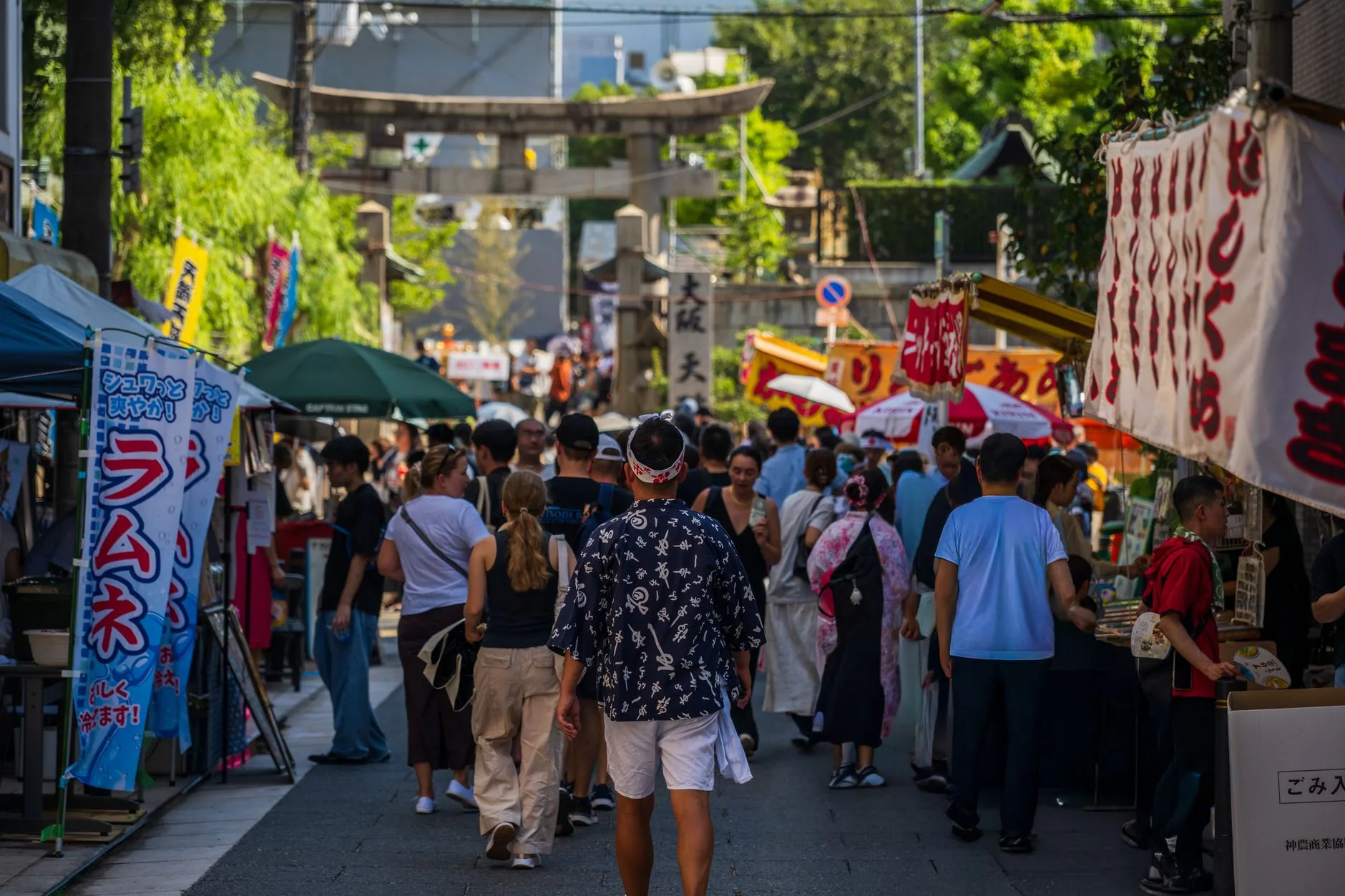
Photo by Guohua Song on Pexels
By nine in the evening on Shijo-dori in Kyoto, the street has stopped being a street. Cars are gone, replaced by a slow tide of people moving between towering yamaboko floats strung with paper lanterns, each one lit from within and creaking faintly as it’s pulled a few metres and set back down. The gion-bayashi music — flute, bell, drum, repeating in a pattern that never quite resolves — comes from every direction at once. Someone hands you a paper cup of cold amazake from a stall wedged between two machiya townhouses, and for a moment the smell of grilled squid and melting candle wax is the only thing that matters.
This is Yoiyama, the three nights before Gion Matsuri’s main procession, and it is one version of what a matsuri feels like from the inside. But Japan holds thousands of these festivals every year, from thousand-year-old shrine rites to a village’s one-night Obon dance in a gravel car park, and the honest answer to “how do I experience one as a visitor” depends on which kind you’re chasing and how much you’re willing to plan around it.
What a Matsuri Actually Is (And Isn’t)
The word “matsuri” gets translated loosely as “festival,” which undersells it. Most matsuri are religious in origin — Shinto shrine festivals marking a deity’s symbolic movement through a neighbourhood, Buddhist Obon rites welcoming ancestral spirits home in August, agricultural rituals timed to planting and harvest. The float processions, the taiko drumming, the food stalls: these grew up around a ceremonial core that’s still there, even when it’s buried under crowds and yakitori smoke.
That distinction matters for a visitor because it changes what respectful participation looks like. A neighbourhood Obon dance (bon odori) in a temple courtyard is often genuinely open — visitors are welcomed to join the circle dance around the yagura tower, no special knowledge required, the steps simple enough to pick up by watching the person in front of you for thirty seconds. A shrine’s mikoshi (portable shrine) procession is different: the men and women carrying it, chanting “wasshoi, wasshoi” under its weight, are usually parishioners fulfilling a ritual obligation, not performers. You watch, you photograph respectfully, you stay out of the path — you don’t try to grab a pole for the experience unless you’ve been specifically invited by the local community organising it.
The Festival Calendar: When to Go for What
Japan’s matsuri season runs almost year-round, but it clusters heavily around summer (July–August) and autumn (September–November), with a smaller cluster in early spring around cherry blossom time. Planning a trip around a specific festival means booking accommodation six to twelve months out for the big names — Kyoto and Tokyo hotels during Gion Matsuri or Awa Odori sell out early, and prices climb accordingly.
| Festival | Location | When | What to Expect | Crowd Level |
|---|---|---|---|---|
| Gion Matsuri | Kyoto | All July, peak July 14–17 | Towering yamaboko floats, Yoiyama street festival, elegant and slow-moving | Very high |
| Awa Odori | Tokushima, Shikoku | August 12–15 | Mass street dancing, “fools dancing” tradition, participatory ren dance troupes | Very high |
| Nebuta Matsuri | Aomori | August 2–7 | Illuminated paper warrior floats, haneto dancers you can join for a small fee | High |
| Kanda Matsuri | Tokyo | Mid-May, odd years (main year) | Elaborate mikoshi procession through Akihabara and Nihonbashi | High |
| Takayama Matsuri | Takayama, Gifu | April 14–15 & Oct 9–10 | Ornate karakuri puppet floats in a mountain town setting | Moderate |
| Local bon odori | Everywhere, rural areas especially | Mid-July to late August | Community dance circles, open participation, minimal crowds | Low |
| Kanto Matsuri | Akita | August 3–6 | Balanced bamboo poles hung with lit lanterns, quieter than the big four | Moderate |
The lower-profile entries on that list — a village bon odori, Kanto Matsuri in Akita rather than Awa Odori in Tokushima — are where the texture tends to be richer and the logistics considerably easier. You won’t need to book a hotel eight months out or fight for standing room three deep. You’ll more likely find yourself one of a handful of visitors watching alongside neighbours who’ve known each other for decades, which is its own kind of experience worth having, covered in more depth in exploring rural Japan beyond Tokyo and Kyoto.
Booking the Big Ones: Seats, Standing, and Reality
For the marquee festivals, there’s usually a tiered system of access. Gion Matsuri’s main procession on July 17th has paid grandstand seating along Kawaramachi-dori, bookable through Japan Railways or local tourism offices — expect to pay roughly 4,000–6,000 yen for a reserved seat, which matters if you’d rather not stand in July humidity for two hours. Free standing viewing is available along the whole route, but arrive at least ninety minutes early if you want an unobstructed view; the Japanese families who show up with folding stools and picnic blankets have this down to a science.
Awa Odori in Tokushima has actual participation on offer: for a modest fee, the “Niwaka-ren” temporary dance groups let visitors join the parade itself, taught the basic steps in a short session beforehand. It’s an unusually direct way in — you’re not watching from the side, you’re one of the shuffling, arms-raised dancers moving down Shinmachi-bashi-dori, and it tends to be the highlight people remember longest, awkward footwork included.
Accommodation during any of these dates needs to be locked in early — think six months minimum for Kyoto or Tokushima in July or August, and be prepared for rates roughly double the normal season. Staying in a neighbouring town and taking a day train in is a legitimate, cheaper alternative; Osaka to Kyoto is a 15-minute shinkansen ride, and Tokushima’s festival crowds thin out considerably once you’re back on the ferry or highway bus to Kobe.
The Food Is Not a Side Note
Festival food stalls (yatai) are as much a part of the matsuri as the procession, and they follow their own seasonal logic. At summer festivals, expect kakigori (shaved ice, often flavoured with matcha or melon syrup), yakitori, takoyaki griddled to order, and cold Asahi or Kirin sold from ice-packed coolers. Okonomiyaki griddles sizzle at most stalls regardless of region, though the Hiroshima-style layered version and the Osaka-style mixed batter are both common enough to compare side by side if a festival draws stallholders from both regions.
Look specifically for regional specialities tied to the location rather than the generic stall food: in Aomori during Nebuta Matsuri, stalls sell hotate (grilled scallop) skewers pulled straight from the nearby coast; in Takayama, the Hida beef skewers reflect the region’s well-known wagyu. Eating standing up, cup of stall-poured sake in hand, jostled gently by the crowd, is as much the point as anything happening on the float above your head.
Etiquette That Isn’t About Fear of Getting It Wrong
The instinct many visitors have is to worry intensely about causing offence, which usually results in either paralysis or over-apologising. The reality at most matsuri is more forgiving than that. A few things genuinely matter: don’t step onto float platforms or touch ropes being pulled by participants, don’t block the procession route to get a photo, and if you’re offered a chance to help pull a float rope by a local organiser (this happens more often than you’d expect at smaller festivals), it’s a generous invitation worth accepting rather than a trap.
Photography is almost universally fine and even welcomed, though flash photography aimed directly at mikoshi bearers mid-procession is generally considered poor form — they’re working hard, often barefoot, under real physical strain. If you want a sense of how these dynamics play out with festivals elsewhere in Asia, the etiquette questions around attending a local festival in Bali as an outsider cover similar ground: curiosity and respect, not caution and distance, tend to be what locals actually want from visitors.
Dress is casual for most festivals — yukata (light cotton kimono) are commonly worn by both Japanese attendees and visitors at summer festivals, and rental shops near major festival sites in Kyoto and Tokyo will fit and dress you for a few thousand yen if you want to wear one rather than just admire everyone else’s.
Finding Festivals That Aren’t on Anyone’s List
The biggest festivals get all the coverage, but Japan’s Agency for Cultural Affairs and local tourism boards maintain far longer, quieter calendars. Prefectural tourism websites, often available in English, list neighbourhood shrine festivals down to the exact date and shrine name — search for the local Kanko Kyokai (tourism association) of wherever you’re staying. Convenience store bulletin boards and community centre notice boards, particularly in smaller towns, often carry hand-drawn posters for that weekend’s local matsuri with a date, time, and a hand-drawn map that no app will surface.
Ryokan owners and local tourist information centres are consistently the best sources for this — asking directly, “is there a matsuri happening nearby this month,” tends to produce answers that Google won’t. Several matsuri are recognised on UNESCO’s Intangible Cultural Heritage lists, including elements of Gion Matsuri’s float processions, which gives a useful starting point for identifying festivals with genuine historical depth rather than tourist-oriented reconstructions — the UNESCO Intangible Cultural Heritage lists are searchable by country if you want to build a trip around festivals with that specific pedigree.
The Japan National Tourism Organization also maintains a seasonal festival calendar with English-language dates, which is worth checking before finalising flights — many festivals move by a week or two year to year depending on the lunar calendar or local scheduling decisions.
Getting There and Getting Around
Almost all major matsuri sit within walking distance of a JR or private rail station, and the Japan Rail Pass remains useful if you’re festival-hopping across regions in a single trip — Kyoto to Aomori for Gion Matsuri then Nebuta Matsuri, for instance, is a full day’s shinkansen and limited express journey, feasible but tiring inside a single week. Local buses run irregular or suspended routes during major festival dates as roads close for processions, so checking the local transit authority’s festival-day notices (usually posted in Japanese and English on the city’s transport website) saves confusion on the day. Taxis become scarce and expensive near festival zones during peak hours — walking or using the train system, even for the last mile, tends to be faster than waiting for a cab that isn’t coming.
For general trip logistics beyond festival dates specifically, the practical basics — rail passes, seasonal weather, regional transport — are covered in First Time in Japan: Practical Travel Guide, worth reading alongside festival planning since the two overlap heavily on timing and booking windows.
The Bottom Line
- Decide first whether you want spectacle or participation — the big four (Gion, Awa Odori, Nebuta, Kanda) deliver scale and atmosphere but require booking accommodation six-plus months ahead; a rural bon odori delivers intimacy and usually needs no planning beyond showing up.
- Budget for the premium: hotel rates near major festivals commonly double, and this is non-negotiable during Awa Odori week in Tokushima or Gion Matsuri in Kyoto.
- Eat from the stalls without hesitation — festival food is regional, fresh, and often the best version of a dish you’ll find in that town all year.
- If a local organiser invites you to help pull a float rope or join a dance circle, say yes — these small invitations are the difference between watching a festival and being briefly part of one.
- Ask locally. Prefectural tourism offices, ryokan staff, and convenience store notice boards will surface festivals that no international guide has ever covered, and those are frequently the ones worth the detour.
Keep reading: Exploring rural Japan beyond Tokyo and Kyoto