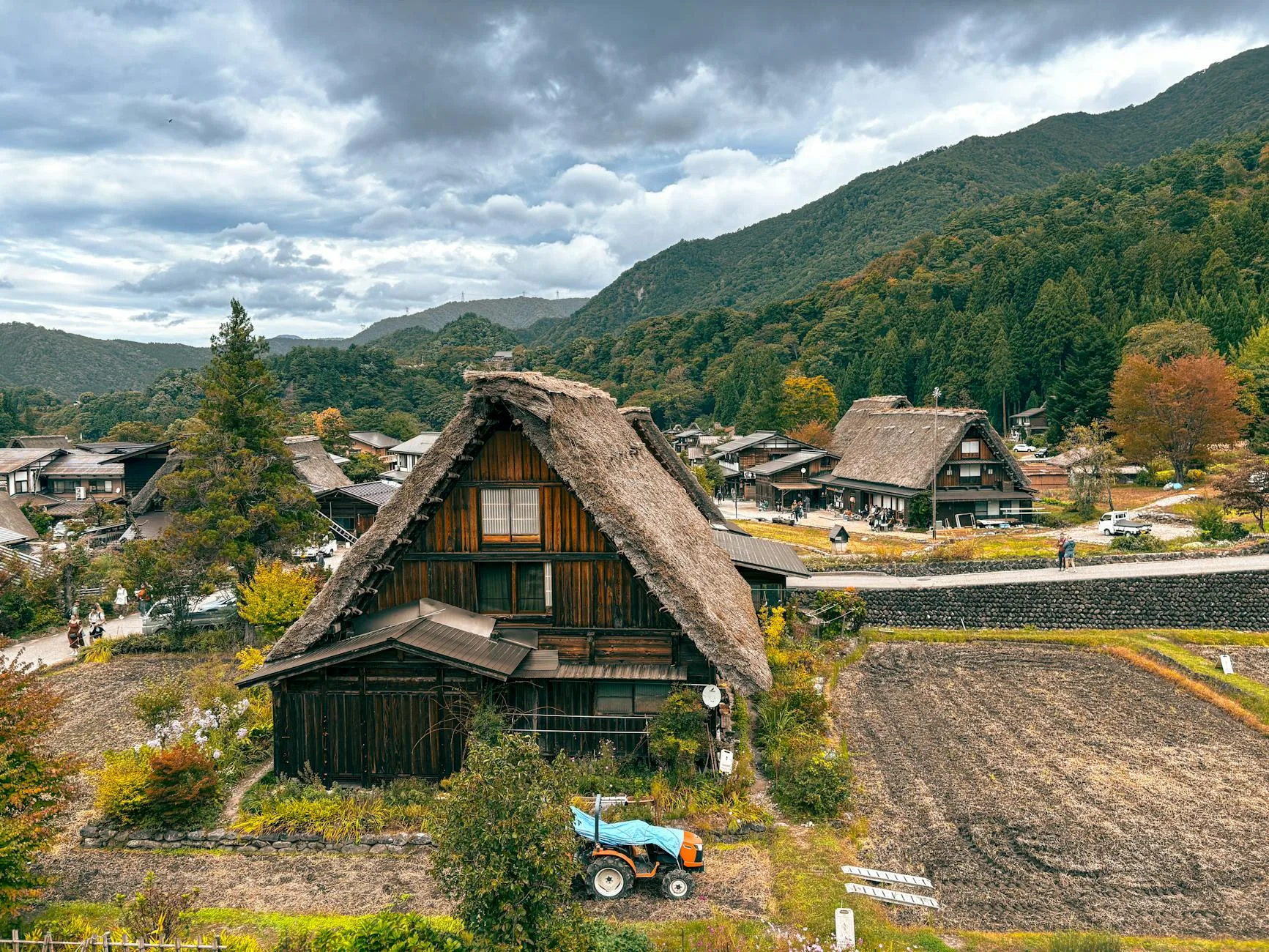
Photo by Shrayas Suryakumar on Pexels
Exploring rural Japan beyond Tokyo and Kyoto
The bus to Tono leaves Shin-Hanamaki Station twice a day. On the afternoon departure, the passengers are mostly elderly women with shopping bags, a couple of schoolchildren in matching hats, and — on the day I made this trip — one confused foreigner with a rolling suitcase and no phone signal. The road follows a river into a valley of rice paddies and cedar forests, past farmhouses with steep thatched roofs. Nobody is performing this landscape for anyone. It simply exists, the way it has for a long time.
This is the version of Japan that doesn’t make it onto the shortlist when people plan their first — or even second — trip. Tokyo has its electric pull, Kyoto its polished temples, Osaka its takoyaki-slicked streets. But Japan is an archipelago of 6,800 islands and a countryside that stretches from sub-tropical Okinawa to the snowbound highlands of Hokkaido. The rural prefectures between the headline cities are where the country’s architecture of daily life — the festivals, the food traditions, the agricultural rhythms — still operates mostly on its own terms.
Getting there takes more planning than booking a shinkansen. But the logistics are manageable, and once you understand the transport patterns, the costs, and what each region actually offers, a rural Japan itinerary becomes something you can build with confidence.
Why rural Japan is more accessible than it sounds
The first thing to know: Japan’s rural areas are not remote in the way that phrase implies in other countries. Most are connected by JR lines, highway buses, or both. What they lack is the density of English signage and the safety net of tourist infrastructure that makes Tokyo and Kyoto so frictionless.
That shift requires some preparation. Before travel, download the Navitime for Japan Travel app, which handles rural transit routing better than Google Maps in most prefectures. A physical JR Pass remains worthwhile if your route covers more than one region — the 14-day pass (around ¥50,000 in 2026) covers most shinkansen and many limited express routes. Highway buses (kōsoku basu) are significantly cheaper and reach towns the rail network misses; book through Willer Express or the Kosoku Bus website.
Language is the more honest challenge. In cities, staff at hotels and convenience stores usually have functional English. In rural guesthouses, village shops, and local izakayas, they often don’t. Before you go, it’s worth reading up on Japanese customs and communication norms — not because people are unfriendly (they’re reliably the opposite), but because knowing a little etiquette reduces friction on both sides. Google Translate’s camera mode works well for menus. A pocket dictionary card with key phrases — kore wa nan desu ka (what is this?), ikura desu ka (how much?) — earns visible goodwill.
Tono, Iwate Prefecture: folklore and working farmland
Tono sits in a river valley in the southern highlands of Iwate, about 90 minutes by the JR Kamaishi Line from Shin-Hanamaki. The town is best known as the source of Kunio Yanagita’s 1910 Tono Monogatari, a collected folklore of kappa (river spirits), mountain gods, and the strange domestic rituals of rural Tohoku. Reading it before you arrive — it’s short, widely translated — does something to how you see the landscape.
The Tono Basin itself is small enough to cover by rental bicycle (available at the tourist information office beside the station for around ¥700 a day). The Denshoen open-air museum on the eastern edge of town preserves a cluster of traditional magariya L-shaped farmhouses, where horses and humans once shared the same roof through winter. Staff can explain the layout in basic English with laminated diagrams. More atmospheric is cycling the back roads south of the Nakatsugarawa River, where unmarked stone kappa shrines sit at irrigation channel junctions, wreathed in moss, with a cucumber left as an offering — placed there by someone, recently.
The best place to eat in Tono is Ichiroku, a small noodle shop on the main street, which serves jajamen — a Tohoku dish of flat wheat noodles with ground meat and miso paste, finished tableside with raw egg and a splash of broth. It is nothing like ramen. Portions are large, prices are low (around ¥750), and the lunchtime queue of construction workers tells you everything you need to know about the clientele.
The Kii Peninsula: pilgrimage routes and mountain temples
The Kii Peninsula hangs south of Osaka and Nara into the Pacific, and it holds one of Japan’s oldest and most coherent sacred landscapes: the Kumano Kodo, a network of pilgrimage trails connecting the three Grand Shrines of Kumano — Hongu Taisha, Hayatama Taisha, and Nachi Taisha. UNESCO listed the routes in 2004, and the infrastructure around them is now well enough developed that independent walking is genuinely practical.
The most walked section is the Nakahechi Route, which runs roughly 70 kilometres from Tanabe (accessible by JR Kuroshio limited express from Shin-Osaka, about 90 minutes) to the shrines at Hongu. Most walkers take three to four days, staying in small guesthouses and minshuku along the way. The Kumano Travel office in Tanabe handles trail maps, accommodation bookings, and luggage forwarding — a service that sends your main bag ahead to your next night’s stop for around ¥1,000 per transfer, so you hike with a daypack only.
The terrain is real forest walking. Cedar and cypress cover most of the route, punctuated by steep stone-stepped climbs and occasional views down into river valleys. In October and November, the maple canopy turns; in July and August, the humidity is serious. Spring (late March to May) and autumn (mid-September to November) are the most comfortable seasons.
At Hongu, the 160-year-old ryokan Minshuku Chikatsuyu sits beside the river and costs around ¥8,500 per person including dinner and breakfast — a full kaiseki spread that will include sansai mountain vegetables, local river fish, and rice from the valley.
Yamagata Prefecture: fermented foods and mountain temples
Yamagata is six prefectures north of Tokyo, accessible by the Yamagata Shinkansen (direct from Tokyo Station, about 2 hours 40 minutes to Yamagata City). It doesn’t appear on many itineraries, which is its main advantage.
The region is best understood through two things: its food preservation traditions and Mount Haguro.
Yamagata winters are heavy with snow, and the local cuisine reflects centuries of making summer abundance last: dashi — not the stock, but a cold relish of finely chopped cucumber, eggplant, okra, shiso, and natto, eaten on rice or tofu throughout the summer months — appears at every table from June through September. Imo-ni, a slow-cooked taro and beef stew, is Yamagata’s autumn communal dish, made in vast riverside pots at gatherings that function as outdoor festivals. If you’re there in September or early October, the riverside areas near Yamagata City and Tendo fill with these gatherings on Sunday afternoons; they’re informal, and arriving as an interested stranger is usually met with an offer of a bowl.
Mount Haguro is the most accessible of the three Dewa Sanzan sacred mountains. The stone staircase from the base — 2,446 steps through old-growth cedar, some trees more than 600 years old — takes 45 minutes to climb and passes a five-storey pagoda that dates to the early 14th century. A bus from Tsuruoka Station (JR羽越本線 from Yamagata, about 1 hour) reaches the trailhead. At the summit, the Sanzan Jinja complex includes a guesthouse (shukubo) where guests eat shojin ryori, the refined vegetarian cuisine of Buddhist monasticism — sesame tofu, pickled bracken fern, clear broths — in a tatami room overlooking the inner courtyard.
Shimane Prefecture: the quietest corner of Honshu
Shimane is Japan’s second-least-populated prefecture, tucked along the Sea of Japan coast between Hiroshima and Tottori. Getting here requires intention: the fastest route from Tokyo is a flight to Izumo or Matsue-Kishima Airport (JAL and ANA both serve it, about 1 hour 20 minutes), or a combination of shinkansen to Hiroshima and then the JR Super Matsunogoto limited express along the coast (about 2 hours 30 minutes from Hiroshima to Matsue).
Matsue, the prefecture’s main city, is called the City of Water for its network of canals and its position between Lake Shinji and Lake Nakaumi. It holds a castle — one of the handful in Japan that is original rather than reconstructed — and a buke yashiki (samurai residence) district in Shiomi Nawate that is functional rather than curated, with actual residents still living in buildings behind old stone walls.
But the reason to come this far is Izumo Taisha, one of Japan’s oldest and most important Shinto shrines, 30 minutes by train from Matsue on the Ichibata private railway. October in the lunar calendar (usually November in the modern calendar) is when Izumo holds the Kamiari-sai — the “assembly of gods” festival, during which all the deities of Japan are said to gather here. The town fills, but nothing like Kyoto in cherry blossom season.
The local dish is Izumo soba, served in three-tiered lacquer bowls called wari-ko. The noodles are darker and nuttier than most buckwheat soba, ground with the outer hull of the grain. Order at any of the small shops on the approach road to the shrine; expect to pay ¥900–¥1,200 for a full set.
Getting the accommodation right
Rural Japan’s accommodation landscape is different from its cities. Business hotels thin out quickly beyond the prefectural capitals, replaced by minshuku (family-run guesthouses), ryokan (traditional inns with meals included), and — in the more remote areas — shukubo (temple lodgings).
If you haven’t stayed in a ryokan before, the format takes some adjustment: check-in is typically between 3–6pm, dinner is served at a fixed time, and the room serves as dining room, bedroom, and sitting room in sequence. It is less about luxury than about structure — and that structure turns out to be part of the experience. For a full introduction to what to expect and how to navigate it, the first-timer’s guide to staying in a traditional Japanese ryokan covers the etiquette and practicalities well.
Booking directly through Jalan or Rakuten Travel (Japanese booking platforms with English interfaces) often gives you access to smaller family guesthouses that don’t list on international platforms. Prices for a minshuku with dinner and breakfast run ¥7,000–¥12,000 per person; for a mid-range ryokan, ¥15,000–¥30,000.
Seasonal and regional comparison
| Region | Best season | Highlight | Getting there from Tokyo | Approx. travel time |
|---|---|---|---|---|
| Tono, Iwate | May–Oct | Folklore, farmhouses, cycling | Shinkansen to Shin-Hanamaki + local bus | 2 hrs 30 min |
| Kii Peninsula | Mar–May, Sep–Nov | Kumano Kodo pilgrimage trails | Shinkansen to Shin-Osaka + limited express | 3–4 hrs to Tanabe |
| Yamagata | Jun–Oct (food), Dec–Mar (snow) | Dewa Sanzan, fermented cuisine | Yamagata Shinkansen direct | 2 hrs 40 min |
| Shimane | Apr–May, Oct–Nov | Izumo Taisha, Matsue castle | Flight or shinkansen + limited express | 3–5 hrs |
Practical logistics
JR Pass vs. point-to-point: A 14-day JR Pass (¥50,000 in 2026) makes financial sense if your itinerary covers three or more of these regions. For a single-region trip, buy point-to-point tickets or use IC cards (Suica or Icoca) for local travel.
Connectivity: A data SIM from IIJmio or NTT Docomo (available at major airports) costs around ¥3,000–¥5,000 for a month of data. Rural Japan has good 4G coverage on main roads and in towns, but mountain trails often don’t.
Cash: Japan remains cash-dependent outside cities. 7-Eleven and Japan Post ATMs accept foreign cards reliably. Carry ¥20,000–¥30,000 in mixed notes when heading into rural prefectures.
Entry: Citizens of most Western European, North American, and Australasian countries receive a 90-day visa waiver on arrival. Check the Japanese Ministry of Foreign Affairs for your specific nationality before travel; the list shifts periodically.
The Bottom Line
-
Rural Japan is accessible but requires a layer of pre-trip planning — transit apps, cash reserves, some basic Japanese phrases, and accommodation booked in advance, particularly on the Kumano Kodo and around Izumo during October-November festivals.
-
The Yamagata Shinkansen is one of Japan’s most underused express routes: two hours forty minutes from Tokyo to a prefecture with serious food culture, a sacred mountain complex, and almost no foreigner-facing tourist infrastructure.
-
The Kumano Kodo is the most structured entry point into rural Japan for first-timers: trail maps are excellent, luggage forwarding makes the walking logistics simple, and the route has genuine depth beyond the scenery.
-
Accommodation costs are lower than in cities but usually include meals — factor that into your daily budget. A ¥10,000 minshuku is often better value than a ¥7,000 business hotel when dinner and breakfast are included.
-
Shimane rewards the extra effort: the farther from Tokyo, the less mediated the experience. Izumo Taisha is one of Japan’s most significant religious sites, and on a quiet midweek morning in November, you may have whole sections of the approach path almost to yourself.
Keep reading: Staying in a traditional Japanese ryokan: first-timer guide