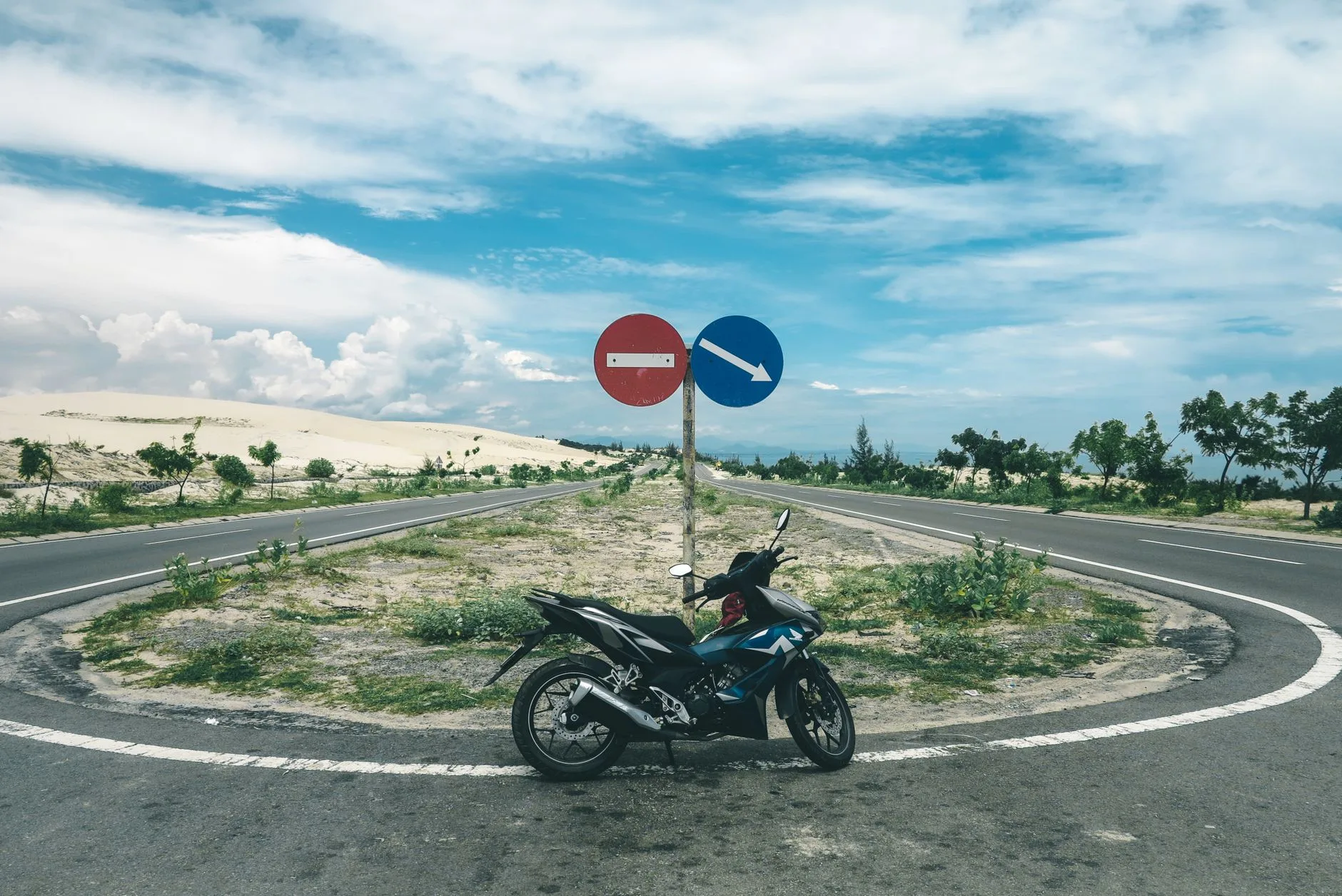
Photo by Quoc Anh Tran Duong on Pexels
The road out of Pai climbs before you’ve finished your coffee. Route 1095 unspools through 762 curves — someone has counted, and posted the number on a T-shirt in every shop in town — and by the third switchback the air has changed from the diesel warmth of the valley to something cooler and pine-scented, thin cloud snagging on karst ridges below. A truck loaded with cabbages grinds past in the opposite direction, horn blaring twice as warning rather than aggression. A dog sleeps in the exact centre of the road at a village called Mae Malai, entirely unbothered by 125cc traffic swerving around it.
This is the Mae Hong Son Loop, one of several routes that have made northern Thailand a proving ground for a particular kind of travel: slow, self-directed, mechanically dependent, and far more rewarding than the bus window it replaces. Motorcycle touring in Southeast Asia isn’t a single trip so much as a loose network of possibilities — Vietnam’s Ho Chi Minh Trail, Laos’s Route 13, the Cardamom foothills of Cambodia — bound together by cheap fuel, minimal bureaucracy, and roads that reward curiosity more than horsepower.
None of it is quite as effortless as the Instagram reels suggest. This is the honest version.
Choosing Your Region: Three Very Different Rides
Southeast Asia doesn’t offer one motorcycle trip — it offers at least three, and they suit different riders.
Northern Thailand and Laos is the gentlest entry point. Roads are mostly sealed, signage is bilingual in tourist areas, and mechanics are common enough that a snapped clutch cable rarely means more than a two-hour delay. The Mae Hong Son Loop (around 600km from Chiang Mai and back) and the Golden Triangle loop through Chiang Rai are the standard routes, both doable in 4–6 days at an unhurried pace.
Vietnam, particularly the stretch from Hanoi to Ho Chi Minh City along the old Ho Chi Minh Trail (Đường Hồ Chí Minh), is the classic long-haul — three to four weeks if done properly, through the Hai Van Pass near Da Nang, the pine forests around Da Lat, and the flooded rice terraces of Mai Chau. It’s harder riding: more traffic density near cities, more unpredictable road surfaces, and a genuine test of nerve around Hanoi’s Old Quarter before you’ve even left town.
Cambodia and the Cardamom Mountains are rougher again — red laterite roads that turn to soup in the wet season, fewer repair shops, and long stretches between towns. This is where touring stops being a scenic ride and starts being an actual expedition, best suited to riders who’ve already done a loop or two elsewhere.
Renting (or Buying) a Bike: What Actually Happens
Rental in Thailand is straightforward in tourist hubs like Chiang Mai’s Nimmanhaemin area or Pai’s main strip — expect $6–12 a day for a Honda Click or Yamaha Fino automatic, more for a manual Honda CRF or Kawasaki for mountain routes. Shops rarely ask for an International Driving Permit despite it technically being required; they’ll usually take your passport as a deposit instead, which is precisely why it’s worth photographing the bike thoroughly before you ride off. Scratches you didn’t cause become scratches you’re billed for.
Vietnam works differently. Long-haul riders more often buy a used Honda Win or Suzuki GN125 in Hanoi for $250–400 and sell it in Ho Chi Minh City at trip’s end, sometimes at a small loss, sometimes breaking even through the informal backpacker resale network centred around hostels in Hanoi’s Ta Hien street and the Pham Ngu Lao district in Saigon. It’s an old ritual, and the bikes involved have covered this route more times than any human ever will.
| Region | Typical bike | Daily cost (rental) | Road difficulty | Best for |
|---|---|---|---|---|
| Northern Thailand/Laos | Automatic scooter or 150cc manual | $6–12/day | Easy–moderate | First-time tourers |
| Vietnam (Hanoi–HCMC) | Honda Win/Suzuki GN125 (often bought) | $250–400 purchase | Moderate–hard | 3–4 week expeditions |
| Cambodia (Cardamoms) | Off-road capable 250cc | $15–25/day | Hard | Experienced riders |
Licences, Insurance, and the Grey Areas
The legally correct answer is that you need an International Driving Permit with a motorcycle category, obtained in your home country before you travel — it cannot be arranged locally. The practical reality is that many riders complete entire loops without ever being asked for one, right up until the moment they’re in an accident or stopped at a checkpoint that’s decided to enforce the rules that day, often near provincial borders or during Songkran in April.
Travel insurance is where the corner-cutting gets expensive. Most standard policies exclude motorcycle accidents above a certain engine capacity, or exclude them entirely if you’re riding without a valid licence for that vehicle class. Read the policy wording specifically for “motorcycle,” not just “vehicle” — it matters. A rider who came off a wet corner near Kasi in Laos without adequate cover faced a medical evacuation bill that dwarfed the entire trip’s budget. This is not a scare story; it’s simply what the insurance documents say if you check them.
Border Crossings: The Actual Logistics
Riding your own rented bike across a border is rarely as simple as riding across a border on foot. Thai rental bikes generally cannot leave Thailand — the paperwork doesn’t exist, and taking one across regardless voids everything, including your freedom if customs takes issue.
For riders determined to cross borders on two wheels, the workable route is Vietnam, where temporary vehicle import isn’t standard but where riders do cross into Laos at the Lao Bao/Dansavanh crossing with a bike bought specifically for the purpose, carrying its blue-card ownership documents and paying a modest informal processing fee at the border post. Crossing into Cambodia at Bavet or O’Yadaw is similarly possible with the right paperwork, though “possible” here means an afternoon of patience, a fixer who appears from nowhere offering to help for a fee, and a certain tolerance for ambiguity about which fees are official.
The simpler and more common approach — and the one most guides quietly recommend — is to treat each country as its own separate loop: sell the bike at the end of Vietnam, cross the border by bus, buy another bike in Laos or Cambodia. It’s less romantic than riding the whole region on one machine, but it avoids weeks of paperwork uncertainty for a saving of maybe $150.
Roads, Weather, and the Rhythm of a Riding Day
The riding day in most of Southeast Asia follows a rhythm worth planning around rather than fighting. Mornings are cool and clear, ideal for covering distance — by 11am, heat radiates visibly off asphalt in the lowlands, and by early afternoon in the wet season (roughly May to October across most of the mainland), rain arrives with real intensity, often for an hour, sometimes for the rest of the day. Riders who push through afternoon storms on mountain roads are the ones who end up describing near-misses at hostel bars that evening.
Dry season — November through February in northern Thailand and Laos, slightly later further south — offers the best combination of visibility, road grip, and manageable heat, though it’s also peak season on the popular loops, meaning more traffic on routes like Mae Hong Son and more competition for guesthouse rooms in Pai and Nong Khiaw.
Fuel is rarely a genuine worry on the main loops — stations or roadside vendors selling petrol from glass bottles appear every 20–30km even in rural Laos — but it’s worth carrying a spare litre on the more remote Cambodian stretches, where distances between reliable stations can stretch past 60km.
What to Eat, and Where the Road Actually Stops
Part of what makes touring by motorcycle different from touring by bus is the ability to stop wherever something smells right. In northern Thailand, that means khao soi at roadside stalls in Mae Hong Son town — a turmeric-yellow coconut curry noodle soup topped with crispy noodles, usually eaten at plastic tables under a corrugated awning. In Vietnam, it means pulling over for bánh xèo, the turmeric-batter crepe folded around pork and bean sprouts, sold from carts along Highway 1 near Da Nang. In Laos, it’s often simpler still — sticky rice and grilled river fish sold from a single stall at a bend in Route 13 with no sign at all, just smoke and the smell of chargrilled catfish.
Markets are worth the detour, not just the roadside stops — Chiang Mai’s Warorot Market and Hanoi’s Đồng Xuân Market both reward an hour’s wandering before a long riding day, and it’s worth knowing the basic etiquette and food safety habits before diving in, which is covered in more detail in a guide to eating at local markets in Southeast Asia.
Gear, Repairs, and What Goes Wrong
A helmet is non-negotiable, and it’s worth buying or bringing a proper one rather than trusting the half-shell “novelty” helmets that some rental shops hand over as an afterthought — these satisfy no safety standard worth mentioning. Lightweight riding gloves, closed shoes rather than sandals, and a rain jacket that packs small are the practical minimum; the tropical sun does more damage over a week of riding than most people expect, and sunburn through a T-shirt on exposed forearms is a common, avoidable injury.
Mechanically, the good news is that roadside repair shops — often just a shaded pavilion with a hand-painted Honda sign and a teenager who can strip an engine faster than most Western mechanics can diagnose one — exist in enormous density throughout the region. A flat tyre, snapped chain, or dead battery rarely costs more than a few dollars to fix, and rarely takes longer than an hour. The exception is Cambodia’s more remote provinces, where the nearest shop might be genuinely distant, which is one more reason experienced riders treat the Cardamoms as an add-on rather than a starting point.
For broader context on how the region handles growing rider numbers on its most scenic routes, and where the crowding is starting to change the experience, avoiding overtourism in Southeast Asia is worth reading before settling on a loop — some once-quiet passes near Pai and Vang Vieng now see a steady stream of rental scooters through peak months, changing both the traffic and the atmosphere.
According to the World Health Organization, road traffic injuries remain disproportionately high in Southeast Asia relative to vehicle numbers, a statistic worth taking seriously rather than dismissing as background noise — it’s part of why slower riding, daylight-only travel, and genuine insurance matter more here than the relaxed local attitude to helmets might suggest. The Lonely Planet forums, despite their age, still hold some of the most detailed and current rider-to-rider route notes for the Ho Chi Minh Trail, worth a read before departure.
Where to Base Between Rides
Chiang Mai functions as the unofficial capital of regional motorcycle touring — bike shops, mechanics, gear stores, and a community of riders who’ve done every loop worth doing cluster within a few streets of the Old City moat. It’s also a reasonable place to spend a few slower days between rides, and anyone considering a longer stay to plan routes or simply recover should look at Chiang Mai as a base — the city’s long-stay infrastructure, originally built for remote workers, works just as well for riders resting between legs of a longer trip.
The Bottom Line
- Northern Thailand is the right place to learn this style of travel — forgiving roads, dense mechanic networks, and a route (the Mae Hong Son Loop) short enough to recover from mistakes.
- Insurance policies deserve real scrutiny before departure — read the exact wording on motorcycle exclusions rather than assuming standard travel cover applies.
- Crossing international borders on a rented bike is rarely possible and rarely worth the paperwork; selling and rebuying at each border is the more realistic pattern most long-distance riders actually follow.
- Dry season riding trades better road conditions for more traffic on the popular loops — there’s no season that gives you both solitude and perfect asphalt.
- The bike is a means of reaching food stalls, mountain passes, and villages that a bus schedule would never allow — the mechanical hassle is the price of that access, not a separate inconvenience to be endured around it.
Keep reading: How to eat at local markets in Southeast Asia