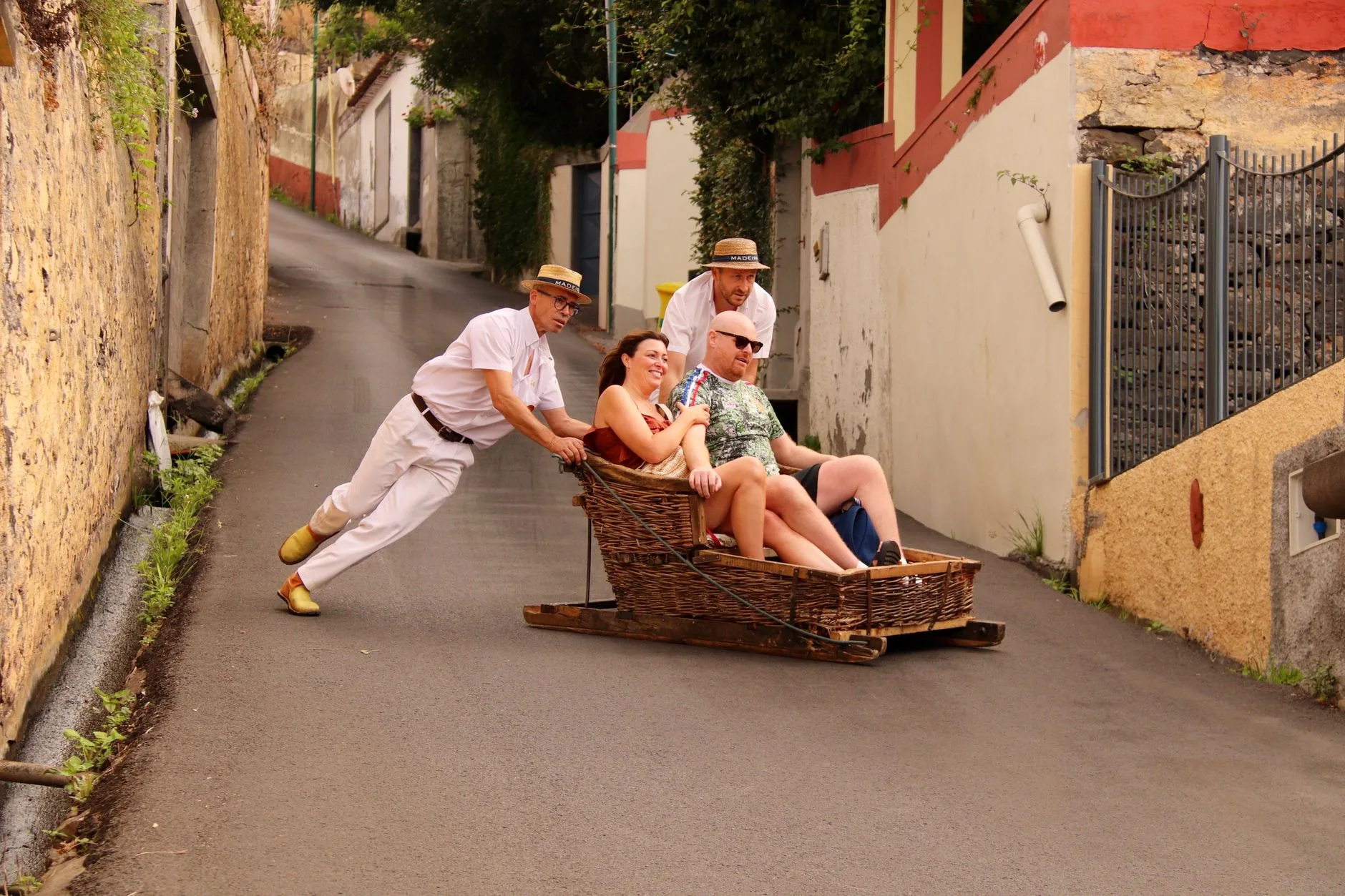
Photo by Patrick Gamelkoorn on Pexels
Jardim do Mar wakes up slowly. By seven, the fishermen are already down on the black volcanic shingle, hauling wooden boats over basalt cobbles worn smooth by a century of this same motion, while the rest of the village — a tangle of steep lanes, banana terraces, and houses stacked like shelves against the cliff — stays shuttered a while longer. There’s no promenade, no souvenir stand, no queue for anything. Just the Atlantic doing its work against the rocks, and the smell of woodsmoke drifting down from someone’s kitchen.
This is Madeira without the cruise-ship crowds that fill Funchal’s Avenida Arriaga on a Tuesday morning. The capital is worth a day or two — the Mercado dos Lavradores, the cable car up to Monte, a glass of poncha in a Zona Velha bar — but it’s a small fraction of what the island actually is. Madeira is 57 kilometres long, folded into ravines and laurel forest and terraced hillsides so steep that entire villages exist at angles that seem to defy the idea of a flat surface. Slowing down here isn’t a philosophy so much as a practical necessity: the roads are narrow, the distances deceptive, and the island rewards exactly the kind of unhurried attention that Funchal’s day-trippers rarely have time for.
Getting around: the car, the bus, and the honest trade-off
Madeira’s road network has improved dramatically since the EN101 était a white-knuckle cliffside crawl — tunnels now cut straight through the mountains, and the VE1 and VE4 expressways connect Funchal to the north and east coasts in a fraction of the old driving time. A rental car, picked up at Cristiano Ronaldo Madeira International Airport, is genuinely the easiest way to reach the villages this guide covers, and prices remain reasonable by European standards (expect €30–45 a day in shoulder season).
That said, Madeira’s public bus system is more capable than most visitors assume. Rodoeste runs services to the west and southwest (Jardim do Mar, Paul do Mar, Ponta do Pargo), SAM covers the east, and Horários do Funchal handles routes closer to the capital. The catch is frequency — some rural routes run two or three times a day, and missing the last bus back means either a taxi or an unplanned night somewhere you hadn’t booked. If you’re building a trip around buses, write the timetables down on paper; signal drops out in the mountain tunnels and you won’t always be able to check online.
| Region | How to get there | Best for | Crowd level |
|---|---|---|---|
| North coast (Santana, São Vicente, Porto Moniz) | Car via VE1/ER101, or SAM bus | Thatched villages, lava pools, dramatic cliffs | Moderate — tour buses stop briefly |
| Southwest coast (Jardim do Mar, Paul do Mar) | Car or Rodoeste bus | Fishing villages, quiet coastal walking | Low |
| Ponta de São Lourenço (east tip) | Car to Baía d’Abra car park, or SAM bus to Caniçal | Arid headland hiking, whale-watching boats | Moderate on weekends |
| Central mountains (Pico do Arieiro, Curral das Freiras) | Car essential, roads narrow and winding | Levada walks, forest, dramatic ridgelines | Low to moderate |
| Câmara de Lobos | 15-minute drive or bus from Funchal | Fishing harbour, poncha bars, Winston Churchill’s old painting spot | Moderate |
Walking the levadas: Madeira’s real transport network
Long before tourism, Madeira’s settlers carved over 2,000 kilometres of irrigation channels — levadas — into the mountainsides to move water from the wet north to the dry south. Today those channels double as some of the most atmospheric walking trails in Europe, running flat and narrow along cliff edges, through laurel forest so dense it feels prehistoric, and past waterfalls that appear with no warning around a bend.
The Levada das 25 Fontes, starting from Rabaçal, is the most walked — a gentle 2-hour round trip ending at a pool fed by two dozen small cascades. It’s beautiful and it’s busy, especially after 10am when tour vans arrive from Funchal. For something with real teeth, the Levada do Caldeirão Verde, from Queimadas near Santana, cuts through the Laurisilva forest — a UNESCO World Heritage Site and one of the last surviving fragments of the subtropical laurel forest that once covered much of southern Europe — passing through several hand-cut tunnels before reaching a waterfall pouring into a green amphitheatre of rock. Bring a torch for the tunnels; some stretch 500 metres with no light at all, and the stone underfoot is uneven and often wet.
These trails reward the same unhurried pace covered in our guide to the best coastal walks in Europe worth the effort — the point isn’t to cover distance quickly, it’s to notice what’s around you. Wear proper footwear regardless of what the distance chart says; levada paths are often just a concrete lip above a drop, and rain makes them slick within minutes.
The north coast: thatched roofs, lava pools, and a sea too rough to swim
Santana is the postcard village most visitors have seen without knowing its name — the triangular, thatched A-frame houses (casas de colmo) that once housed farming families are now mostly preserved for visitors, with a few still functioning as small museums you can walk into for a couple of euros. The village itself sits on a plateau above dramatic sea cliffs, and the drive in from the VE1 offers views over terraced farmland that drop straight into the Atlantic.
Fifteen minutes west, São Vicente has volcanic caves (Grutas de São Vicente) worth an hour if you’re curious about the island’s geology, but the real draw is continuing on to Porto Moniz, where lava flows created a series of natural swimming pools along the shoreline. The Piscinas Naturais do Porto Moniz are partly developed now — changing rooms, a small entrance fee, lifeguards — but the water is still genuinely volcanic rock pool, cold, clear, and separated from the open ocean only by black stone. Go on a calm day; when the Atlantic swell is up, the pools close for safety and you’ll just watch waves break over the rocks instead, which has its own appeal.
Seixal, a short drive further along, is smaller and quieter still — a fishing village with a black sand beach and a natural pool of its own, usually with a fraction of Porto Moniz’s visitors.
The southwest coast: fishing villages without the itinerary
This is the stretch of Madeira that rewards travellers willing to slow down completely. Jardim do Mar and Paul do Mar, connected by a coastal path along old fishing trails, were once among Europe’s most prized big-wave surf spots before a breakwater project altered the swell patterns — surfers still come, but the villages themselves have reverted to something closer to their older rhythm: steep cobbled lanes, small bars with handwritten menus, and fishermen mending nets on the quay.
Ponta do Pargo, at the island’s westernmost point, has a lighthouse (Farol da Ponta do Pargo) with a small museum and genuinely spectacular sunset views over cliffs that drop 300 metres to the sea — arrive an hour before sunset and you’ll likely have the viewpoint mostly to yourself, which is rare anywhere in coastal Europe worth visiting.
The eastern tip: Ponta de São Lourenço
Madeira’s eastern end looks nothing like the lush interior — this is dry, reddish, almost lunar terrain, formed from older volcanic rock than the rest of the island. The hike out to Ponta de São Lourenço, starting from the Baía d’Abra car park near Caniçal, runs along a narrow ridge with sheer drops on both sides; it’s roughly 8 kilometres round trip and takes 3–4 hours at a comfortable pace, with wind strong enough on exposed sections to make you lean into it. Caniçal itself, once a whaling village, now runs whale and dolphin-watching boats — a more honest, lower-impact way to encounter the marine life that historically sustained the town’s economy.
Porto da Cruz, back on the north side of the peninsula, has one of Madeira’s few sandy-ish (actually pebble) beaches with real surf, backed by terraced vineyards climbing the hillside behind it — a good base for a slower two or three nights away from the island’s busier western routes.
Food beyond the tourist menu
Madeiran food outside Funchal leans rural and unfussy. Espetada — skewered beef marinated in garlic, bay leaf, and salt, grilled over wood and traditionally served hanging from a metal hook at the table — tastes meaningfully different at a simple grill restaurant in Camacha or Santo da Serra than at a Funchal tourist menu version. Bolo do caco, the flat sweet-potato bread grilled and slathered in garlic butter, is sold from small family bakeries throughout the island and is worth seeking out fresh and warm rather than pre-packaged.
Lapas (limpets), grilled with butter, garlic, and lemon, show up on menus in coastal villages like Seixal and Câmara de Lobos, usually for a few euros a plate. Espada — black scabbard fish, an ugly deep-sea creature that tastes considerably better than it looks — appears fried with banana in Câmara de Lobos, where it’s been a local pairing for generations, odd as it sounds on paper. And poncha, the island’s honey-rum-and-citrus drink, tastes genuinely different made in a rural bar with a wooden muddler than from a bottle in a Funchal gift shop; Câmara de Lobos still has several bars where it’s made to order.
Where to stay for a slower trip
Rural guesthouses and quintas — old manor houses converted into small inns — scattered through Santana, Ponta do Pargo, and the Porto da Cruz area offer a genuinely different pace from Funchal’s hotel strip along the Lido. Many are family-run, serve breakfast from their own gardens, and sit close enough to levada trailheads that you can walk out the door and onto a path. Expect fewer amenities than a Funchal resort — don’t assume air conditioning, and wifi can be patchy in the mountains — but the trade-off is proximity to the island that most visitors never see. Travellers who’ve read our broader guide to backpacking in Portugal beyond Lisbon will recognise the pattern: Portugal consistently rewards the detour from its capital cities, and Madeira is no exception.
The Bottom Line
- A rental car opens up Madeira in a way buses can’t fully match — the island’s rural routes exist on a timetable, not on demand, and missing a connection means a long wait or an expensive taxi.
- Levada walking is the single best way to understand the island’s geography and history at once; start with an easier route like 25 Fontes before attempting tunnel-heavy trails like Caldeirão Verde.
- The west and southwest coasts (Jardim do Mar, Paul do Mar, Ponta do Pargo) offer the clearest contrast to Funchal — fishing villages with almost no tourist infrastructure, best visited with a car and no fixed schedule.
- Food tastes different outside the capital — seek out espetada, lapas, and poncha in Câmara de Lobos or rural villages rather than Funchal’s main tourist strip.
- Shoulder season (April–June, September–October) gives the best balance of mild weather, lower crowds at the main trailheads, and calmer seas for the natural pools at Porto Moniz and Seixal.
Keep reading: Best places for slow travel in Portugal