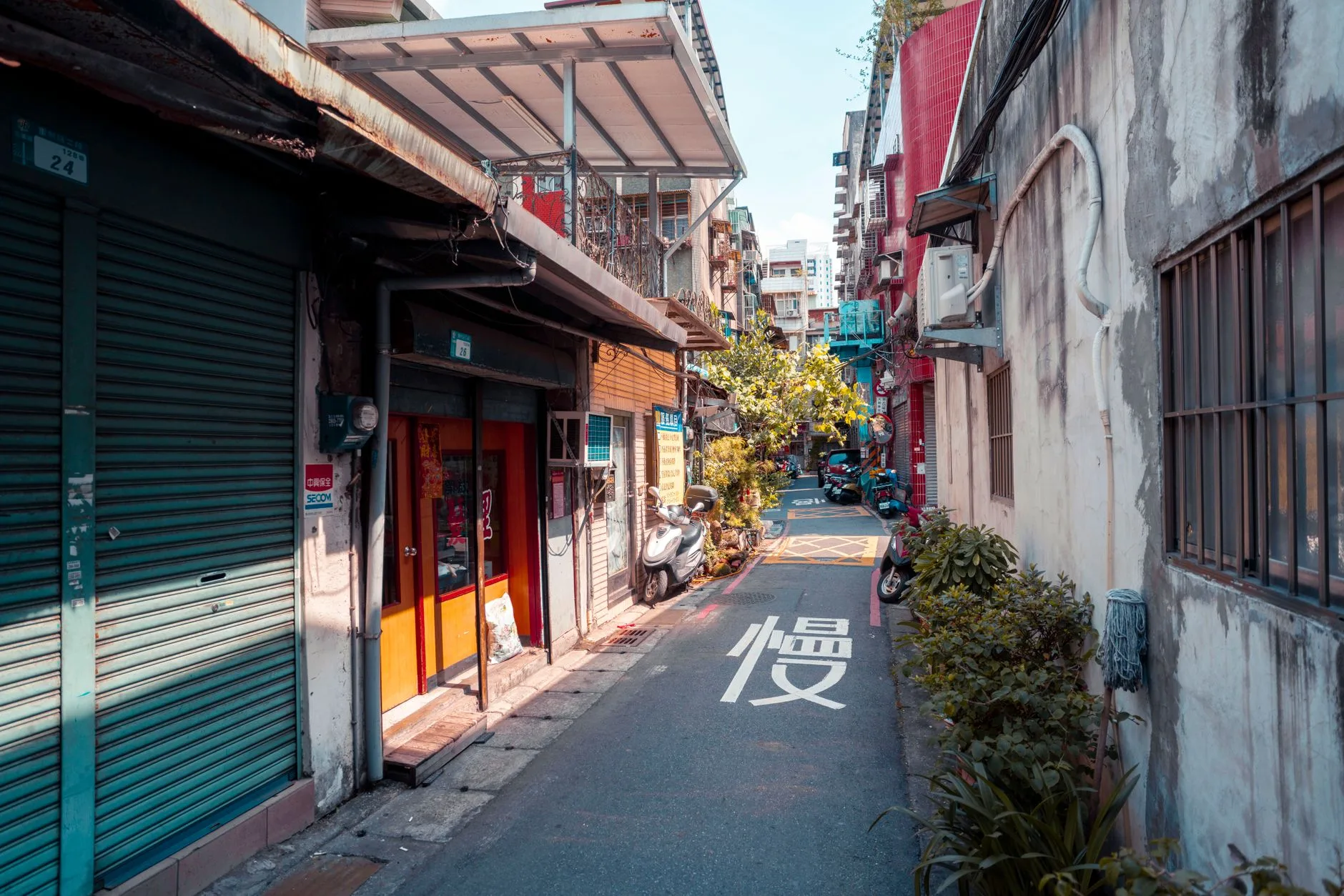
Photo by Jimmy Liao on Pexels
Slow travel in Taiwan off the tourist trail
The 7-Eleven on the corner of Zhongzheng Road in Meinong is open at 6am, and already half the town seems to have passed through it. An old man on a scooter parks up, buys a pork floss bun and a hot can of milk tea, and nods at no one in particular. Across the street, a temple committee is arranging paper offerings outside a red-pillared shrine, unhurried, practised. The air smells of incense and two-stroke fuel and, faintly, of the tobacco fields that made this Hakka market town famous a generation ago.
Most visitors to Taiwan follow a groove worn smooth: Taipei’s night markets, the Taroko Gorge photo stops, Sun Moon Lake by tour bus, perhaps a day trip to Jiufen. All of it worth seeing — but none of it what Taiwan actually feels like from the inside. The island rewards patience. Spend less time ticking landmarks and more time in Meinong, Tainan’s backstreets, the east coast’s aboriginal townships, or the volcanic landscape of the northeast, and you encounter a country that is dense with history, food culture, and a particular brand of hospitality that is genuinely, not performatively, warm.
This guide is for people who want to stay longer in fewer places, move by train and local bus rather than tour van, and eat at the places that don’t have English menus.
Getting your bearings: how Taiwan works for slow travellers
Taiwan is compact — about the size of the Netherlands — but the Central Mountain Range divides it into dramatically different worlds. The west coast is flat, urban, and dense with Taiwanese Hokkien and Hakka culture. The east coast is narrow, mountainous, and home to most of Taiwan’s sixteen officially recognised indigenous peoples. The north is subtropical and often wet; the south is hotter, drier, and sunnier year-round.
For slow travel, the High Speed Rail (HSR) is your spine. A single-day pass covering the Zuoying (Kaohsiung)–Taipei corridor costs around NT$3,000 (roughly US$95), though individual tickets are perfectly adequate if you’re not moving constantly. The slower Taiwan Railways Administration (TRA) network is the more useful tool for travellers who want to stop at mid-sized towns — Changhua, Taitung, Hualien, Fangliao — that the HSR bypasses entirely. Local buses fill the gaps into rural areas, though they run infrequently outside major corridors; renting an e-scooter (easy at most train stations, around NT$350–500 per day) gives you genuine freedom.
Entry is visa-free for most Western passport holders for up to 90 days. There are no land border crossings — Taiwan is an island, so all arrivals are by air or sea. Taiwan Taoyuan International Airport (TPE) handles most long-haul arrivals; Kaohsiung International (KHH) is convenient if you plan to start in the south.
Tainan: the city that runs on temple and street food time
Tainan is Taiwan’s oldest city and its de facto culinary capital, and the pace here is noticeably different from Taipei — slower, more self-assured, unbothered by trends. The city has more registered temples per square kilometre than anywhere else in Taiwan, and they’re embedded in the urban fabric in a way that makes them genuinely part of daily life rather than set-piece attractions.
The Anping District, on the western edge of the city, is where Dutch colonial-era ruins sit alongside oyster farms and crumbling salt warehouses. Skip the reconstructed Anping Fort if you’re pressed for time (pleasant, but sanitised) and instead walk the narrow lanes behind it — Anping Old Street’s tourist strip gives way quickly to working fish processing facilities and family shrines, the kind of streets where grandmothers dry fish on low plastic tables outside their front doors.
For food: breakfast should be milkfish congee (虱目魚粥) at Ah-Tang Milkfish Congee on Haian Road — milkfish is Tainan’s signature protein, and at 7am the congee is silky and light, the fish belly soft and clean-tasting. Lunch is coffin bread (棺材板) at Chihkan Towers — a deep-fried bread box filled with creamed seafood, invented in Tainan in the 1940s, still sold at a handful of stalls near the landmark itself. For the evening, the area around Yongfu Road and Minsheng Road — locals call it the “old city area” — has dense concentrations of small-plate restaurants and dessert stalls without the overtourism of some Taipei equivalents.
Accommodation: the Xinhua District, about 20km northeast of the centre, has a handful of renovated courtyard guesthouses (民宿, minsu) in old tobacco-era buildings that cost NT$1,200–1,800 per night and put you in the middle of an actual Tainan town rather than a hotel corridor.
Meinong and the Hakka heartland of Kaohsiung County
Meinong, about 40 minutes by bus from Kaohsiung’s Zuoying station, is a Hakka township that has managed a careful balance: it has a small tourist economy built around handmade paper umbrellas and Hakka food, but its agricultural structure and community character remain largely intact. The fields around town grow rice, tobacco (less than before), and lotus; the streets are quiet on weekday mornings.
The thing to do here is hire a bicycle — multiple shops near the main bus stop rent them for NT$100–150 per hour — and follow the cycling paths through the rice paddies toward Jhongjung Lake (中正湖). The route takes roughly 90 minutes at an easy pace and passes through working farmland, small shrines, and the occasional roadside stall selling ban tiau (粄條), the wide, silky Hakka rice noodle that is the district’s staple dish. Eat it braised with dried shrimp and pork at any stall that has a line; there’s no shortage.
The Hakka Cultural Museum on Zhongzheng Road is genuinely good — not a vanity project but a well-curated explanation of Hakka migration history and material culture — and free with a foreigner’s passport.
If you’re thinking about how this kind of engaged, community-embedded visit works, the community-based tourism examples that work article on this site offers useful context for approaching places like Meinong with some intentionality.
The east coast: Hualien County and indigenous Taiwan
The east coast is the part of Taiwan that most visitors see from a tour bus window on their way to Taroko Gorge and don’t look at closely enough. Hualien city itself is a practical base — well-connected by TRA train from Taipei (about 2 hours via the Suhua Improvement highway section, or 4 hours on the coastal route), with a decent restaurant strip along Zhongshan Road.
But the more substantial experiences are south of Hualien, along the Pacific Coast Highway (Provincial Highway 11) toward Taitung. This 167km stretch runs between ocean and mountains, passes through Amis, Truku, and Bunun indigenous communities, and has almost no international tourist infrastructure — which means the guesthouses are run by local families, the food at roadside stalls reflects actual community diet rather than a tourist version of it, and you’ll need some Mandarin or a willingness to point and smile.
Key stops:
- Fuyuan National Forest Recreation Area (near Ruisui): a quiet river forest used almost entirely by Taiwanese families; day entry costs NT$100
- Ruisui Township: small Amis community; look for the monthly indigenous cultural market held on the first Sunday of the month at the community centre on Zhongshan Road
- Dulan Village (都蘭): a small, slow Amis township near Taitung with a surf culture grafted onto its traditional structure — Dulan Sugar Factory has been converted into an arts space and live music venue that operates on a genuinely casual, community-driven model; shows happen on weekend evenings from around 7pm, entrance is typically NT$200–300
Getting between these points: TRA trains run along the coast but stop at town centres, not the stretches between. Renting an e-scooter in Hualien (around NT$400–500 per day, ID and international licence required) and following Highway 11 south over 2–3 days is the most rewarding method. The road is occasionally narrow; traffic is manageable outside summer weekends.
The northeast corner: Jiulong River valley and Pingxi without the crowds
Most people who visit Jiufen, Pingxi, and the northeast do so on a day trip from Taipei. The gold rush hillside town and the sky lantern town are genuinely atmospheric places, but they heave with tour groups on weekends. The fix is simple: stay in the area for two or more nights, move on weekdays, and walk the sections that the tours don’t touch.
The Jiulong River valley (九份/瑞芳 area), explored by foot along the old mining trails rather than the main Jiufen street, opens up quickly into abandoned mine infrastructure, moss-covered stone steps, and ridge-line views over the Pacific. The Shuinandong Smelting Ruins — a vast, otherworldly complex of ruined industrial buildings on the coast near Jinguashi — are accessible by local bus from Ruifang station (Bus 788 or 1062) and are often quiet on weekday mornings.
The Pingxi branch railway line (4 stations, 12km) is best done on a Tuesday or Wednesday morning. The sky lantern releasing at Shifen Station is commercial but photogenic; more interesting is the 40-minute walk from Shifen along the railway line to Lingjiao Waterfall, which involves walking along the actual tracks (legal, permitted, and done by everyone) and passes through rain-forest-thick subtropical vegetation.
Accommodation in Ruifang or Shuangxi (the next valley east, almost entirely unvisited) runs NT$800–1,500 per night in small family guesthouses.
Planning your time: a practical comparison
| Region | Best season | Getting there | Daily budget (midrange) | Mandarin needed? |
|---|---|---|---|---|
| Tainan | Oct–Apr (hot and humid in summer) | HSR to Tainan station | NT$1,500–2,500 | Helpful but manageable |
| Meinong | Oct–Mar (avoid typhoon season) | TRA/bus from Kaohsiung | NT$1,000–1,800 | Useful for food ordering |
| East coast (Hualien–Taitung) | Mar–June, Sept–Nov | TRA from Taipei (2–4 hrs) | NT$1,200–2,000 | Strongly recommended |
| Northeast (Ruifang/Pingxi) | Mar–May, Oct–Nov | TRA from Taipei (45 min) | NT$1,000–1,800 | Minimal |
Budget notes: Taiwan is mid-range by Southeast Asian standards but reasonable by East Asian ones. Street food meals run NT$60–150; sit-down restaurants NT$200–450 per head. Guesthouses outside Taipei are genuinely good value. Transport is cheap — most TRA journeys are under NT$300.
Eating well away from the tourist circuit
Taiwan’s food culture is deep and specific — it draws on Hokkien, Hakka, Japanese colonial, and indigenous traditions — and the further you get from Taipei’s night markets, the less it’s been adjusted for outside tastes.
A few dishes worth actively seeking by region:
- Tainan: Tainan-style dan tsai noodles (擔仔麵) at Du Hsiao Yueh on Zhongzheng Road (original branch, open since 1895 — the recipe is unchanged); shrimp rolls (蝦捲) at almost any market stall in Anping
- Meinong: ban tiau noodles, Hakka stir-fry (客家小炒 — dried squid, pork belly, tofu), and lei cha (擂茶, ground nut and herb tea served with rice) at the Meinong Folk Village restaurant
- East coast: Amis-influenced dishes including wild boar sausage and mochi (rice cakes) at the Ruisui indigenous market; fresh poke-style raw fish (生魚片) at harbour-side stalls in Chenggong Township
- Northeast: scallion pancakes (蔥油餅) at roadside stalls in Pingxi; fish ball soup (魚丸湯) at Ruifang’s morning market
For practical guidance on navigating market food hygiene and ordering without a shared language, the advice in how to eat at local markets in Southeast Asia translates well to Taiwan’s temple and township market settings — the logic of cooked-to-order stalls and peak-hour freshness applies here just as much.
For broader context on Taiwan’s food culture, National Geographic’s coverage of Taiwanese culinary traditions is a useful starting point before you arrive.
Practical logistics
Visa: Visa-free for most EU, UK, US, Canadian, Australian passport holders (90 days). Check the Bureau of Consular Affairs Taiwan website for your specific nationality before travel.
SIM card: Buy on arrival at Taoyuan Airport (Chunghwa Telecom or Taiwan Mobile counters in the arrivals hall). A 30-day data SIM costs around NT$300–500. Essential for offline maps and translation.
Translation: Google Translate’s camera function handles Traditional Chinese characters reasonably well. Download the offline Chinese (Traditional) pack before travel.
Cash: Taiwan is still heavily cash-based outside Taipei. Withdraw NT$ at 7-Eleven ATMs (they reliably accept foreign cards) rather than banks, which sometimes don’t.
Typhoon season: July–September. Taiwan takes typhoons seriously — schools close, trains halt, and you should too. Check the Central Weather Bureau’s forecast if travelling in summer. It’s not a reason to avoid Taiwan in summer; it’s a reason to check forecasts daily and be flexible.
The Bottom Line
-
Build your trip around TRA trains, not the HSR: the slow coastal and mountain rail network stops where the interesting things are — Ruifang, Ruisui, Fangliao, Taitung — and each of these is a genuine base rather than a transit stop.
-
Tainan deserves three or four days, not one: it’s the most food-specific, architecturally layered, and culturally confident city in Taiwan, and it rewards unhurried exploration of its temple districts and market streets far more than any rushed day-trip.
-
The east coast is best done slowly on an e-scooter: Highway 11 between Hualien and Taitung is one of the most striking coastal roads in Asia, and the indigenous communities along it — Ruisui, Chenggong, Dulan — are genuinely distinct from the west coast mainstream. Give it three days minimum.
-
Basic Mandarin makes a significant difference outside Taipei: even twenty phrases — numbers, food terms, directions, polite greetings — shifts how people respond to you in market towns and rural guesthouses. Taiwan’s hospitality is already generous; a little effort in the language multiplies it considerably.
-
Avoid the northeast on summer weekends: Jiufen and Pingxi are genuinely worth seeing, but the tour-bus pressure on Saturdays and Sundays is real. The same places on a Tuesday morning, with an overnight stay nearby, are entirely different experiences.
Keep reading: Avoiding overtourism in Southeast Asia: where to go