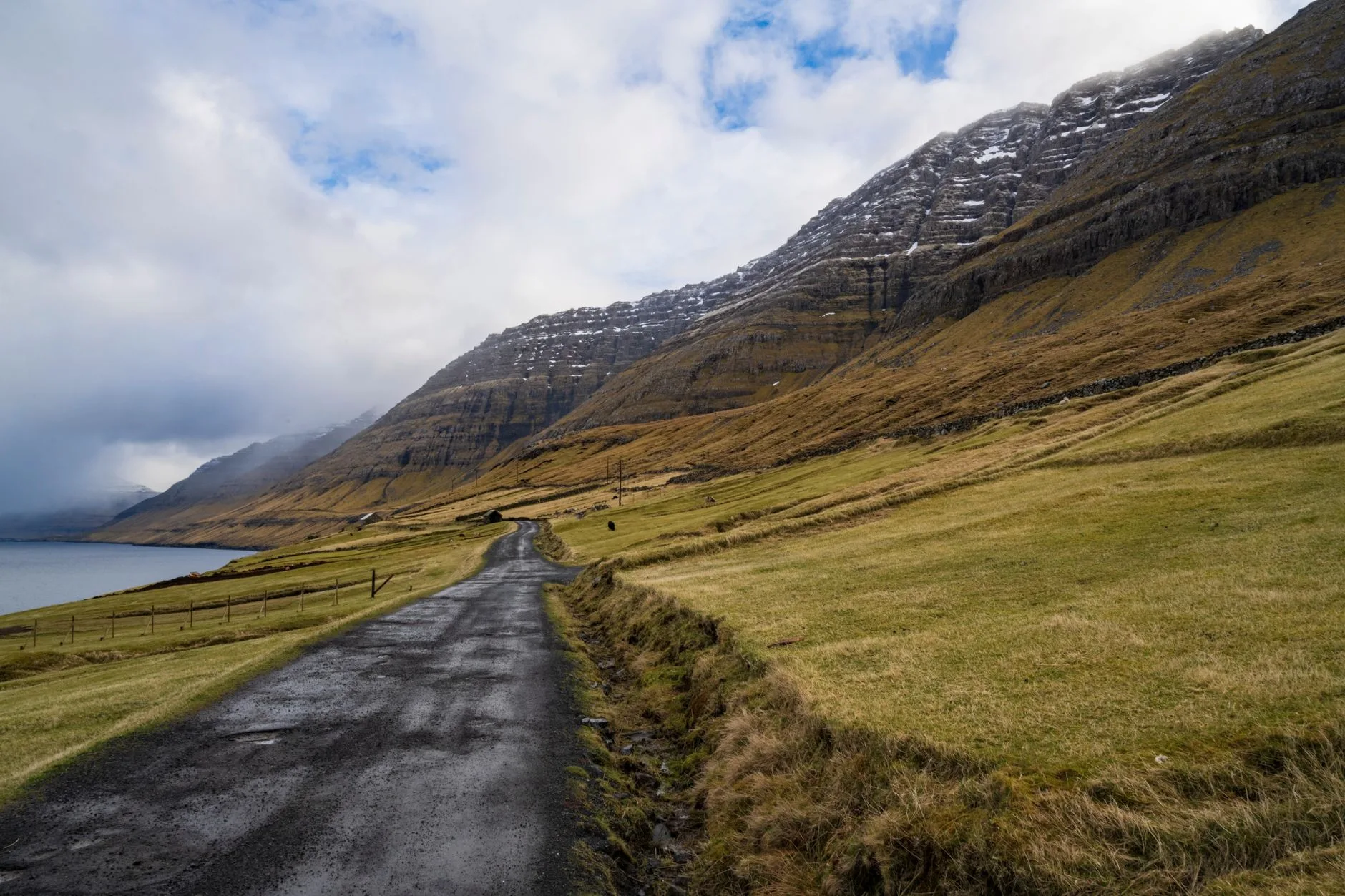
Photo by Evelin Magnus on Pexels
The Faroe Islands sit between Norway and Iceland in the North Atlantic, eighteen volcanic islands connected by roads, tunnels, and a handful of ferry crossings. The weather changes every twenty minutes. The mountains drop straight into the sea. There are more sheep than people (around 80,000 to 54,000 at last count), and on a clear day the visibility can extend across a hundred kilometres of open ocean. On a foggy one, you can’t see the village across the valley.
Road tripping is the natural way to travel here. The islands are small enough that you can cross the largest, Streymoy, in under an hour, and the road infrastructure — including a remarkable series of subsea tunnels — connects most of the main islands without needing a ferry. This guide covers everything practical: how to get there, what driving is actually like, where to sleep, what to eat, and what things cost.
Getting There
The only commercial airport is Vágar Airport (FAE) on the island of Vágar. Atlantic Airways operates scheduled flights from Copenhagen, and in summer adds routes from London Heathrow, Edinburgh, and several Scandinavian cities. Booking well in advance (3–6 months for summer travel) makes a significant difference to fares. A return from the UK runs £180–£350 depending on timing and how far ahead you book.
There is also a weekly ferry — the Norröna, operated by Smyril Line — which runs between Hirtshals in Denmark and Tórshavn, the Faroese capital, stopping in Bergen (Norway) on the way. The crossing from Hirtshals takes about 46 hours. If you want to bring your own vehicle, this is the only practical way. Cabins are comfortable, the ferry is a notable experience in itself, and taking the ship allows you to drive without a rental car.
From the airport to Tórshavn is about 45 minutes by road. Most car rental companies are based at the airport. Pre-book your rental — availability is genuinely limited in peak summer (June–August).
Driving the Islands: What It’s Actually Like
The Faroese road system is more comprehensive than you’d expect for a population of 54,000. The main islands are connected by a series of tunnels, several of which pass under the sea at depths of 100 metres or more. The Eysturoy Tunnel, opened in 2020, is the world’s first undersea roundabout — it splits inside the mountain, with one branch heading to Strendur and the other to Runavík. It is exactly as surreal as it sounds.
Practical driving notes:
- Drive on the right
- Speed limits: 50 km/h in towns, 80 km/h on open roads
- Headlights are required at all times, day and night
- Sheep on the road are a genuine and constant hazard — slow down when you see the warning signs, which is often
- Toll tunnels: Norðoyatunnilin (connecting to the northern islands Esvágoy, Kunoy and Klaksvík) costs around 80–100 DKK per crossing; most rental car companies include a transponder
- Petrol (97 octane) is sold in litres, priced around 16–18 DKK per litre in 2026
Distances are short. From Tórshavn to Klaksvík (the second-largest town, on Borðoy) takes about 45 minutes via tunnel. A full loop of Streymoy and Eysturoy takes 2–3 hours of driving, more if you stop.
What driving looks like in practice: single-lane sections appear frequently on mountain passes and coastal roads, with passing places every 50–100 metres. The conventions are largely self-evident and Faroese drivers are patient. On a September weekend with low visitor numbers, you might drive for 20 minutes without seeing another car. In July, some of the most visited spots (Saksun, Gásadalur) attract enough visitors that the approach roads become congested by mid-morning.
The Islands to Prioritise
Streymoy is the largest island and home to Tórshavn. The capital is worth half a day minimum: the old town (Tinganes) is a peninsula of brightly painted wooden buildings dating to the 15th century. The public market near the harbour sells local lamb, dried fish, and produce. Kirkjubøur, a short drive south from Tórshavn, has the ruins of a medieval cathedral and a farmhouse that has been inhabited by the same family for 17 generations.
Vágar — where you land — has two of the most photographed landscapes in the islands. Lake Sørvágsvatn appears to sit dramatically above the ocean when viewed from a specific angle on the cliffs above — a widely shared image that requires a 3km uphill walk from Trælanípa (trolls’ point) to reach. The view is real; the perspective trick makes the lake look higher than it is. The walk takes about 90 minutes return from the village of Miðvágur. The second site is Gásadalur, a village of a few dozen people with a waterfall tumbling directly into the sea below — only accessible by road since 2006 when a tunnel replaced the mountain path.
Eysturoy has the Eiðisvatn lake and a drive over the mountain pass between Eiði and Funningur that gives views down both sides of the island simultaneously on clear days. The village of Gjógv, on the northern tip, sits above a natural gorge that serves as the village harbour, cut into the basalt by millennia of wave action.
Borðoy and Klaksvík — the northern islands, reached via the tolled tunnel. Klaksvík is the only place outside Tórshavn with a real supermarket, a swimming pool, and a concentration of services. The road north from Klaksvík to the village of Skarð, abandoned in 1913, passes through emptying mountain terrain that feels genuinely remote even by Faroese standards.
Mykines — the westernmost inhabited island, accessible by a short ferry from Sørvágur or a helicopter (subsidised by the Faroese government) when weather permits. Famous for its puffin colony, which nests in the cliffs from April to August. The crossing is frequently cancelled due to weather. If you go, book the first ferry of the day, walk to the lighthouse (2.5 km one way, moderate terrain), and come back on the last ferry. Don’t plan a same-day connection from Vágar airport.
Where to Stay
Accommodation options are limited and book out months in advance for summer. Options include:
| Type | What it’s like | Price range (per night) |
|---|---|---|
| Guesthouses (heimagisting) | Family-run rooms in private homes; often breakfast included; genuine local interaction | 700–1,200 DKK |
| Hostels | Available in Tórshavn and Klaksvík; dormitory or private rooms; good facilities | 350–700 DKK |
| Hotels | Tórshavn has 4–5 options at various price points; Klaksvík has one | 1,200–2,500 DKK |
| Camping | Wild camping is permitted; basic campsites exist near major villages | 100–200 DKK |
| Self-catering cottages | Increasingly available via Visit Faroe Islands and direct booking; best for longer stays | 1,200–2,000 DKK |
Wild camping is legal across the islands outside enclosed private land and without a separate permit requirement. The terrain is mostly open moorland — a freestanding tent, a good sleeping bag (temperatures drop to 5–8°C even in summer), and waterproof gear are all you need. The wind makes cheap tents impractical.
What to Eat and Drink
The Faroese food tradition is built around preservation: lamb, fish, and seabird dried, salted, and fermented in the absence of refrigeration for most of their history. Skerpikjøt — mutton air-dried in a hjallur (a slatted wooden shed) for 5–9 months — is the defining Faroese food. It has a pronounced fermented quality that divides opinion sharply. At least try it once; small portions are sold at the public market in Tórshavn.
Practical eating for a road trip budget:
- Supermarkets (Miklagarður in Tórshavn, Bonus in Klaksvík) sell local lamb, fresh fish from that morning’s catch, Faroese dairy, and bread at mainland Danish prices
- Petrol stations (particularly SMS Sp/F stations) serve cheap hot food — fish burgers, lamb rolls — that are useful when you’re far from towns
- Restaurants in Tórshavn range from mid-range (around 200–300 DKK for a main) to high-end (KOKS held two Michelin stars before relocating to Greenland; its replacement RÆST continues in a similar tradition of fermented ingredients)
- Tipping is not expected anywhere in the Faroe Islands
The local brewery is Föroya Bjór, making lagers and ales widely sold in supermarkets. Alcohol is otherwise expensive; duty-free allowances on arrival are worth using.
How Much Does It Cost?
The Faroe Islands are not cheap, but they’re cheaper than Iceland.
| Item | Approximate cost (2026) |
|---|---|
| Return flights from UK | £180–350 |
| Car rental (7 days, compact) | £400–600 |
| Accommodation (per night, guesthouse) | £80–130 |
| Supermarket food (daily) | £20–35 |
| Restaurant meal per person | £25–50 |
| Fuel (full tank, compact car) | £50–70 |
| Mykines ferry return | £35–45 |
| Tunnel tolls (full week) | £30–50 |
A week-long self-catered road trip for two people — flights, car, accommodation in guesthouses, mostly cooking your own food — typically comes to £1,400–£1,900 all in.
When to Go
June–August: peak season. Long days (18+ hours of usable light in June), puffins on Mykines, all accommodation open. Also the busiest, most expensive, and most likely to have traffic on narrow roads. Book everything months in advance.
May and September: the best balance of weather, crowd levels, and accommodation availability. Days are still long, the landscape is green, and the islands feel properly quiet. Shoulder season prices.
October–March: dramatic but challenging. Storms are frequent and severe (gusts above 100 km/h are recorded regularly in winter). Many guesthouses close. The upside: the northern lights are visible on clear nights from around November to February, and you may have entire landscapes to yourself.
Conclusion
The Faroe Islands reward a slow, unhurried approach more than almost anywhere in Europe. The key practical points:
- Book flights and car rental early — summer availability is genuinely constrained and prices rise steeply as the date approaches
- Don’t over-plan the itinerary — weather and visibility dictate what’s worthwhile on any given day; build in flexibility
- The subsea tunnels change everything — most of the main islands are now connected without ferries; a car gives you access to all of them in a single day’s driving
- Self-catering saves significantly — groceries at Faroese supermarkets are competitively priced; eating out every meal will double your daily budget
- Go to Mykines if you can — but build in a contingency day in case the ferry is cancelled
Keep reading: Wild camping in Scotland: what you need to know