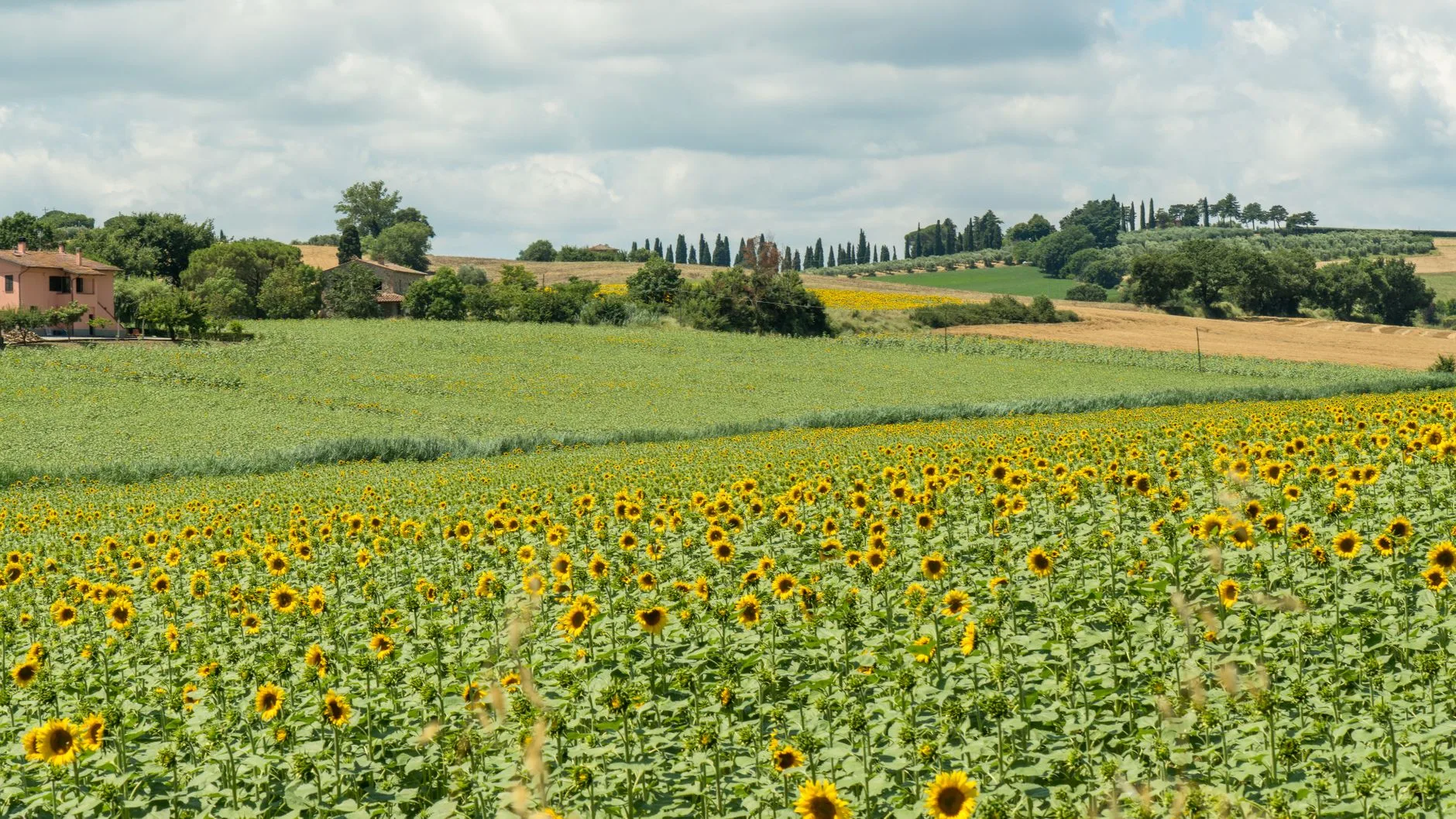
The 7:14 train from Florence Santa Maria Novella to Chiusi-Chianciano Terme makes nine stops, and by the fifth one — Montevarchi, maybe, or Terontola — the carriage has mostly emptied of anyone carrying a rolling suitcase. What’s left are commuters, a few nuns, a man transporting two crates of live snails, and the kind of quiet that Val d’Orcia postcards never quite capture: fog sitting low over ploughed fields, a church bell somewhere off to the left, cypress trees standing like exclamation marks nobody’s bothered to read in years.
This is the Tuscany and Umbria that exists once you stop trying to see all of it in four days. San Gimignano’s towers and the Uffizi’s queues are real and worth seeing once — but they’re also a narrow slice of a region built for a slower rhythm, one where the point isn’t checking off hill towns but learning the difference between a Thursday market in Panzano and a Saturday one in Montepulciano, or which agriturismo makes its own pecorino and which just buys it in.
Why rural Tuscany and Umbria reward slowing down
The math of mass tourism in central Italy is straightforward: Florence, Siena, and Pisa absorb the overwhelming majority of visitors, concentrated into roughly the same six weeks of peak summer. Everywhere else — the Crete Senesi, the Valnerina, the Niccone valley — operates on a completely different schedule, one set by olive harvests and wine racking rather than tour operator calendars.
Slowing down here isn’t an aesthetic choice so much as a practical one. Distances are short but roads are winding and towns close for riposo between 1pm and 4pm, which means a day plotted like a checklist collapses under its own ambition. Three villages a day is optimistic. One village, properly inhabited for an afternoon, is usually the better trade.
Base yourself somewhere that isn’t a postcard
Skip the temptation to stay inside Siena’s walls or in central San Gimignano, both of which empty out dramatically after the last tour bus leaves around 6pm, leaving restaurants built for turnover rather than lingering.
Consider instead:
- Montefollonico, a walled hamlet in the hills above Montepulciano with maybe 600 residents, one excellent trattoria (La Botte Piena, worth booking ahead), and views across the Val di Chiana that rival anything in the more famous towns ten minutes away.
- Spello, in Umbria, a stone town on the slopes of Monte Subasio that gets a fraction of neighbouring Assisi’s foot traffic despite being arguably prettier, with flower-draped alleys and a genuinely good enoteca scene.
- Panicale, overlooking Lake Trasimeno, where the morning ritual of coffee in Piazza Umberto I comes with almost no other visitors even in July.
An agriturismo — a working farm offering rooms, usually with half-board — is the single best lodging decision in this region. Expect to pay €80–150 a night for a double with dinner included, often built around whatever the farm produced that week: its own wine, its own olive oil, a pasta made that morning. Book directly with the farm by email rather than through a platform; many family-run places quote lower rates that way and the relationship starts on better footing.
The markets that actually run on local time
Food markets are where rural central Italy still operates almost entirely outside the tourist economy, and visiting one tells you more about a place than most museums will.
Camucia’s Saturday market, just below Cortona, is a working market — bootlaces, porcini mushrooms in season, bedsheets, a van selling nothing but cheese wheels the size of car tyres. Norcia’s Thursday market in Umbria leans into the region’s reputation for cured meats and black truffle, sold by weight from stalls that have been in the same families for generations; Norcia itself is still rebuilding from the 2016 earthquakes, and visiting supports a town that genuinely needs the business, though some of the historic centre remains fenced off for restoration.
For a broader sense of how Europe’s food markets fit into travel more generally, it’s worth reading up on the best local food markets in Europe for travellers before deciding which ones merit a special trip.
Walking the connective tissue between towns
The hill towns of Tuscany and Umbria were built to be walked between, not driven between, and several old pilgrim and farm paths still connect them.
The Via Francigena, the medieval pilgrim route from Canterbury to Rome, cuts straight through this territory. The stretch from San Gimignano to Siena (around 48km over three manageable days) passes through Monteriggioni’s intact medieval walls and crosses genuinely rural Chianti countryside — gravel farm roads, not highway shoulders. Waymarking is decent but not flawless; a GPS app (the official Via Francigena app or Komoot both work) is worth having as backup.
Shorter and less committing is the walk from Montefalco to Bevagna in Umbria, about 8km through vineyards that produce Sagrantino, one of Italy’s more tannic and underrated reds. It’s flat enough for an afternoon, ends at a town with actual Roman mosaics still visible in a basement bathhouse, and requires no logistics beyond comfortable shoes.
For context on how this compares to other European walking routes, see the roundup of the best long distance walking trails in Europe.
Getting around without a tour bus
A car gives the most freedom and is close to essential for reaching smaller hamlets, but it comes with real friction: ZTL zones (limited traffic areas) in nearly every historic centre carry automatic cameras and fines that arrive by mail months later, often to a rental company that then charges an administrative fee on top. Park outside the walls, always.
Public transport is more viable than most guides admit, provided expectations adjust. Regional trains (Trenitalia) connect Florence, Arezzo, Chiusi, and Orvieto efficiently and cheaply — Florence to Orvieto runs about 90 minutes and €15–20. From those hub towns, regional buses (run by companies like TIEMME in Tuscany or Busitalia in Umbria) reach smaller towns, but schedules thin out drastically on Sundays and can mean a single bus a day.
| Route | Mode | Time | Approx. Cost | Notes |
|---|---|---|---|---|
| Florence → Orvieto | Train | 1h30 | €15–20 | Regional train, book same-day |
| Florence → Montepulciano | Train + bus | 2h15 | €12–18 | Change at Chiusi, infrequent connecting bus |
| Perugia → Spello | Train | 35 min | €4–6 | Frequent, scenic valley route |
| Siena → San Gimignano | Bus | 1h10 | €7 | Direct TIEMME bus, no train line exists |
| Renting a car (regional) | Car | — | €40–70/day | Essential for hamlets off bus routes; watch for ZTL zones |
Eating the way the region actually eats
Tuscan and Umbrian food resists the version of “Italian food” sold in most tourist-centre restaurants — heavy on tomato, light on the genuinely regional. What’s actually local is plainer and better: Tuscany’s famously unsalted bread (a historical quirk, allegedly from a medieval salt tax dispute with Pisa), ribollita in winter, pici pasta rolled by hand in Val d’Orcia kitchens, and bistecca alla fiorentina cooked rare, by weight, at places like Antica Macelleria Falorni in Greve in Chianti.
Umbria leans earthier: lentils from Castelluccio, black truffle shaved generously over strangozzi pasta in Norcia, and wild boar ragù that’s worth seeking out in Trevi or Bevagna rather than in Perugia’s more tourist-facing centre. A genuinely useful rule: if a restaurant’s menu is translated into five languages and has photographs, it’s optimised for turnover, not flavour. The good places usually have a menu only in Italian, handwritten, changing with what’s at the market that day.
Timing the visit
Late April to early June and mid-September through October are the sweet spots — warm enough for long outdoor meals, cool enough for walking, and before or after the August crush when much of Italy itself goes on holiday and small-town restaurants close for two weeks without warning. November brings olive harvest (frantoio visits are worth arranging directly with producers) but also grey skies and shuttered agriturismi in quieter corners. Winter has its charms — truffle season peaks, towns are genuinely empty — but expect shorter days and some rural accommodation closed entirely.
Anyone comparing this region’s pace against other slow-travel destinations in Europe might find it useful to look at how the best cities in Europe for slow travel approach the same tension between depth and efficiency, even if Tuscany and Umbria’s answer is largely rural rather than urban.
The Bottom Line
- Pick a base in a town most visitors haven’t heard of — Montefollonico, Spello, Panicale — and let day trips radiate outward rather than chasing a different hill town every night.
- Public transport works between larger towns but a rental car (driven carefully around ZTL zones) is the only realistic way to reach the smaller hamlets that make this region worth the slower approach.
- Markets, not monuments, are where the region’s actual rhythm is visible — Camucia on Saturday, Norcia on Thursday.
- Budget more time than seems necessary; three towns in a day is a tour-bus itinerary, and this region punishes that pace with traffic, riposo closures, and missed trains.
- Shoulder season — late spring or early autumn — delivers the better version of this region: open restaurants, walkable weather, and roads that aren’t backed up behind rental cars from the airport.
Keep reading: Compare it with how slow travel works in Portugal’s interior