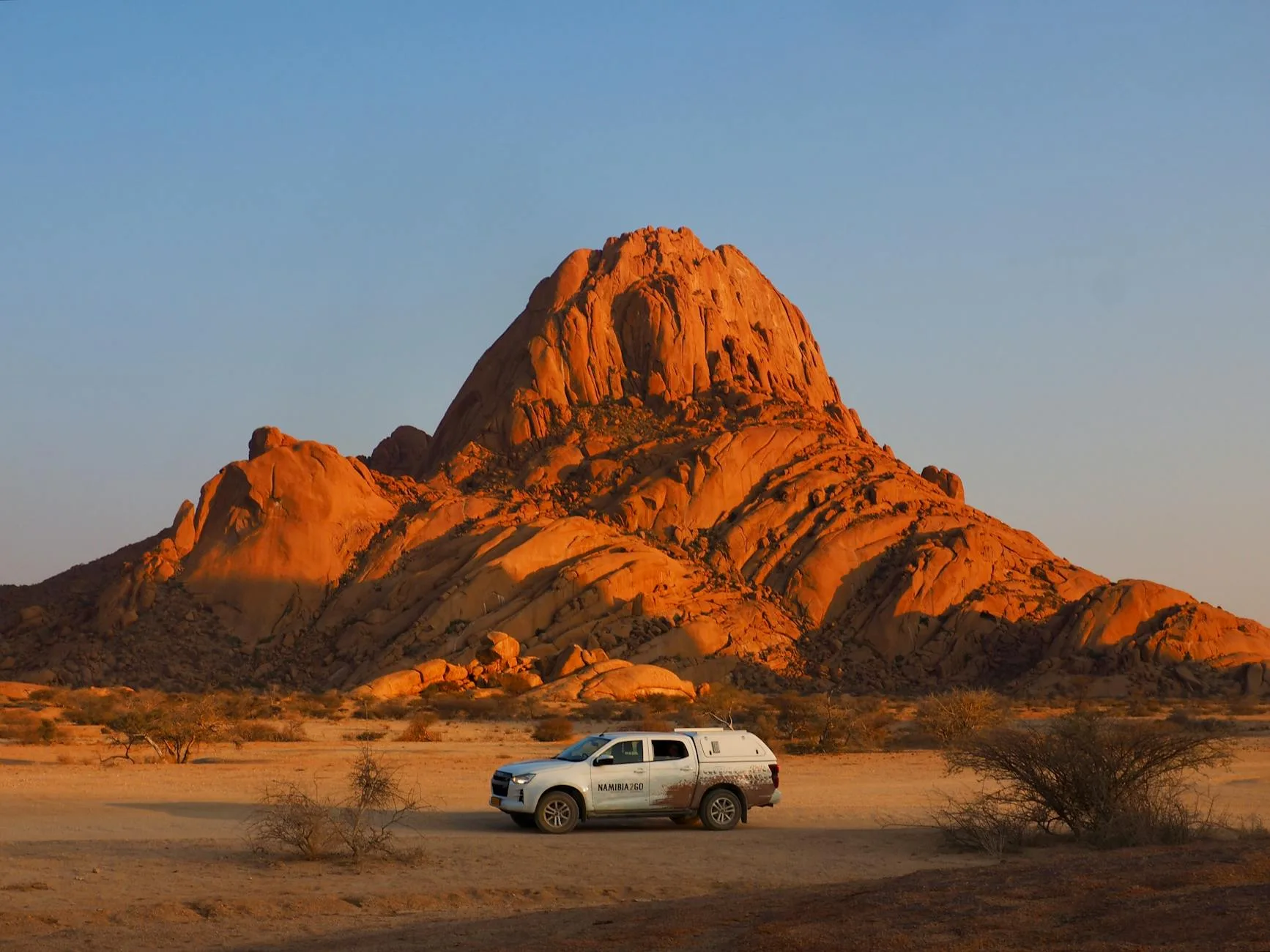
Photo by Timon Cornelissen on Pexels
Road trip through Namibia: self-drive guide
The gravel turns the colour of dried bone as you leave the tarmac south of Sesriem. Ahead, the road — more suggestion than surface — disappears into a plain of yellowed grass and quiver trees. Your tyres crunch. The temperature gauge reads 36°C. The next fuel station is 140 kilometres away, and your spare is strapped to the roof. This is the particular arithmetic of self-driving Namibia: long distances, thin infrastructure, and a landscape that rewards the prepared.
Namibia is one of the few places in southern Africa where driving yourself is not only possible but arguably the best way to travel. The road network, a mix of sealed B-roads and maintained gravel C- and D-roads, is well-signposted and manageable in a 4WD or high-clearance vehicle. There are no visa complications for most nationalities, campsites and lodges are bookable in advance, and the distances — while real — are clearly mapped. What it asks of you is attention, preparation, and a willingness to be somewhere genuinely empty for long stretches at a time.
This guide covers a practical loop of roughly 3,000 kilometres that takes in the country’s most rewarding regions: the Namib Desert, the Skeleton Coast, Damaraland, Etosha National Park, and the return south through the central highlands. It is designed for 14–18 days, which gives you time to move without rushing.
What vehicle you actually need — and where to hire it
Most of Namibia’s key routes can be driven in a 2WD saloon during the dry season (May to October), but a high-clearance 4WD with a roof tent or camping kit gives you access to the full network, including the Skeleton Coast, the Kaokoveld, and the deeper gravel roads through Damaraland. It also removes the anxiety of wondering whether your rental agreement covers the road you’re on.
Hire from Windhoek Hosea Kutako International Airport, which is 45 kilometres east of the city centre. The major operators — Avis, Budget, and Hertz — are all present, but local companies like Asco Car Hire and Namibia Car Hire tend to offer better rates and less restrictive contracts. Expect to pay NAD 1,500–2,500/day (roughly USD 80–135) for a fully equipped 4WD camper with rooftop tent, camp kitchen, and two spare tyres. Book at least three months ahead for travel between June and September — the peak season sells out early.
What to check before leaving the lot: Both spare tyres (not just one), a working jack and wheel brace, a tow rope, a fire extinguisher (legally required in Namibia), the coolant level, and whether the fridge runs off the secondary battery. Walk around the vehicle and photograph every scratch. Namibian roads are hard on tyres — budget for at least one puncture.
The route: Windhoek to the coast and back
This loop runs anti-clockwise from Windhoek, which puts the desert first and gives you the cooler northern regions mid-trip.
Day 1–2: Windhoek to Sesriem (345 km on the B1 and C19)
Leave Windhoek on the B1 south, then turn west at Rehoboth onto the C17, picking up the C19 toward Sesriem. The drive takes around five hours without stops. The landscape shifts from acacia scrub to open desert plain as you cross the Tropic of Capricorn — there’s a roadside marker you’ll drive past without drama. Arrive in Sesriem by late afternoon and check into Sesriem Campsite, managed by NWR (Namibia Wildlife Resorts), which sits at the gates of the Namib-Naukluft National Park. Book through NWR’s website in advance. Sites cost around NAD 250/person.
Day 3–4: Sossusvlei and Deadvlei
The gate opens at sunrise and closes at sunset. Drive the 65 km paved road inside the park to the car park at the 2WD terminus, then take the short shuttle (NAD 100 return) to the base of Dune 45 and Big Daddy if conditions are soft. Deadvlei — the white clay pan with its black-barked camelthorn trees, bleached against orange dunes — is 5 kilometres further and worth the extra time. Get there before 8am. By 10am the heat and the tour buses arrive together.
Day 5–7: Sesriem to Swakopmund via the C14 and C19 (380 km)
The C14 north from Solitaire to Walvis Bay is one of the finest desert drives in southern Africa: the Kuiseb Canyon, the Gaub Pass, and the sudden appearance of the Atlantic. The road is gravel but well-maintained. Plan for six hours. Swakopmund itself is a strange, pleasant town — German colonial architecture, fish restaurants, a cold Atlantic fog, and Namibians from the interior wearing winter coats in August. Stay in the Altstadt neighbourhood, where the old German quarter meets the beach. Brauhaus Arcade on Theo-Ben Gurirab Avenue has decent bratwurst and even more decent Tafel lager, brewed locally in Windhoek.
Day 8–9: Skeleton Coast (C34 north to Henties Bay and beyond)
Drive north on the C34 along the coast. The Skeleton Coast — named for the whale bones that once littered the beaches — is open to self-drivers as far as the Ugabmund Gate (100 km north of Henties Bay). Beyond that, access requires a permit or a fly-in safari. The accessible stretch is still worth it: shipwrecks visible from the road, Cape Cross Seal Reserve (the largest Cape fur seal colony in the world — 80,000 animals, and the smell reaches you from 500 metres), and a coastline that feels genuinely inhospitable. Bring all food and water from Swakopmund or Henties Bay. There is nothing once you’re past the petrol station at Henties Bay.
Day 10–12: Damaraland (turn east on the C35 from the C34 junction)
Damaraland is the arc of semi-arid highland between the Skeleton Coast and Etosha, and it’s where the road trip deepens. The C35 and D2612 take you through Twyfelfontein, a UNESCO World Heritage Site with over 2,000 ancient rock engravings on sandstone — arrive before 9am and you can walk the site with a small guided group before larger vehicles arrive. The entrance fee is NAD 200. Nearby, Organ Pipes and Burnt Mountain are accessible without a guide and cost nothing extra.
The desert-adapted elephants of Damaraland are not in a reserve. They roam freely, and sightings depend on season and rainfall. The Huab River valley between Khorixas and the Palmwag Lodge road is the most consistent area for encounters — enquire locally about recent sightings.
Stay at Palmwag Lodge (NAD 750–1,200/person for camping or budget chalets) or at the community campsite at Mowani Mountain Camp for a more elevated option.
Day 13–15: Etosha National Park (enter via Anderson Gate at Okaukuejo)
From Damaraland, take the C40 or C35 to the B1 north, then into Etosha via Anderson Gate near Okaukuejo. Etosha is a self-driver’s park: you navigate between waterholes and watch what comes to drink. The floodlit waterhole at Okaukuejo camp — elephants and rhino materialising from the dark at 2am — is one of those things that earns no superlatives and needs none. The entrance fee (NAD 250/person/day) covers the gate and all internal roads. The main camps — Okaukuejo, Halali, Namutoni — all have NWR accommodation and campsites, and all have waterholes. Halali’s waterhole, smaller and quieter than Okaukuejo’s, is worth an evening.
Allow at least two full days inside the park. The eastern section around Fischer’s Pan (accessible from Namutoni) produces flamingos in wet years. Speed limit inside the park is 60 km/h on gravel, 80 km/h on tar — and actually observed, because elephants.
Day 16–17: Return to Windhoek via the B1 south (485 km)
The B1 from Tsumeb south to Windhoek is fully tarred and largely empty. Stop in Otjiwarongo for fuel and lunch — the town has a handful of decent sit-down restaurants and a well-stocked supermarket for restocking the cooler box. From Otjiwarongo, it’s another three hours to Windhoek. Return the vehicle clean (check the rental contract — many operators charge a cleaning fee for dust-caked 4WDs).
Fuel, water, and the logistics that actually matter
Namibia’s fuel station network is thinner than the map suggests. Several stations shown on older maps no longer operate, and others are only open during business hours. Carry a 20-litre jerry can and fill it whenever you drop below half a tank.
Water from taps in towns is generally safe to drink, but many rural campsites draw from boreholes — taste is fine, safety variable. Carry at least 10 litres per person per day in the desert. This is not overcaution; Namibia’s casualty statistics from the interior are largely dehydration-related.
Mobile data: MTC and Telecom Namibia have reasonable coverage on the B-roads and around main towns. In Damaraland and the Skeleton Coast, assume no signal. Download offline maps (Maps.me or OsmAnd) before leaving Windhoek.
Driving at night: Don’t. Livestock on unfenced roads, no cats’ eyes, no lighting — this is where most accidents happen.
Where to eat and what to order
Namibian cuisine in the conventional sense is hearty and protein-heavy. Braai (the regional barbecue tradition shared across southern Africa) is the default social cooking — campsites provide fire pits, butchers in every town sell boerewors, and you’ll quickly understand why people drive 400 kilometres to a piece of land and cook over open fire for three days.
Beyond braai, look for:
- Kapana — grilled strips of beef, spiced and served with chilli sauce, from street vendors in the Katutura township market in Windhoek and at roadside spots in Oshakati and Ondangwa in the north.
- Potjiekos — slow-cooked stew in a cast-iron pot, found at many farm stalls and lodges.
- Biltong — dried, spiced meat, available at every petrol station and supermarket. Buy it at Meat World or Woermann & Brock in Swakopmund for better quality than the shrink-wrapped versions at fuel stops.
In Windhoek, Joe’s Beerhouse on Nelson Mandela Avenue is reliably good for game meat — oryx, kudu, springbok — served simply with chips and salad. It’s touristy in the best sense: locals eat there too.
Costs: what to budget
| Expense | Budget (per day) | Notes |
|---|---|---|
| 4WD hire with camping kit | NAD 1,500–2,500 | Shop local operators for better rates |
| Fuel | NAD 400–700 | Diesel ~NAD 22/L (2026 est.); avg 300km/day |
| NWR campsites | NAD 200–300/person | Book ahead for Etosha camps |
| Lodge/chalet upgrade | NAD 700–1,500/person | Palmwag, Mowani, private concessions |
| Etosha park fee | NAD 250/person/day | Payable at each gate |
| Food (self-catering) | NAD 200–350/person | Supermarkets in Windhoek, Swakopmund, Otjiwarongo |
| Eating out | NAD 150–350/meal | Per person including a drink |
For two people sharing a vehicle and mostly self-catering, a comfortable two-week budget runs to roughly NAD 35,000–45,000 all-in (approximately USD 1,900–2,450 at 2026 exchange rates), excluding flights.
When to go
The dry season — May to October — is the standard window, and for good reason. Roads are passable, wildlife concentrates around waterholes (making Etosha particularly productive), and the heat, while real, is manageable. July and August are the peak months; prices rise and NWR camps can fill entirely.
November to April is the green season: the desert blooms, birds arrive in numbers, and the light is extraordinary. The trade-off is that gravel roads in Damaraland and the Kaokoveld can wash out entirely after rain, Etosha’s waterholes become less critical (wildlife disperses), and some lodges close. If you’re going in the green season, check road conditions with Namibian Roads Authority (roads.mdn.na) and keep your itinerary flexible.
Driving independently in Namibia is not inherently difficult, but it asks for the same methodical preparation you’d bring to any extended self-supported trip — the kind of mindset you’d apply on routes like a road trip through the Caucasus, where the landscape is compelling and the infrastructure thins out as you move away from the obvious nodes.
Entry requirements and practicalities
- Visa: Citizens of the EU, UK, US, Canada, Australia, and most Commonwealth countries receive a free 90-day stamp on arrival.
- Driving licence: Your home country’s licence is valid for up to 90 days. Carry it at all times, along with your passport and vehicle hire documents.
- Currency: Namibian Dollar (NAD), pegged 1:1 with the South African Rand. Both are accepted everywhere. Card payments work in towns; carry cash for campsites, craft stalls, and fuel in remote areas.
- Health: No malaria prophylaxis required in most of the country, but Etosha and the north (especially the Caprivi Strip/Zambezi Region) are malaria zones — consult your GP or a travel clinic. Yellow fever vaccination is required if arriving from an endemic country.
- Road emergencies: Save the number for Namibia Automobile Association (NAA): +264 61 224 201. Mobile signal is unreliable; in an emergency on a remote road, stay with your vehicle and wait for the next passing car. On gravel roads, traffic is usually hourly at minimum.
For a wider view of how self-directed travel through Africa compares across different countries and budgets, the overland travel from Cairo to Cape Town piece on this site puts Namibia in useful regional context.
The Namibian Tourism Board maintains an updated map of registered campsites, conservation areas, and park fees, and is the most reliable source for current gate entry costs. For independent travellers concerned about low-impact travel in fragile desert environments, National Geographic’s responsible travel resources offer a useful framework.
The Bottom Line
-
A high-clearance 4WD with two spares is not optional on a full loop — it’s the difference between accessing Damaraland and the Skeleton Coast or spending the trip on tarmac. Book three months out for June–September.
-
Fuel and water management is the core logistical discipline. Fill the tank and the jerry can whenever the opportunity exists. Carry 10 litres of water per person per day in the desert. These two habits remove almost all serious risk.
-
The best of Namibia is not in the obvious highlights alone. Deadvlei at sunrise, Etosha’s lit waterhole at midnight, and the Cape Cross seals are genuinely worth the trip — but so is the 200-kilometre gravel stretch between Palmwag and Khorixas, which you’ll have almost entirely to yourself.
-
Self-catering keeps costs reasonable — a well-stocked cooler box from Windhoek’s Woermann & Brock supermarket, a camp stove, and a supply of boerewors will serve you better than most remote lodge menus, at a fraction of the price.
-
Build slack into your itinerary. A corrugated road that looks like 90 minutes on the map can take four. A waterhole worth watching will hold you longer than planned. Namibia punishes tight schedules and rewards the loose ones.
Keep reading: How to travel Africa without a tour group