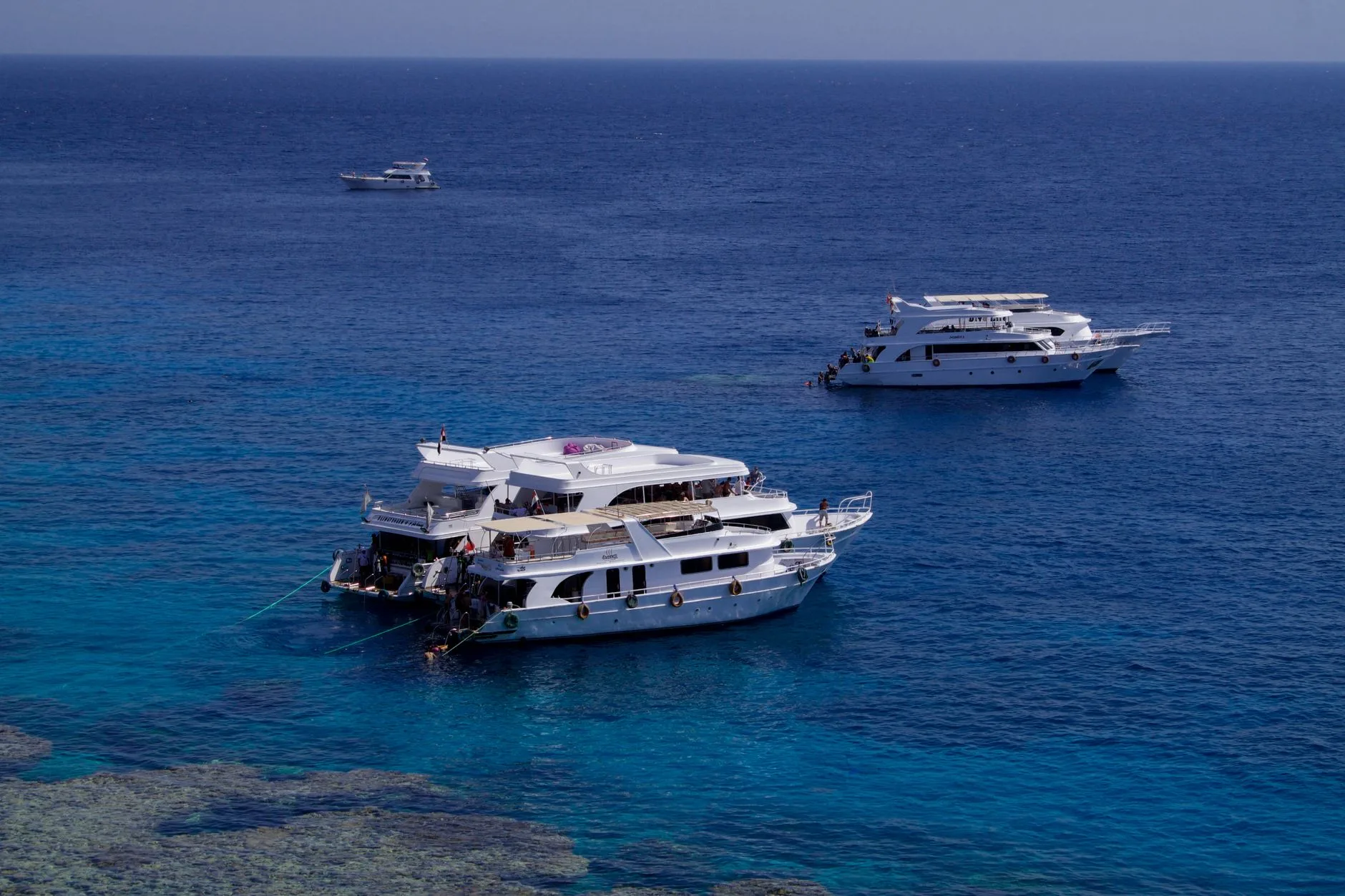
Photo by Youssef Samuil on Pexels
Diving in the Red Sea: Sharm el Sheikh vs Dahab
The water here is so clear that from the surface you can watch a school of glassfish ripple like a murmuration forty metres below. The Sinai Peninsula sits at the northern tip of the Red Sea — a narrow, almost enclosed body of water that stays warm year-round, rarely gets rough, and holds some of the most biodiverse coral reef systems on the planet. Two towns built their reputations entirely on what lies beneath: Sharm el Sheikh to the south, polished and resort-heavy; Dahab to the northeast, low-rise and unhurried. Both give you access to outstanding diving, but they are very different experiences above the waterline — and that difference matters when you’re choosing where to base yourself for a week.
This guide compares the two honestly: the dive sites, the logistics, the costs, and the character of each place. If you’re trying to decide between them, or wondering whether to split your time, read on.
What makes Red Sea diving worth the trip
Before the comparison: why the Red Sea specifically? The water temperature sits between 22°C and 28°C depending on season, visibility regularly exceeds 30 metres, and the reef systems here have been protected — imperfectly but meaningfully — since the 1980s. The coral is predominantly hard coral: tables, branching staghorn, brain coral, all of it in generally good health compared to much of the Indo-Pacific. You’ll dive alongside Napoleon wrasse, reef sharks, moray eels, lionfish, and almost certainly a turtle or two. Pelagic encounters — hammerheads, whale sharks, oceanic whitetip sharks — are possible at certain sites and seasons.
The Red Sea also has exceptional wreck diving, most of it in the Sharm area: the SS Thistlegorm, sunk by a German bomber in 1941, is arguably the most visited wreck dive in the world. None of this requires advanced certification to access, though some sites strongly reward it.
Sharm el Sheikh: the infrastructure
Sharm el Sheikh is a purpose-built resort town on the southern tip of the Sinai. Naama Bay is the tourist centre — a strip of hotels, restaurants and dive shops running parallel to the water, with the beach a few minutes’ walk down towards the waterfront. It is not a town that grew organically. The roads are wide, the hotels are large, and the dive industry here is enormous: dozens of operators run boats daily to sites across the Strait of Tiran and out towards the open sea.
Key dive sites from Sharm:
-
Ras Mohammed National Park — The headland at the very tip of the Sinai, about 20km from town by road, accessible by boat or 4WD. Shark Reef and Yolanda Reef are the flagship dives: a sheer wall dropping into blue water, with strong current that brings the pelagics through. Grey reef sharks and hammerheads appear most reliably between March and May. The current here can be significant; this is best suited to divers with at least 20 logged dives.
-
The Thistlegorm — A 3–4 hour boat ride from Sharm, this British cargo ship lies at 30 metres and is packed with WWII-era cargo: motorcycles, trucks, weapons crates, railway engines. It is genuinely spectacular and genuinely crowded. Go mid-week and try to be on the water early (06:00 departure) to beat the worst of it. Minimum certification: Open Water, but Advanced Open Water is recommended for comfort at depth and in current.
-
Shark Bay (Sharm el Sheikh) — A shore-accessible site north of Naama Bay, good for night dives and macro. Reliably calm. This is where many operators run check-out dives for newly certified divers.
-
The Straits of Tiran — Four reefs (Jackson, Woodhouse, Thomas, Gordon) running north to south in the channel between the Sinai and Saudi Arabia. Fast current, strong fish life, occasional hammerhead sightings. A full-day boat trip from Sharm.
Dive operators in Sharm: Camel Dive Club (in Naama Bay, PADI Five Star, been operating since 1993) is reliable and well-organised. Sinai Divers is another long-standing operator. Expect to pay $60–100 USD for a two-tank boat dive including equipment hire. The Thistlegorm trips typically cost $90–120 USD all-in.
Getting to Sharm: Sharm el Sheikh International Airport (SSH) receives direct flights from London, Frankfurt, Warsaw, Moscow, and various Gulf hubs. A visa on arrival is available for most nationalities at the airport ($25 USD, check current requirements with the Egyptian embassy before travel). The airport is about 15km from Naama Bay; taxis are the only real option — agree a price before you get in (100–150 EGP is roughly right in 2026, though negotiate).
Dahab: the dive sites and the pace
Dahab sits 90km north of Sharm along the Gulf of Aqaba coast. The town is small — the main area stretches along a promenade above the water, backed by low concrete guesthouses, dive schools and restaurants selling koshary and Bedouin tea. It developed as a backpacker alternative to Sharm in the 1980s and 90s, and while it’s been tidied up considerably, it retains a slower, more habitable character.
The diving here is different in type as well as atmosphere. Most of Dahab’s famous sites are shore dives, accessed directly from the beach. This changes the economics significantly — no boat fees — and changes the experience. You kit up on the promenade, walk into the water, and descend on your own schedule.
Key dive sites from Dahab:
-
The Blue Hole — One of the most famous and most dangerous dive sites in the world. A submarine sinkhole dropping to around 100 metres, with an arch at 52–56 metres connecting the hole to open water. The arch itself has claimed many lives — divers who misjudge the depth, narcosis, or their own air supply. This is not a site to dive on a whim or with a cavalier operator. However, diving the rim of the Blue Hole to 25–30 metres is accessible to recreational Open Water divers and is beautiful in its own right: the rim is excellent for coral and fish life, and the sense of looking into the void is unlike anything on a reef. Freediving into the Blue Hole is a separate, highly specialised discipline. The site is 8km north of central Dahab; taxis cost 30–50 EGP from the promenade.
-
The Canyon — A slot canyon beginning at around 18 metres and narrowing as it descends to 52 metres before opening back up. One of the better advanced dives in the area: disorienting, dramatic, and not for claustrophobics. Shore entry from the northern edge of the Lighthouse area.
-
Lighthouse (El Fanar) — The main beach dive site in front of the Lighthouse restaurant area, right in central Dahab. Good coral, abundant reef fish, accessible from shore and easy for all levels. A reliable spot for a warm-up dive or a night dive.
-
The Islands — A short boat ride north of town, this site has sandy channels between reef structures with strong fish populations and occasional guitar sharks resting on the bottom.
-
Gabr el Bint — A remote site south of Dahab, accessed by 4WD and then a short walk. Hard coral reef, good visibility, almost no other divers. Not every operator runs trips here; ask specifically.
Dive operators in Dahab: Reef 2000 and Dive Urge are both well-regarded. Nesima Dive Centre has been operating for decades and runs a solid technical diving programme. Expect to pay $30–50 USD for a shore dive with equipment, or $50–70 for a two-tank boat trip. PADI Open Water certification courses run $300–380 USD in Dahab, which is notably cheaper than most European dive schools and comparable to Sharm.
Getting to Dahab: There is no airport in Dahab. Options from Cairo: fly to Sharm (1.5 hours), then take a taxi or bus to Dahab (90km, roughly 1.5–2 hours, shared taxis depart from the bus station area and cost 80–100 EGP per person). Alternatively, take the overnight bus from Cairo’s Turgoman or Abbassiya bus stations (East Delta Travel Co.) to Dahab direct — around 8 hours, 200–250 EGP. Buses are air-conditioned and reasonably comfortable. From the Israeli/Jordanian side: the Taba border crossing is 100km north of Dahab (shared taxi or local minibus from Dahab, 1.5–2 hours). Check current border conditions before travel.
The broader context of independent travel in Egypt — costs, transport, what to expect — is worth reading about before you finalise plans, particularly if you’re combining this trip with time in Cairo or Luxor. Our guide to budget travel in Egypt covers the country’s transport and logistics in more detail.
Comparing the two: what you’re actually choosing between
The dive quality is high in both places. The choice is really about what kind of trip you want.
| Factor | Sharm el Sheikh | Dahab |
|---|---|---|
| Dive type | Mostly boat dives | Mostly shore dives |
| Famous sites | Thistlegorm, Ras Mohammed, Tiran | Blue Hole, The Canyon, Lighthouse |
| Pelagic encounters | More likely (hammerheads, OWT sharks) | Less common, but possible at Blue Hole rim |
| Certification courses | Widely available, slightly pricier | Widely available, slightly cheaper |
| Cost per dive | $60–100 (two-tank boat) | $30–70 (shore or boat) |
| Crowds at dive sites | High (especially Thistlegorm) | Moderate (Blue Hole can be busy) |
| Town atmosphere | Resort, structured, package-holiday feel | Laid-back, small-scale, Bedouin-influenced |
| Airport access | Direct international flights (SSH) | Via Sharm or Cairo + bus/taxi |
| Accommodation budget | Mid-range to luxury dominated | Budget to mid-range options plentiful |
| Best season | October–May (cooler, good vis) | Year-round; summer (Jun–Aug) suits freediving |
| Technical diving scene | Limited | Strong (Dahab has several technical centres) |
| Night diving | Available at Shark Bay | Good at Lighthouse, popular |
Seasons and visibility
Both towns sit in the Gulf of Aqaba, which is sheltered from the open Red Sea. Surface conditions are almost always calm — this is not the Pacific; you will rarely encounter significant swell. Water temperature ranges from around 22°C in February to 28°C in August. A 3mm wetsuit covers most of the year; in winter (December–February), a 5mm or wetsuit plus hood is more comfortable, especially for multiple dives per day.
Visibility is consistently good year-round — 20–30 metres is normal. It is marginally better in winter when plankton blooms are lower. Summer (June–August) brings hot, dry air temperatures (35–40°C in Dahab, where there is less sea breeze than Sharm), which is uncomfortable above water but fine below it. Summer also brings freedivers to Dahab in large numbers, particularly to the Blue Hole. If you’re a scuba diver who wants fewer people around, October through April is your window.
Who should go where
Go to Sharm el Sheikh if:
– You want to dive the Thistlegorm — it is genuinely one of the world’s great wreck dives and the best access is from Sharm.
– You’re travelling with non-divers or mixed-ability groups who want resort amenities.
– You want organised, boat-based diving with consistent infrastructure and guides.
– You’re flying in with limited time and want to be in the water on day one without complicated logistics.
Go to Dahab if:
– You want to dive at your own pace, particularly shore diving without a fixed boat schedule.
– You’re doing a certification course and want to keep costs down and atmosphere relaxed.
– You’re interested in technical diving or freediving.
– You want to spend a week somewhere that has a life beyond the dive boat — cafes, Bedouin camps, desert day trips to Coloured Canyon or St Catherine’s Monastery.
Go to both if you have 10+ days. Sharm to Dahab takes two hours by taxi along the east Sinai coast road — the road itself is straightforward and the shared taxi (service taxi) from near the Sharm bus station costs around 80 EGP per person. Hire a private taxi for around 350–450 EGP if you’re carrying dive kit or travelling in a small group.
Practical notes: safety and entry
The Sinai has had a complicated security history, and it is worth checking your government’s current travel advisory before booking. The UK Foreign Office, Australian DFAT, and US State Department have all issued varying levels of caution for parts of the Sinai at different points — though Sharm and Dahab specifically have remained open to tourism and largely incident-free for travellers in the main resort areas. That said, overland travel to certain parts of northern and central Sinai has been restricted, so if you’re planning to combine a Sinai trip with, say, a visit to St Catherine’s Monastery (which is generally accessible via Dahab or a tour from Sharm), verify the current road situation.
Entry to Egypt for most Western nationalities requires a visa. An e-visa (evisa.gov.eg) can be obtained online before departure for around $25 USD and is simpler than queuing on arrival. A separate “Sinai Only” stamp is issued free at some entry points (including Taba from Israel) and covers the tourist areas of the Sinai but not the rest of Egypt — make sure you get a full Egyptian visa if you’re combining the trip with Cairo.
UNESCO’s Red Sea coral reef documentation provides useful context on the ecological significance of what you’ll be diving through — the northern Red Sea reefs are among the few coral systems showing resilience to warming, which makes what you see here more remarkable in context. For a broader look at world-class diving beyond this region, the best dive sites in Indonesia offer useful comparison — different ecosystem entirely, but similarly exceptional. PADI’s dive site directory is a practical reference for verifying operator credentials before you book.
The Bottom Line
- Sharm el Sheikh is the better base for big-ticket boat dives — the Thistlegorm and Ras Mohammed are world-class, and the infrastructure around them is excellent. It costs more and feels more like a resort town, but the dive logistics are smooth.
- Dahab offers shore diving flexibility, lower costs, a more relaxed pace, and a stronger technical and freediving scene. The Blue Hole’s rim dive is accessible to recreational divers; the arch at 52 metres is not.
- Don’t feel you have to choose — the two-hour road between them is easy, and spending four or five nights in each gives you access to the full range of what the Sinai coast offers.
- Both towns work year-round, but October through April brings cooler air, slightly better visibility, and thinner crowds at the most popular sites.
- Book your dive operator before you arrive, particularly for the Thistlegorm from Sharm — boats fill up, especially in peak season (November and March are the busiest months). Ask about group sizes; anything over 10 divers per guide is worth querying.
Keep reading: Budget travel in Egypt: beyond the pyramids